

How Much Does Seedance 2.5 Cost? Pricing by Platform and Real Clip Cost
Seedance 2.5 does not have a single universal price. Dreamina publishes a per-second rate on some plans, API access is billed separately, and creator platforms convert generations into credits or membership use.

Key takeaways
Seedance 2.5 has no universal price: platforms bill by generated second, API task, credits, or subscription allowance.
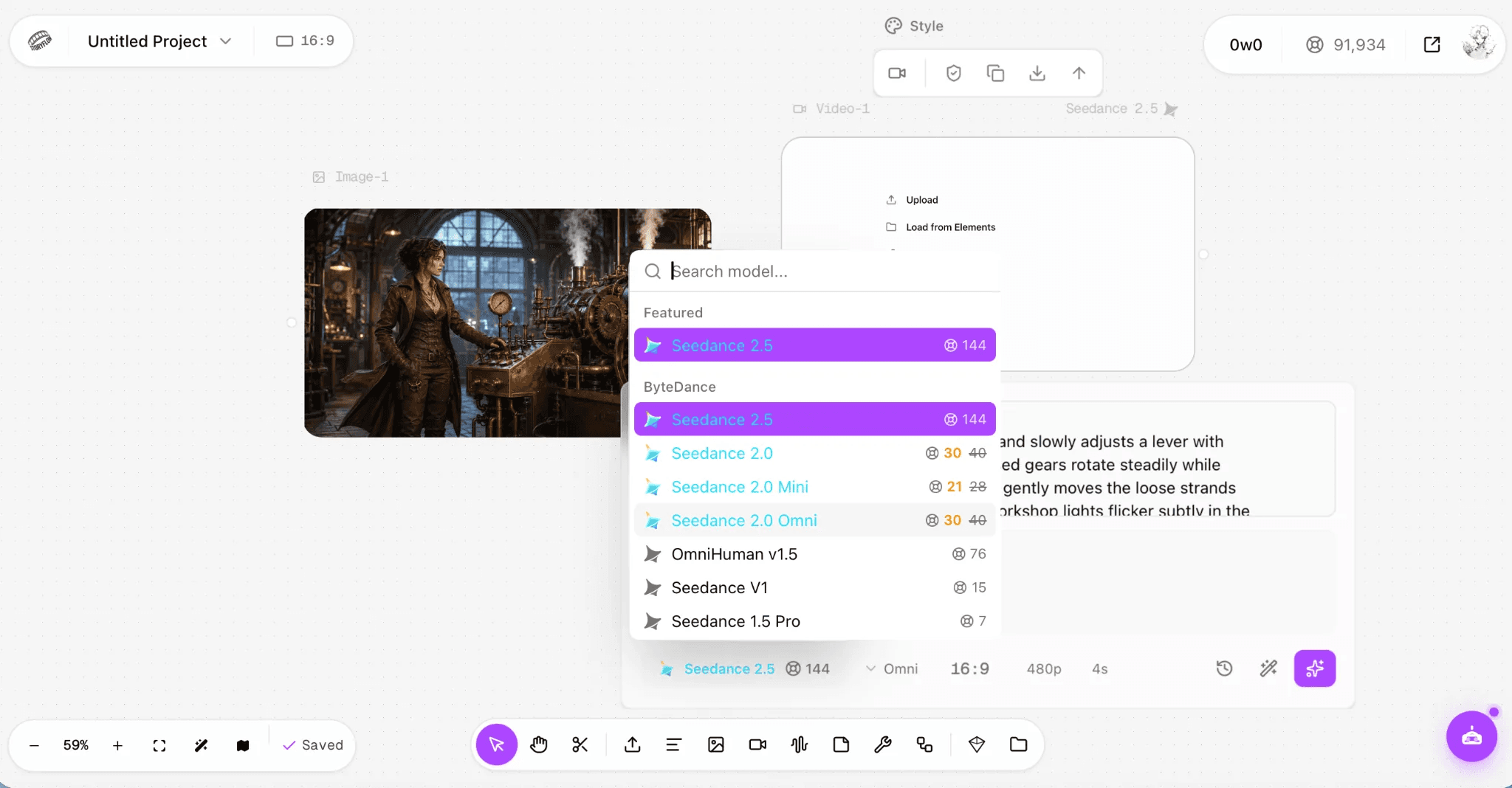
In the checked Astorie workspace, 480p cost 36 credits per second and 720p cost 79 credits per second.
The real cost of a usable clip depends on the number of attempts, not only the price of one generation.
Start with a short 480p test, verify the motion, and move to a longer 720p render only when the result is close to final.
Seedance 2.5 Pricing by Platform
The final bill changes with the platform, account, resolution, duration, reference inputs, and number of attempts. Treat every number here as dated, and use the estimate shown in your workspace before you click Generate.
| Access route | How billing works | Price checked in August 2026 | What to verify |
|---|---|---|---|
| Dreamina | Free credits may be available; paid plans lower the effective rate | From $0.097 per generated second on the annual Advanced plan we checked | Current plan, region, allowance, watermark, and export limits |
| BytePlus ModelArk | API pay-as-you-go billing and resource packs | The live quote depends on the task and input specification | Resolution, reference inputs, resource pack, and campaign rate |
| Astorie | Credits per generated second | 480p: 36 cr/s — 144 / 360 / 1,080 credits for 4 / 10 / 30s. 720p: 79 cr/s — 316 / 790 / 2,370 credits | Live node total and current credit conversion; the checked top-up rate was $1 per 100 credits |
| PixVerse | Paid membership plus model credits | The workspace shows the estimate; Seedance 2.5 is listed for Pro, Premium, and Ultra plans | Current plan, region, and live model-card estimate |
We checked these figures on August 18, 2026. Rates, plan benefits, and promotions can change, so the live quote shown before generation is the final number to trust.
What Changes the Cost of Seedance 2.5?
Resolution and duration make the biggest visible difference. I use 480p to check whether the subject, objects, and camera move correctly, then switch to 720p only when the take is close to being kept. A longer clip also costs more and gives the model more actions to coordinate, so it is worth testing the motion plan first.
Single Generation Cost vs. Usable Clip Cost
One quoted generation is only the starting point. If the first clip has a bad hand, a missed action, or an unwanted camera move, the next attempt costs the same again. For planning, I allow two or three tries on an ordinary shot and more only when the brief is unusually difficult. That is a working allowance, not a rule for every project.
What Our Astorie Cost Test Included
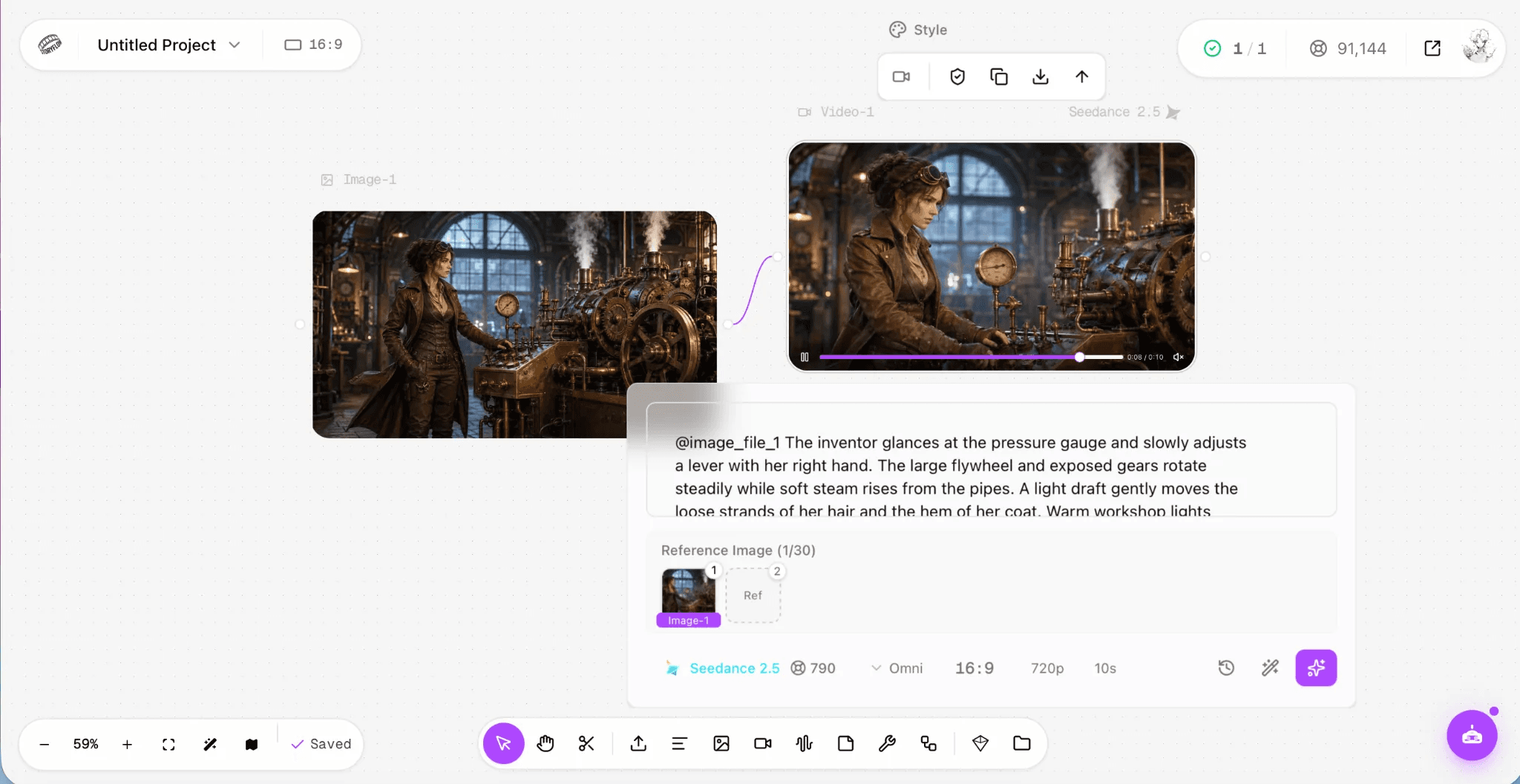
To check the displayed rate against a real job, I generated a 16:9, 720p, 10-second image-to-video clip from the steampunk workshop image. The prompt included a lever movement, turning machinery, steam, hair and fabric motion, a light change, and a slow push-in. This is the exact prompt:
The inventor glances at the pressure gauge and slowly adjusts a lever with her right hand. The large flywheel and exposed gears rotate steadily while soft steam rises from the pipes. A light draft gently moves the loose strands of her hair and the hem of her coat. Warm workshop lights flicker subtly in the background. Slow cinematic push-in. Keep her face, hands, clothing, machinery, and the original steampunk style consistent. Smooth, realistic, controlled motion.
The render took about four minutes. The account balance fell by exactly the amount shown before generation, so the interface quote matched the completed job. This is one timing observation; queue speed can change.
How to Lower the Real Cost of Seedance 2.5
- Prototype at the shortest duration and lowest resolution that can reveal the motion problem.
- Keep the image, prompt, and camera fixed when comparing platforms or model versions.
- Change one thing per rerender so it is clear what the extra attempt improved.
- Use timed beats only when the duration genuinely supports more than one action.
- Check whether failed or canceled jobs are billed before running a large batch.
- Convert platform credits into a cost per second and then multiply by the expected number of attempts.
How Much Should You Budget for Seedance 2.5?
Budget from the live quote on the platform you will actually use, then allow for at least one rerender. In our Astorie case, the per-second estimate matched the final deduction. I would still begin with a short 480p test, because finding a motion problem there is cheaper than discovering it after a longer 720p render.
Frequently asked questions
- Is Seedance 2.5 free?
Sometimes. Dreamina says eligible users can receive free daily credits, while other platforms may require a paid plan or purchased credits. Free access and allowances vary by account and region.
- How is Seedance 2.5 priced?
Depending on the route, pricing can be per generated second, per API task, through credits, or inside a subscription. Resolution, duration, reference inputs, and plan discounts can change the effective rate.
- Why does Seedance 2.5 cost vary by platform?
Platforms package the model with different interfaces, storage, queues, reference limits, plan credits, and margins. The model name is the same, but the commercial offer is not.
- How much does a usable Seedance 2.5 clip really cost?
Start with the price of one attempt, then multiply it by the number of versions you realistically expect to make. A three-attempt allowance simply means budgeting three times the live quote.
Related reading
Seedance 2 Handbook: Variants, Best Workflows, and How to Use It on Astorie
Hands-on guide to Seedance 2 — variants, strengths, and the production workflows it fits on Astorie's canvas.
GPT Image 2 Guide: Workflows, Strengths, and Where It Fits on Astorie
How GPT Image 2 fits product, text, and reference image workflows on Astorie's multi-model canvas.
Nano Banana 2 Workflows for Multi-Image Reference and Character Consistency
Multi-image reference and character consistency workflows on Astorie using Nano Banana 2.
Ready to try it on the canvas?
Open Astorie and fan your prompt across every frontier model in one workflow.