

Nano Banana 2.1 vs Nano Banana 2
Key Takeaways
• Compare official model names separately from platform labels.
• Published 2.1 image-output rates are lower at the shared resolution tiers.
• Both family outputs follow the main subject count and scene roles.
• Different Thinking controls prevent a controlled benchmark claim.
Nano Banana 2.1 vs Nano Banana 2 is a choice between the current workhorse and its predecessor. Start with 2.1 for a new project because Google recommends it and lists lower image-output API rates at the shared resolution tiers. Keep 2 in an approved production workflow until replacement outputs meet the same acceptance checks; a lower output rate alone does not establish a lower total request cost.
Nano Banana 2.1 vs Nano Banana 2 official model differences
Google’s official IDs are gemini-nano-banana-2.1 for Nano Banana 2.1 and gemini-3.1-flash-image for Nano Banana 2. Nano Banana Pro is a separate model, gemini-3-pro-image. Clara’s Astorie tests use the selector labels Nano Banana 2.1 Premium and Nano Banana 2 Premium; Premium is recorded as an interface label, not an official model ID. [1, 2]
The input types, reference capacity and Thinking tiers below are official API specifications. Clara used text-only inputs for these comparisons; multi-reference limits, video/PDF inputs and API Thinking modes were not tested. [1–3]
Capability | Nano Banana 2.1 | Nano Banana 2 |
Native image generation and editing | Supported | Supported |
Official input types | Text, image, video, PDF | Text, image, video, PDF |
Official output types | Image and text | Image and text |
Reference capacity | Up to 14; up to 4 characters and 10 objects | Up to 14; up to 4 characters and 10 objects |
API Thinking controls | minimal, medium default, high | minimal default, high |
Audio generation | Not supported | Not supported |
Shared resolution tiers | 1K, 2K, 4K | 1K, 2K, 4K |
Small draft tier | No 0.5K tier | 0.5K supported |
Google web and image grounding | Supported in official API | Supported in official API |
Official positioning | Updated workhorse; new-project recommendation | Previous workhorse |
Motion or audio output in these tests | Not tested; still images only | Not tested; still images only |
The model pages support the identity and shared capabilities above. Google’s image guide recommends 2.1 for new projects. Neither the model’s generation quality nor Google’s API options should be inferred from a host’s abbreviated controls. [1–3]
What the supplied tests can establish
Clara supplied two scene pairs from Astorie: a single Hector figure on 10 October 2026 and a family farewell scene on 11 October. For both pairs, the selected settings were 16:9, 4K, PNG and Web Off. The 2.1 nodes used High Thinking; switching to 2 removed that parameter. Four selected outputs are reviewed, one per model per scene, as confirmed by Clara. No complete retry or failure log, timing record or actual-charge statement is available. These are case studies, not a head-to-head benchmark.
Record | 2.1 nodes | 2 nodes |
Selector | Nano Banana 2.1 Premium | Nano Banana 2 Premium |
Thinking control | High | Removed when switching |
Displayed quote | 30 credits | 60 credits |
Delivered selected files | 2048 × 1143 PNG | 2048 × 1143 PNG |
Reference in family comparison | None | None |
Single figure results
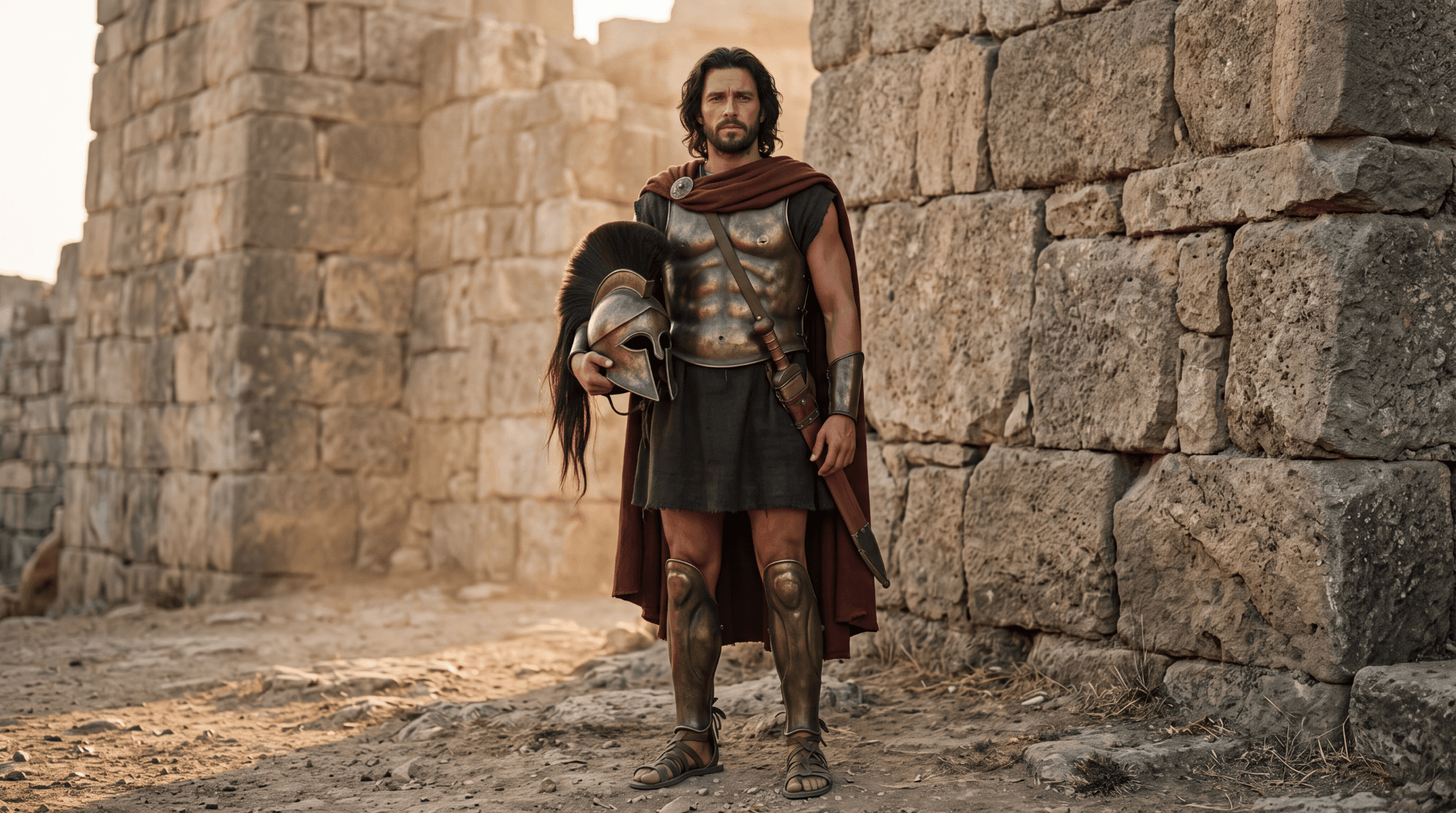
Figure 1. Nano Banana 2.1 single-figure output. Hector has bronze greaves, a dark skirt, a red cloak and a helmet held in front of his body.
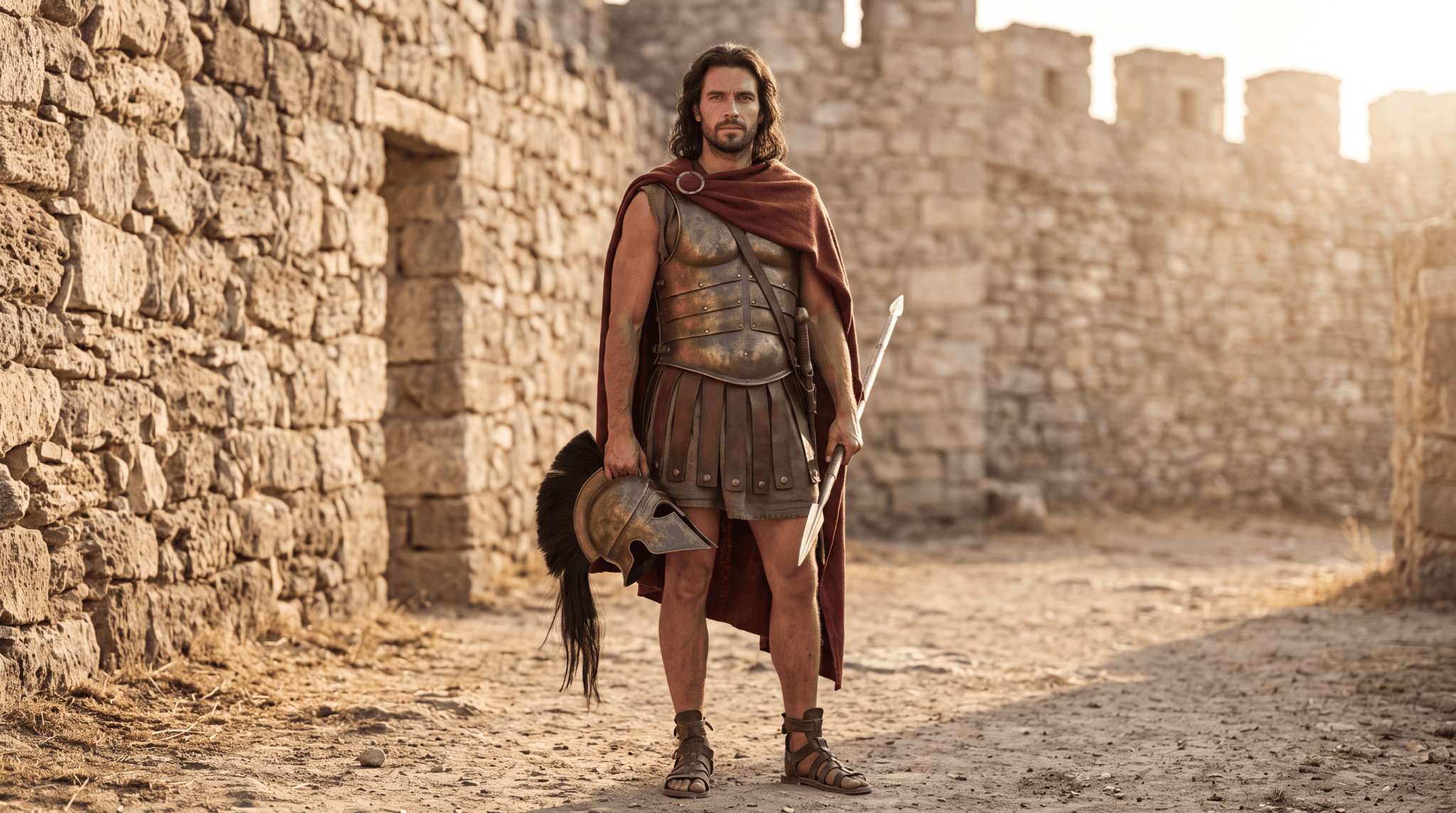
Figure 2. Nano Banana 2 single-figure output. Armor and skirt treatment differ, greaves are absent, and a long spear-like object appears at the figure’s side.
The pair illustrates why clothing and props deserve their own checks. Both pictures communicate a bareheaded warrior beside stone walls, but the equipment is not interchangeable. The complete original single-figure input is not reproduced here because only partial prompt evidence was retained. The differences are visible observations, without attributing every one to an instruction violation.
Family scene results with the same recorded prompt
The family pair used the same text-only prompt: Hector on the right holding his son, Andromache on the left with clasped hands, and a single helmet on the ground at lower right. Both outputs contain the requested three people and broadly follow those roles.
Original test input
Create a photorealistic cinematic still depicting Hector and Andromache's farewell in Book VI of the Iliad.
Show exactly three people beside the weathered stone walls of Troy.
Hector stands on the right, bareheaded, with dark wavy shoulder-length hair and a short dark beard. He wears a bronze cuirass, a deep-red cloak, and a dark tunic. He holds his young son securely against his chest, with one hand supporting the child's bottom and the other supporting his back.
The child wears cream-colored clothing and looks toward Hector's face.
Andromache stands on the left, wearing a simple blue dress, with her dark hair tied back. She watches them with a tender, sorrowful expression. Her hands are gently clasped at waist height.
Place one bronze helmet with a dark horsehair crest on the ground at the lower right. Keep the entire helmet visible.
Use a medium-wide horizontal composition showing both adults from the knees upward, with all three heads fully visible. Warm late-afternoon sunlight, restrained earthy colors, natural skin texture, realistic fabric and bronze details.
Exactly two adults, one child, and one helmet. No other people, no additional weapons, no modern objects, no text, no logos.
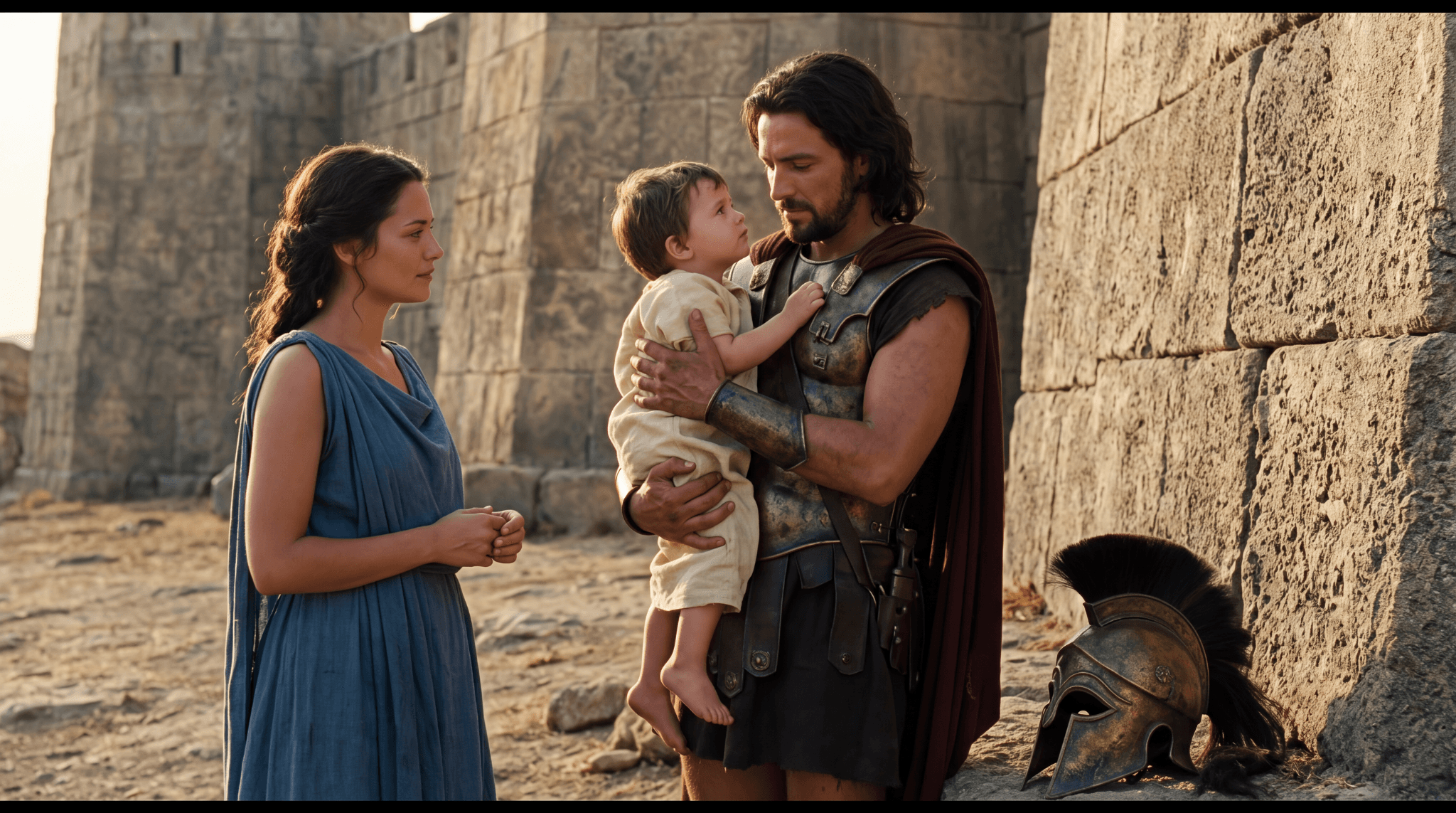
Figure 3. Nano Banana 2.1 family output, Image-10. The helmet is fully visible and the environment is closely enclosed by stone walls.
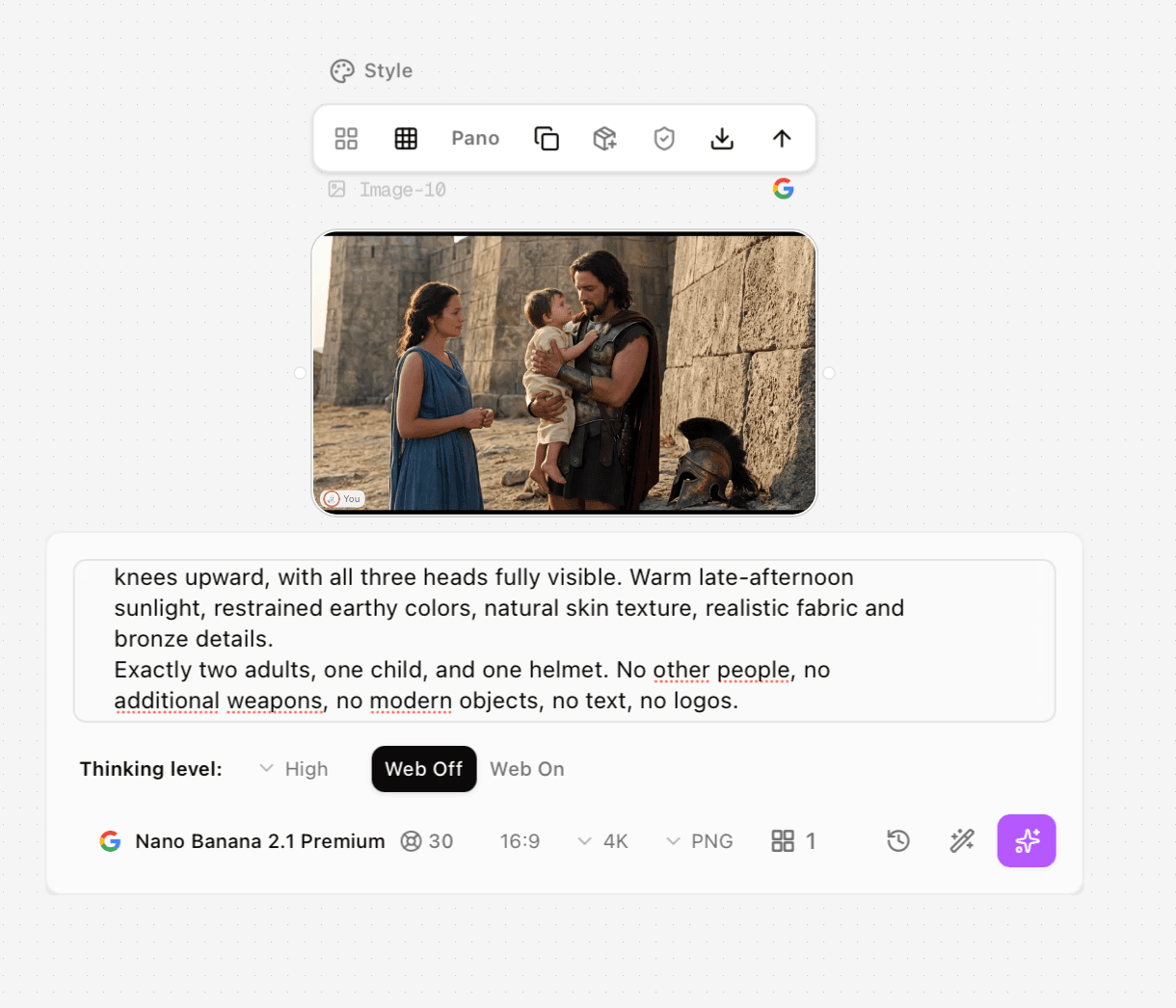
Process screenshot 1. The Nano Banana 2.1 family node retains High Thinking, Web Off and the 30-credit quote. Its actual downloaded dimensions are recorded separately.
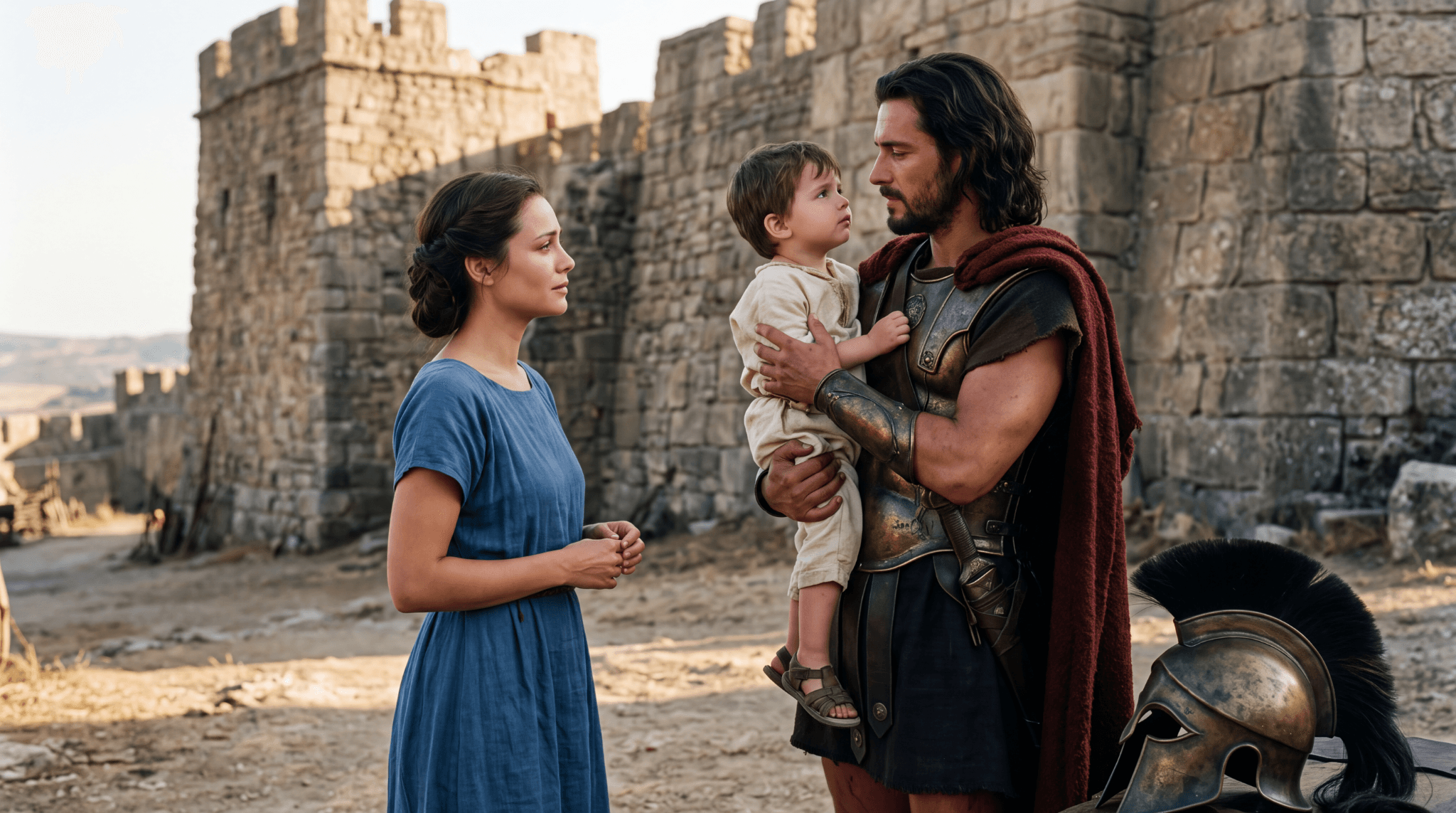
Figure 4. Nano Banana 2 family output, Image-11. More distant wall architecture is visible; the helmet meets and is cropped by the lower edge.
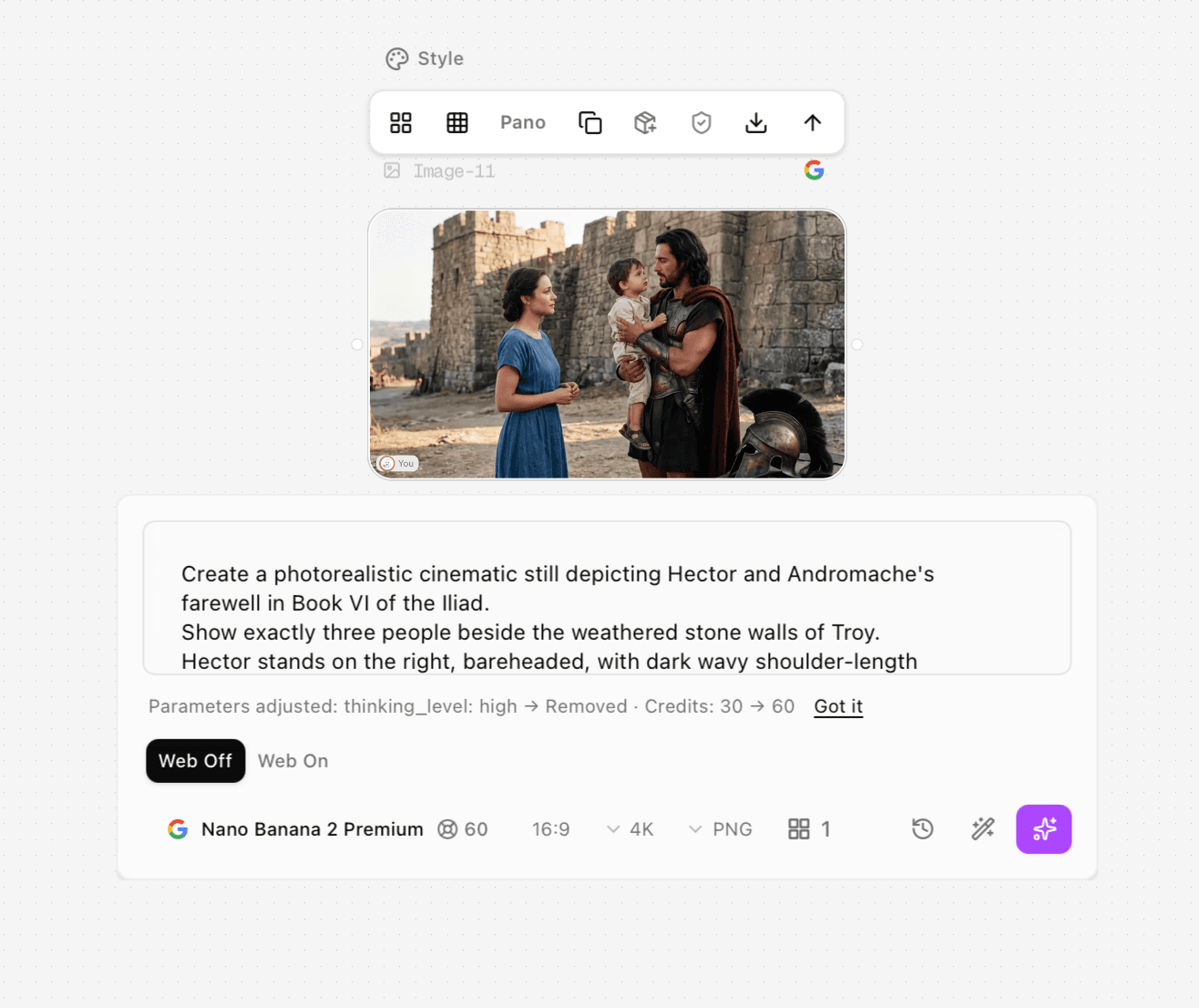
Process screenshot 2. After the switch to Nano Banana 2 Premium, Astorie reports removal of High Thinking and a quote change from 30 to 60 credits. This is a host-control difference; Google’s API supports Thinking for both models.
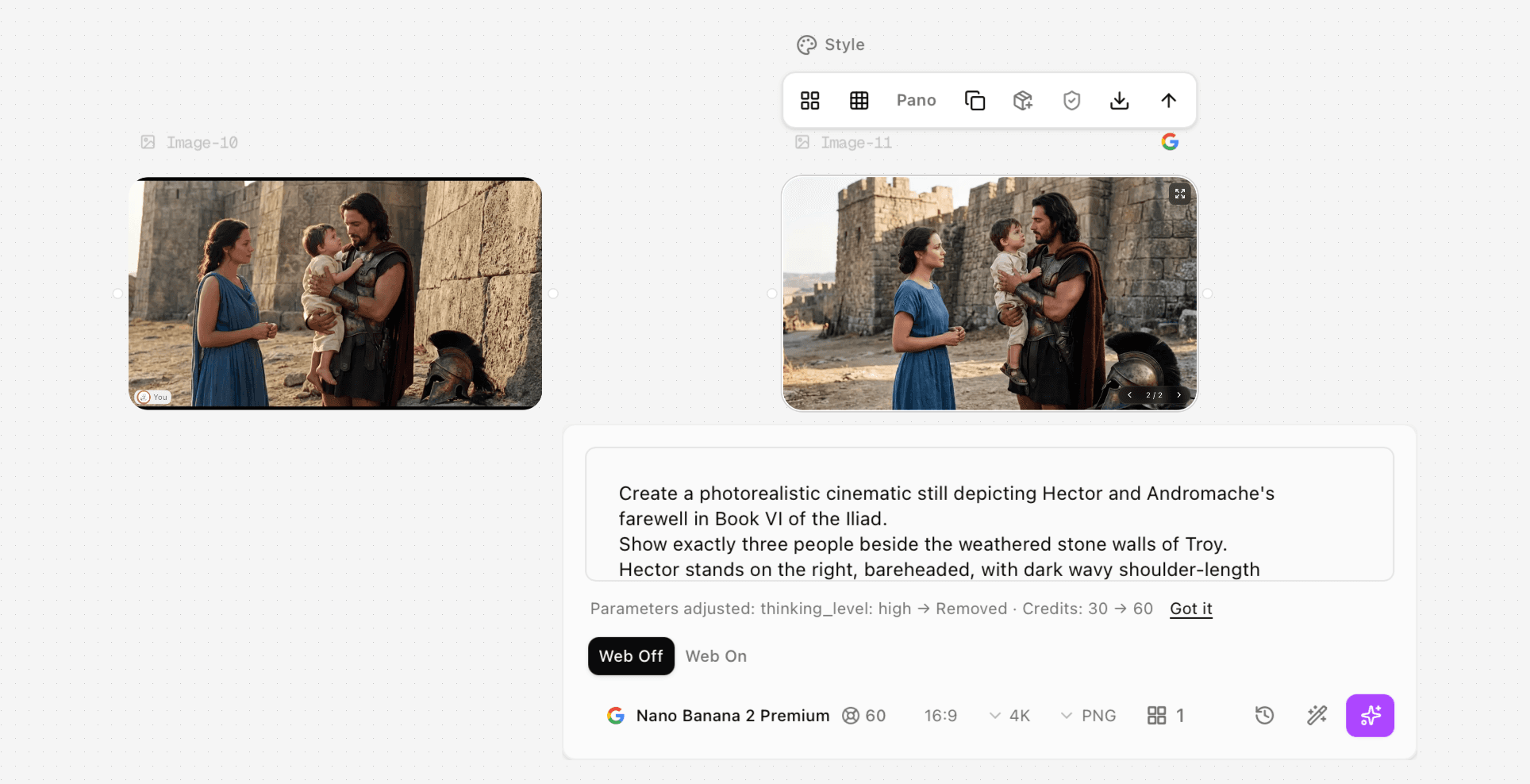
Process screenshot 3. The two selected family outputs appear side by side with the Nano Banana 2 panel. This is the same supplied Image-11 result, not evidence of another generation attempt.
The 2.1 result keeps the helmet inside the frame, while the 2 result provides a more open view of the walls. Neither clearly delivers the requested knees-up adult framing. Their expressions and outfits also differ, as expected from independent text-to-image generation without an identity reference. Image-10 includes black strips at its top and bottom. None of these observations establishes a general realism winner.
API output costs and Astorie credits
Google’s standard paid API pricing on 11 October 2026 lists the following image-output equivalents. Input, text and Thinking output, and chargeable search queries are separate. These dollar rates are not Astorie credit conversions. [4]
Resolution | 2.1 image output | 2 image output |
1K | $0.0336 | $0.067 |
2K | $0.0504 | $0.101 |
4K | $0.113 | $0.151 |
The same standard pricing page lists input at $1.50 per million tokens for 2.1 versus $0.50 for 2, and text/Thinking output at $7.50 versus $3.00 per million tokens. Lower image-output rates therefore do not guarantee a lower total for every request. Compare the complete request cost, including the actual input and Thinking usage. [4]
For ten 2K outputs, the listed output component is 10 × $0.0504 = $0.504 for 2.1 and 10 × $0.101 = $1.01 for 2. Input tokens and other billable components are additional. A new creative attempt adds another request; a cheap output that must be replaced is not a cheaper usable image. Google lists no API free tier for either model on that pricing page. [4]
Astorie displayed 30 and 60 credits for the tested 4K configurations. That establishes the quotes visible in this session, not the actual debits, refund policy or monthly-plan value. Budget from the current node quote and account terms rather than dividing Google’s API rate by an assumed credit value.
Choose by the workflow you need
Start with 2.1 for a new project, then check your recurring prompts and downloaded output dimensions.
Retain 2 temporarily when an existing campaign depends on approved results and the migration has not been reviewed.
For character continuity, compare reference-driven scenes from the same source; this text-only family pair does not test identity retention.
For editing, test a small change and a structural change separately. More attractive generation does not prove stronger local preservation.
For a migration check, keep the reference, prompt and resolution fixed; record every generated candidate and retry; and compare the downloaded files at the same display scale. Set an acceptance rule before generating, such as one helmet fully inside the frame and no change to the subject’s outfit. Google’s deprecation page currently recommends 2.1 as the replacement for the stable 2 model but lists no announced shutdown date for that stable ID. [5]
Recorded tests and settings
The table identifies the selected files reviewed in this article. Clara executed the tests in Astorie. A selected result is not a complete count of generation attempts.
Output and date | Input role and prompt record | Selected settings and quote |
Image-1 and Image-2; 10 Oct | Text-only single figures; complete original inputs not retained | 2.1 / 2; selected 16:9, 4K, PNG, Web Off; quotes 30 / 60 |
Image-10 and Image-11; 11 Oct | Text only; same complete family input above | Same resolution and format selections; 2.1 High / 2 control removed; quotes 30 / 60 |
Record | Evidence retained |
Exact host labels | Nano Banana 2.1 Premium and Nano Banana 2 Premium |
Prompt availability | The complete shared family input is retained. The single-figure comparison is limited to visible differences because its complete prompt record is unavailable. |
Generated candidates and failures | One selected supplied output per listed node; total attempts and failures not recorded |
Timing basis | Queue time, generation time and total elapsed time not recorded |
Actual account debit | Not recorded; displayed credits are quotes |
Downloaded files | Original PNGs; 2048 × 1143 each |
Audio review | Not applicable to these still-image tests |
Rerun status | Independent scene pairs; no corrective rerun is evaluated |
Frequently asked questions
Is 2.1 twice as cheap?
Not uniformly. The published output prices vary by resolution, and a request also has other billable components. The tested Astorie quotes happened to be 30 versus 60 credits.
Is 2.1 faster?
No timed runs were recorded for this comparison. Do not infer latency from the model name or credit quote.
Are the downloads 4K?
The supplied PNGs measure 2048 × 1143 despite the 4K node selection. Confirm your downloaded asset rather than using the selector as a pixel measurement.
The practical reason to try 2.1 is its current official positioning and output pricing. The reason to keep either result is whether it meets your scene, identity and delivery requirements.
For the node setup and download controls, see the Astorie Image Node guide.
Ready to try it on the canvas?
Open Astorie and fan your prompt across every frontier model in one workflow.