

Nano Banana 2.1 Character Consistency Test
Key Takeaways
• Track facial likeness separately from clothing and scene continuity.
• Return to the original reference when changing camera distance.
• Use the approved family scene when all three characters matter.
• Accept a scene only after reviewing details at the intended publication size.
This Nano Banana 2.1 character consistency test found recognizable hair, clothing colors and scene styling across Clara’s Hector sequence, while facial detail, pose and framing changed. Use references to carry a character design into another scene, then approve the face, wardrobe and props separately rather than assuming that a familiar-looking figure is identical.
Google documents reference-image fusion with up to 14 images, including support for character consistency. That is a capability description, not a promise of identical faces across all poses. Clara’s test used one reference per recorded node; it does not evaluate the model’s maximum multi-reference capacity. [1]
Nano Banana 2.1 character consistency test criteria
Dimension | What to compare | Why it matters |
Face | Jaw, nose, eyes, age cues and expression | Costume alone can conceal a different face |
Hair and beard | Length, hairline, texture and beard shape | These are conspicuous identity anchors |
Wardrobe | Cloak, clasp, armor, strap and sleeves | Small changes can break a campaign sequence |
Props | Helmet shape, number and location | A familiar object may be redesigned |
Scene | Stonework, direction of light and palette | Cohesion differs from an unchanged backdrop |
Decide which details must remain exact for your project and which may vary naturally. A new shot can have a different pose and background depth; a product or character costume sheet may require stricter geometry. This test uses visual inspection rather than a facial-recognition score or a numerical similarity threshold.
The reference and branch structure
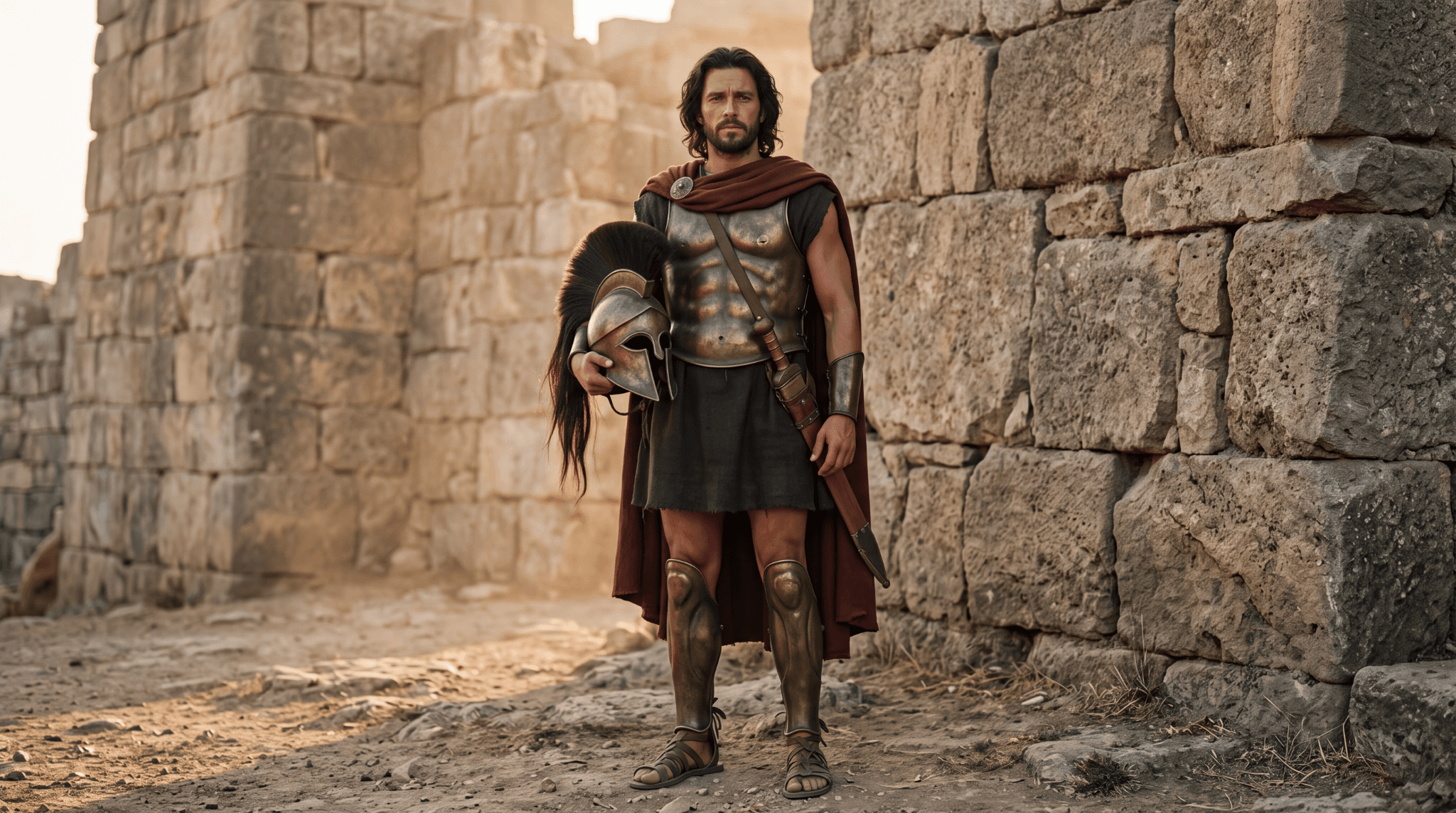
Figure 1. Original character reference, Image-1, generated by Clara with Nano Banana 2.1 on 10 October 2026.
Image-1 establishes the single figure. It feeds the family scene, Image-4, and independently feeds the portrait, Image-8. Image-4 feeds the helmet-removal edit, Image-5. Image-5 then feeds the new child-holding scene, Image-7. Returning to Image-1 for the portrait avoids making the close-up depend on every intervening family edit.
Output | Reference | Purpose |
Image-4 | Image-1 | Introduce Andromache and the child |
Image-5 | Image-4 | Remove helmet and turn child toward Hector |
Image-7 | Image-5 | Transfer child to Hector |
Image-8 | Image-1 | Create a closer view of Hector |
The sequence was supplied and tested by Clara in Astorie on 10–11 October 2026. The recorded 2.1 nodes used 16:9, 4K, PNG, High Thinking and Web Off, with 30-credit quotes. Each supplied file measures 2048 × 1143. There is one selected output per listed node; no complete run count, seed, latency or debit log was retained. The scenes test appearance continuity, not repeatability.
Adding the family preserves the design more clearly than the face
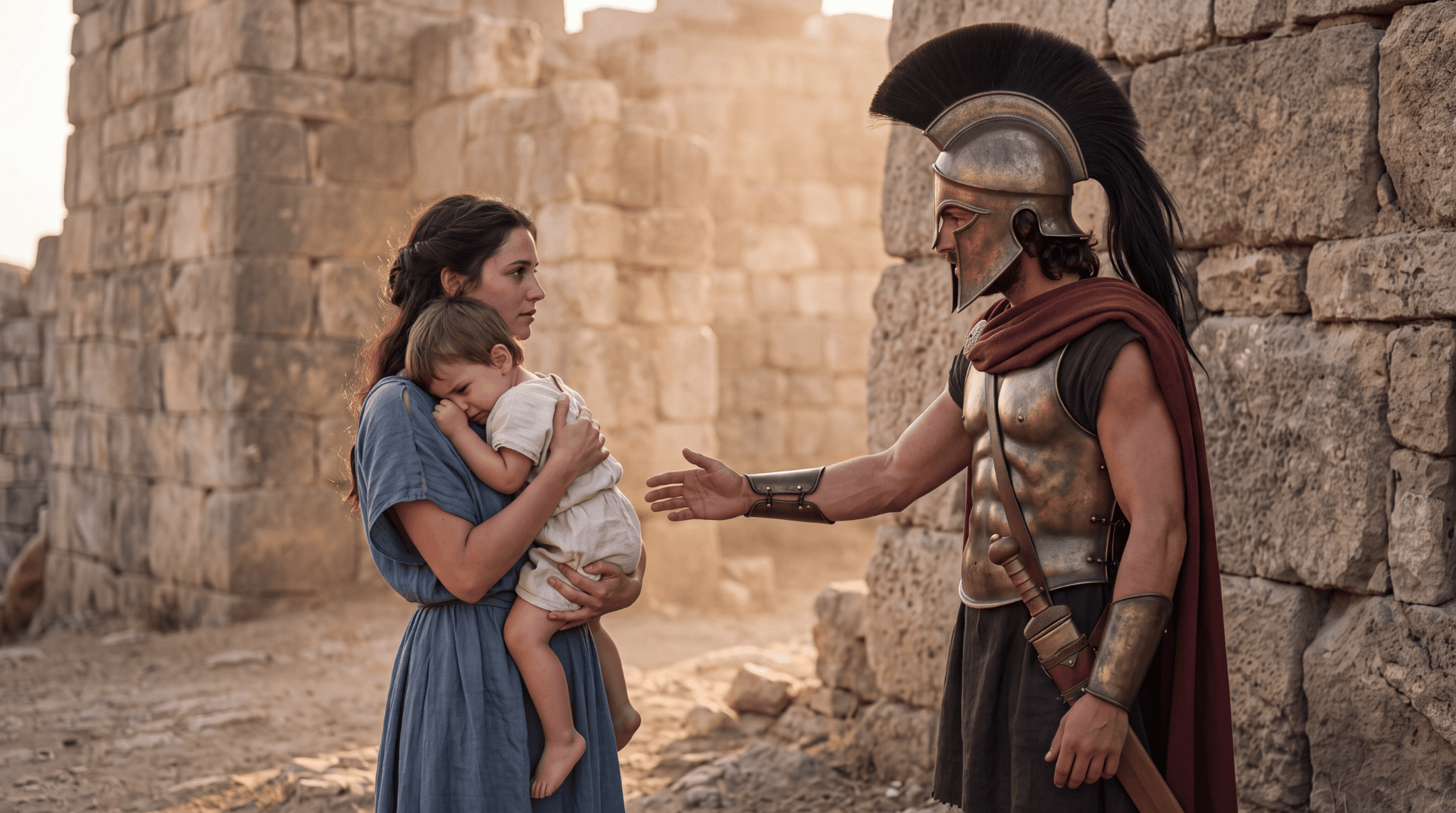
Figure 2. Image-4 adds the mother and child while carrying Hector’s red cloak and bronze armor into the family scene.
The family scene retains Hector’s broad design and the warm stone setting, but his helmet covers much of the head. That makes it poor evidence for an exact facial match. It is stronger evidence for costume and palette continuity. Andromache and the child first become visible here; later scenes can be compared with this family reference.
Original revised helmet test input
Edit the reference image while preserving its original composition.
Keep all three people at exactly the same screen positions and scale. Preserve Andromache's face, blue dress, hairstyle, and the way she supports the child. Preserve Hector's bronze armor, dark-red cloak, body position, stone walls, lighting, and camera framing.
Make only these changes:
1. Remove the helmet from Hector's head, revealing dark wavy hair and a short beard.
2. Place that same helmet in Hector's right hand at waist height. His left arm hangs naturally at his side.
3. Turn the child's head toward Hector while keeping the child's torso, legs, clothing, and position in the mother's arms unchanged.
Do not move the people closer together. Do not reframe or zoom. One helmet only. No additional objects, people, text, or logos.
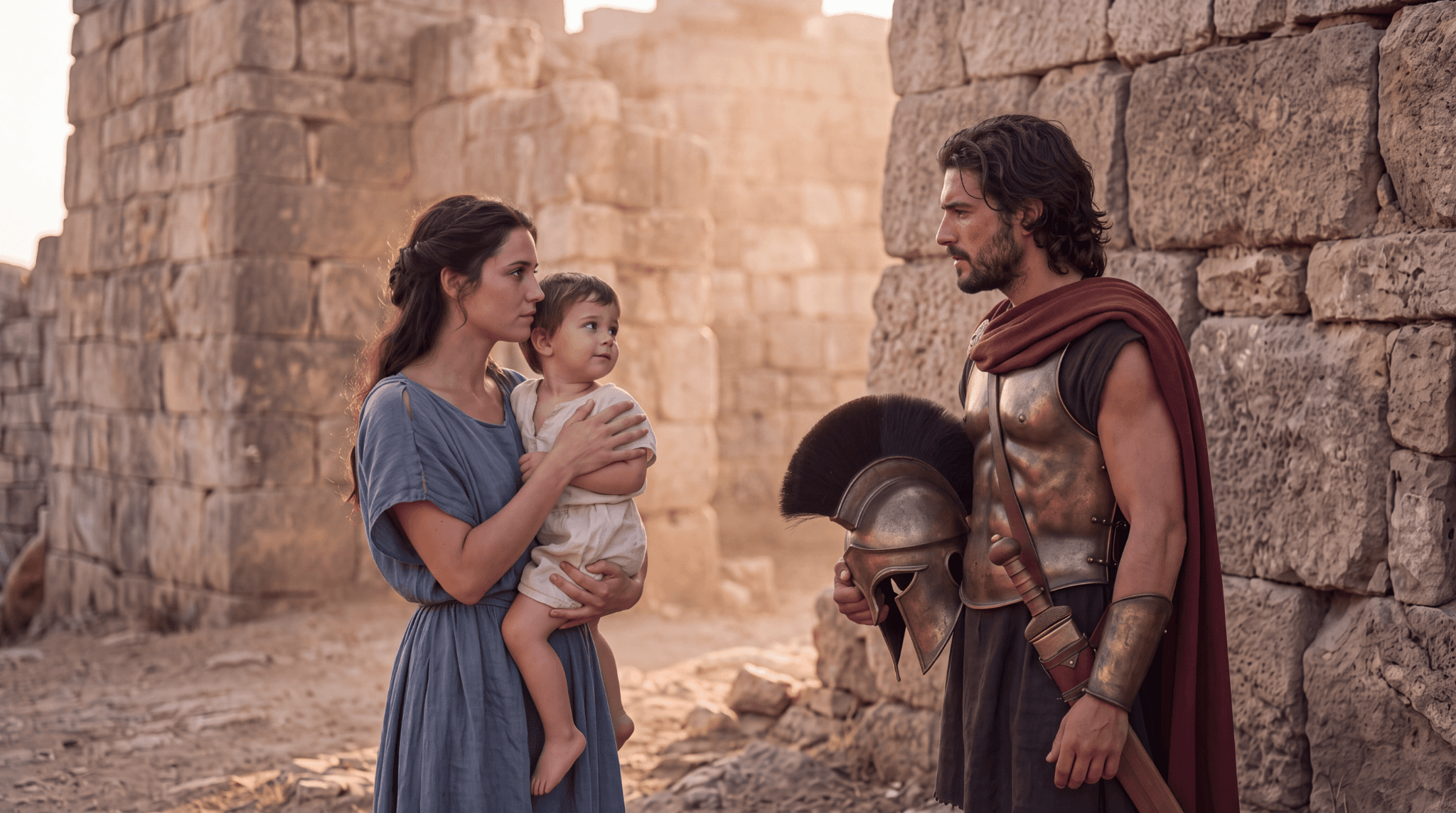
Figure 3. Image-5 reveals Hector’s hair and beard and turns the child toward him. It also changes the family’s placement and support gestures.
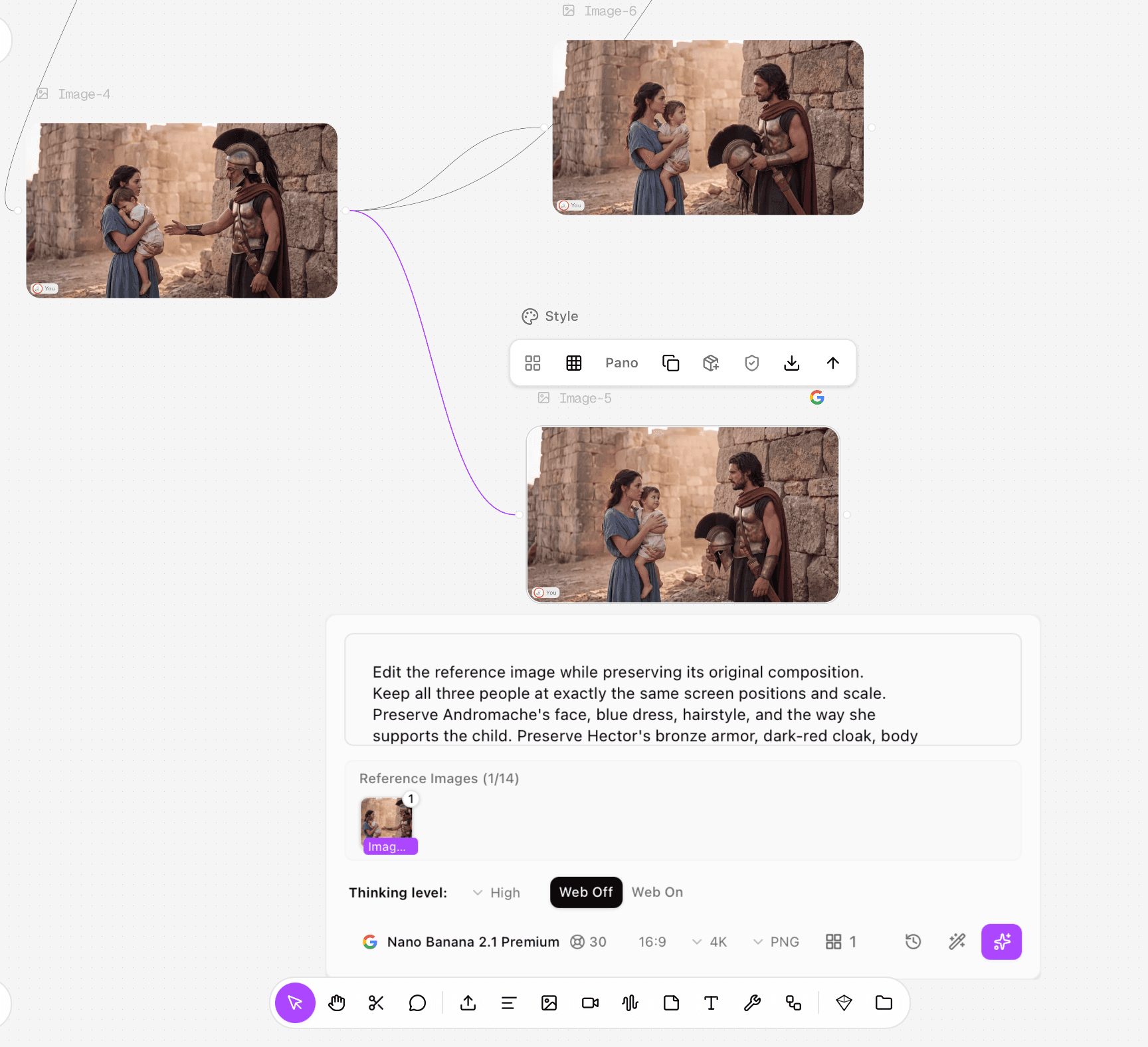
Process screenshot 1. Image-4 independently supplies Image-5 and Image-6. The selected revised edit shows the original family scene as the reference.
Once the helmet is removed, the dark wavy hair and short beard are recognizable. However, this is a profile view, unlike the original frontal figure. The child’s head turn is requested, while changes in the mother’s hands and the spacing of the figures are collateral. Scene consistency should therefore be described as a similar setting and cast, not an unchanged composition.
A new interaction needs its own continuity check
The following original input was used with Image-5 as the reference for Image-7. It explicitly assigns the child to Hector, keeps the mother on the left and retains the family’s clothing.
Original test input
Create a new still image of the same family during Hector and Andromache's farewell in Book VI of the Iliad, using the supplied image as the character reference.
Hector stands on the right, bareheaded, holding his young son securely against his chest. One hand supports the child's bottom and the other supports his back. The child looks toward Hector's face.
Andromache stands on the left, watching them with a tender, sorrowful expression. Her hands are gently clasped at waist height.
Preserve all three characters' facial identities, ages, hairstyles, and clothing from the reference. Keep Hector's bronze cuirass and deep-red cloak, Andromache's blue dress, and the child's cream-colored clothing.
Place Hector's bronze helmet with its dark crest on the ground beside the wall, visible at the lower right. Show one helmet and one child only.
Use a slightly wider composition that shows all three figures from the knees upward, with the same warm afternoon light and weathered stone walls. Natural anatomy and realistic textures. No text, no logos.
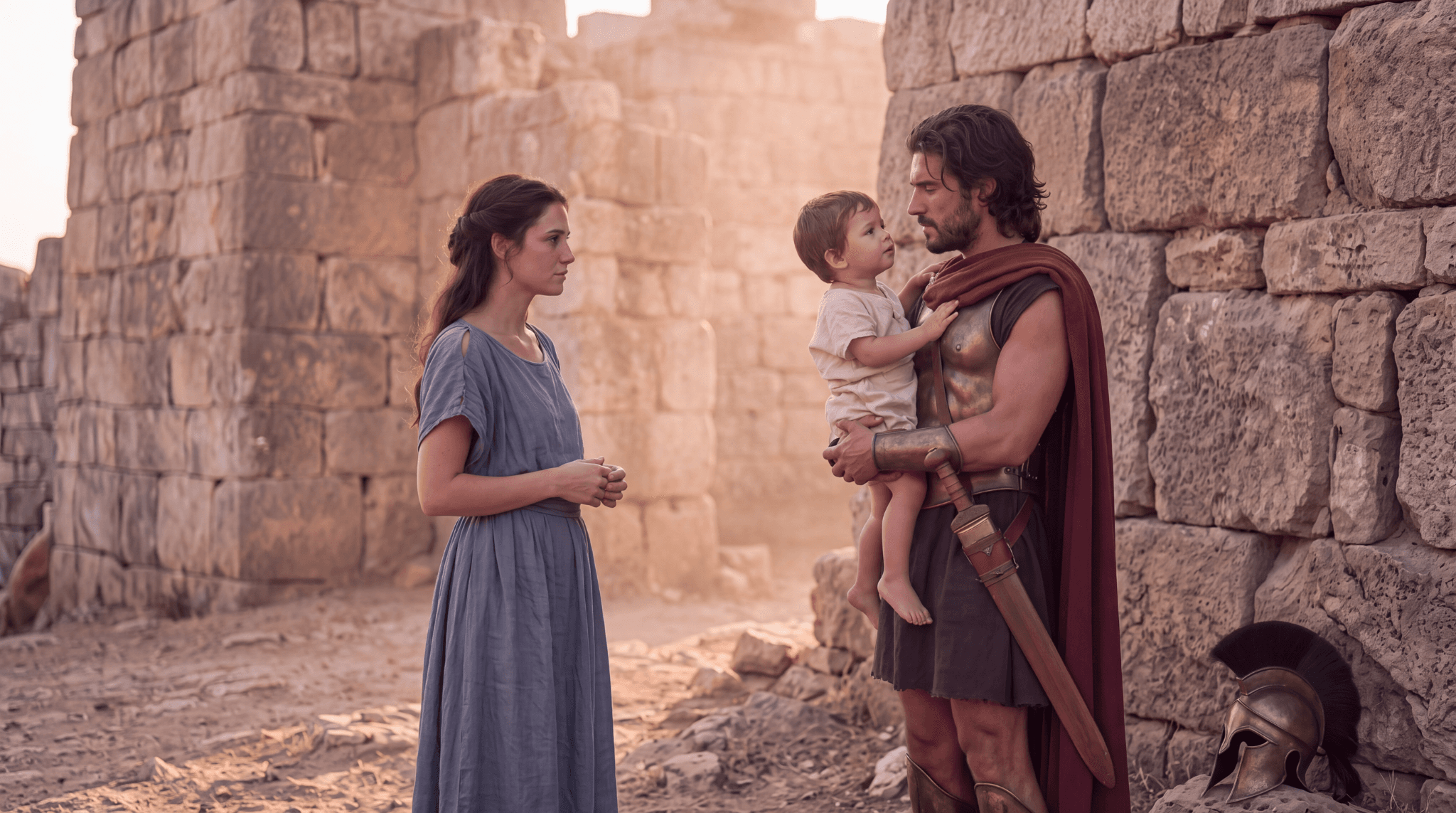
Figure 4. Image-7 changes the action to Hector holding the child. The familiar clothing colors remain, and the helmet is placed near the lower-right edge.
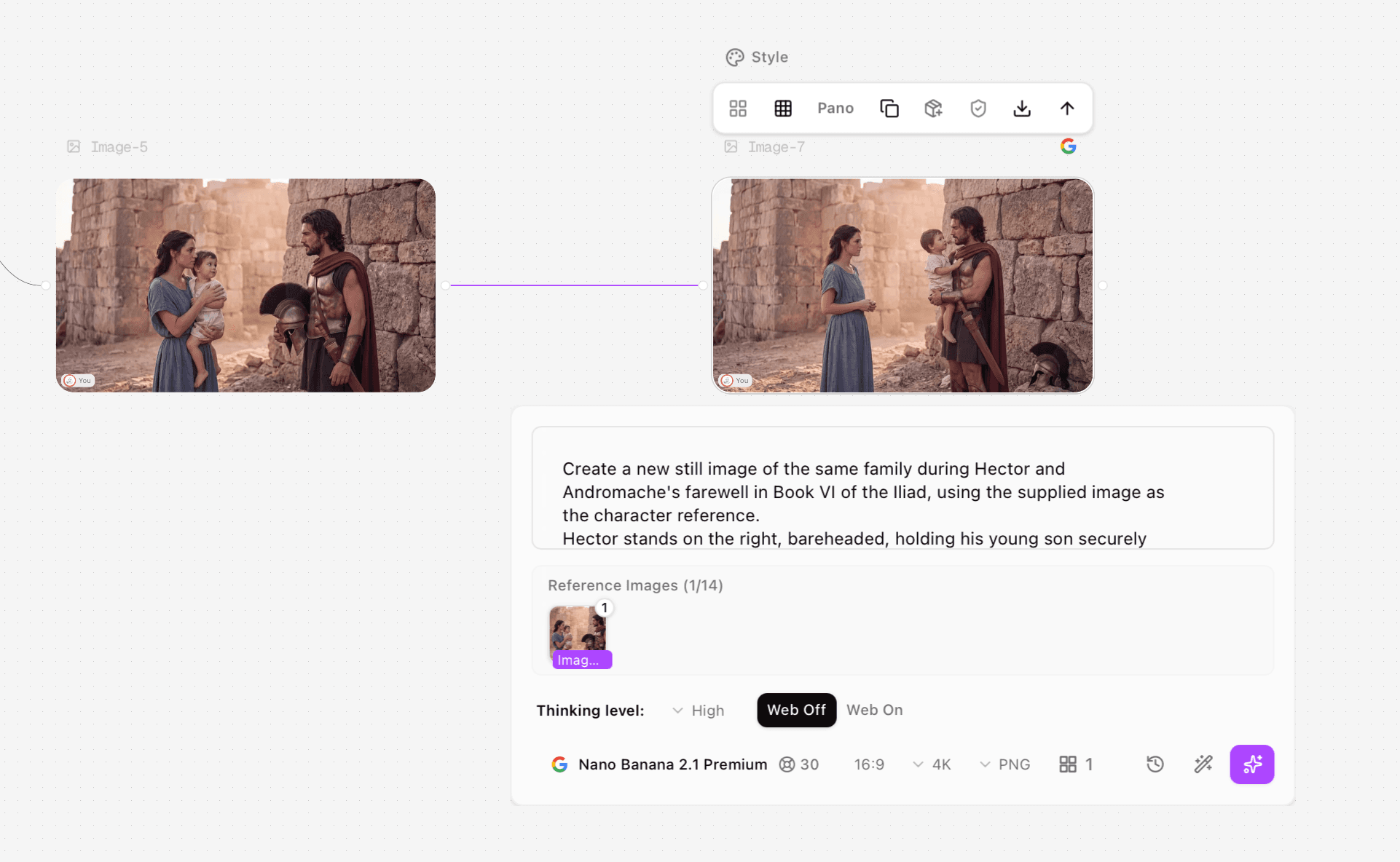
Process screenshot 2. Image-5 feeds Image-7, whose prompt assigns the child to Hector. The screenshot shows the source connection, one reference image and the 2.1 settings.
The image maintains the intended family roles and color cues. It also widens the scene and brings the helmet close to the lower edge, where part of it is cropped. Do not use this scene to claim that all props retain their exact shape or that the mother’s facial identity is unchanged; both need closer comparisons with the corresponding source views.
Returning to the source for a portrait
Original portrait test input
Create a cinematic chest-up portrait of the same Hector shown in the reference image, during his farewell to his family beside the walls of Troy.
Preserve his facial identity, age, facial proportions, dark wavy shoulder-length hair, and short dark beard. Keep the same bronze cuirass and deep-red cloak.
Hector is bareheaded. Show him in a gentle three-quarter view, looking slightly toward the left of the frame with a restrained, sorrowful expression.
Use the same warm late-afternoon lighting and weathered stone-wall setting, with the background softly out of focus. Keep natural skin texture and realistic armor details.
Horizontal 16:9 composition. Frame him from the chest upward, with his entire head visible. Hector only. No helmet in the frame, no additional people, no text, no logos.
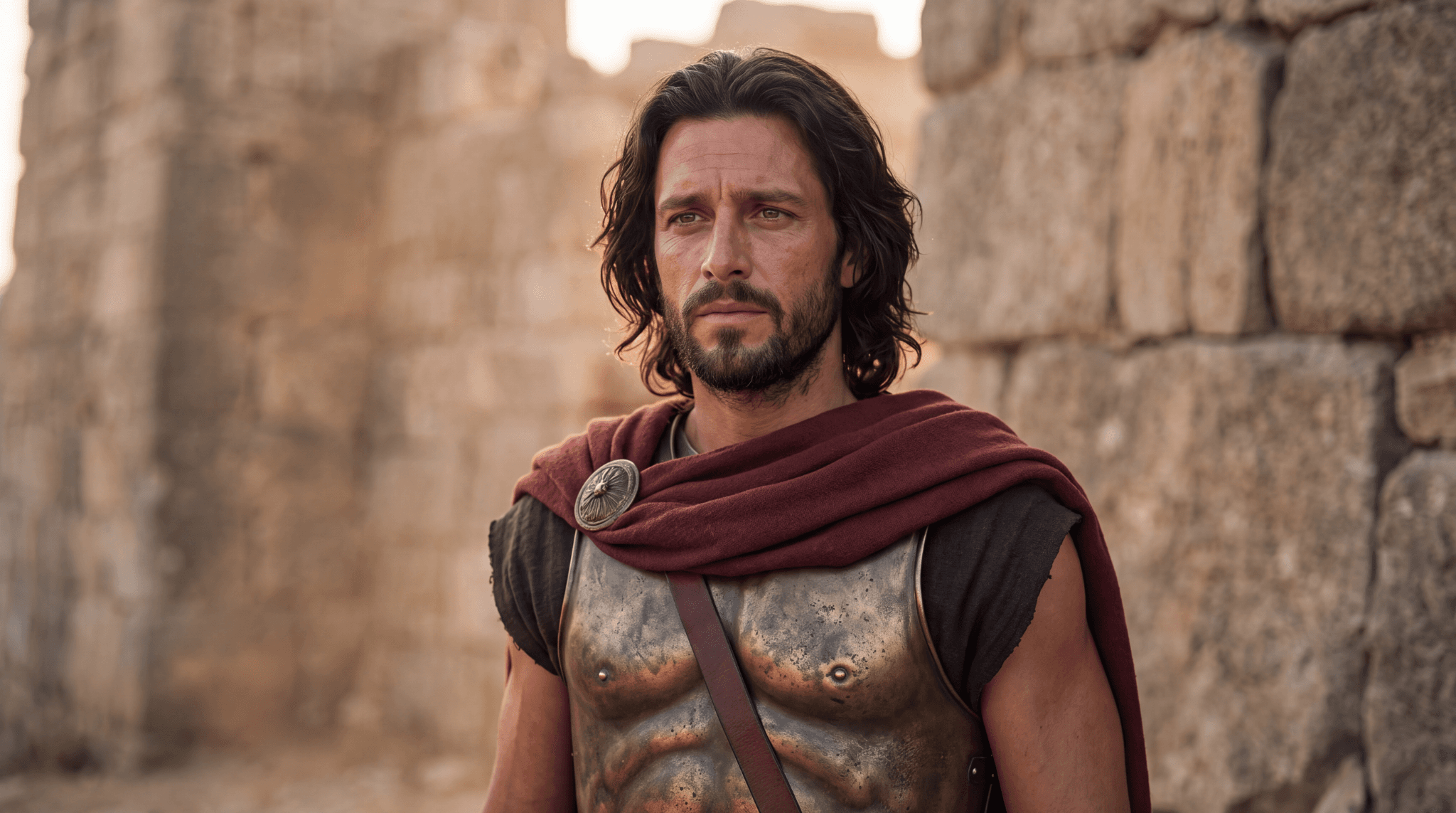
Figure 5. Image-8 uses Image-1 directly as the reference for a chest-up portrait. The face is easier to inspect at this scale.
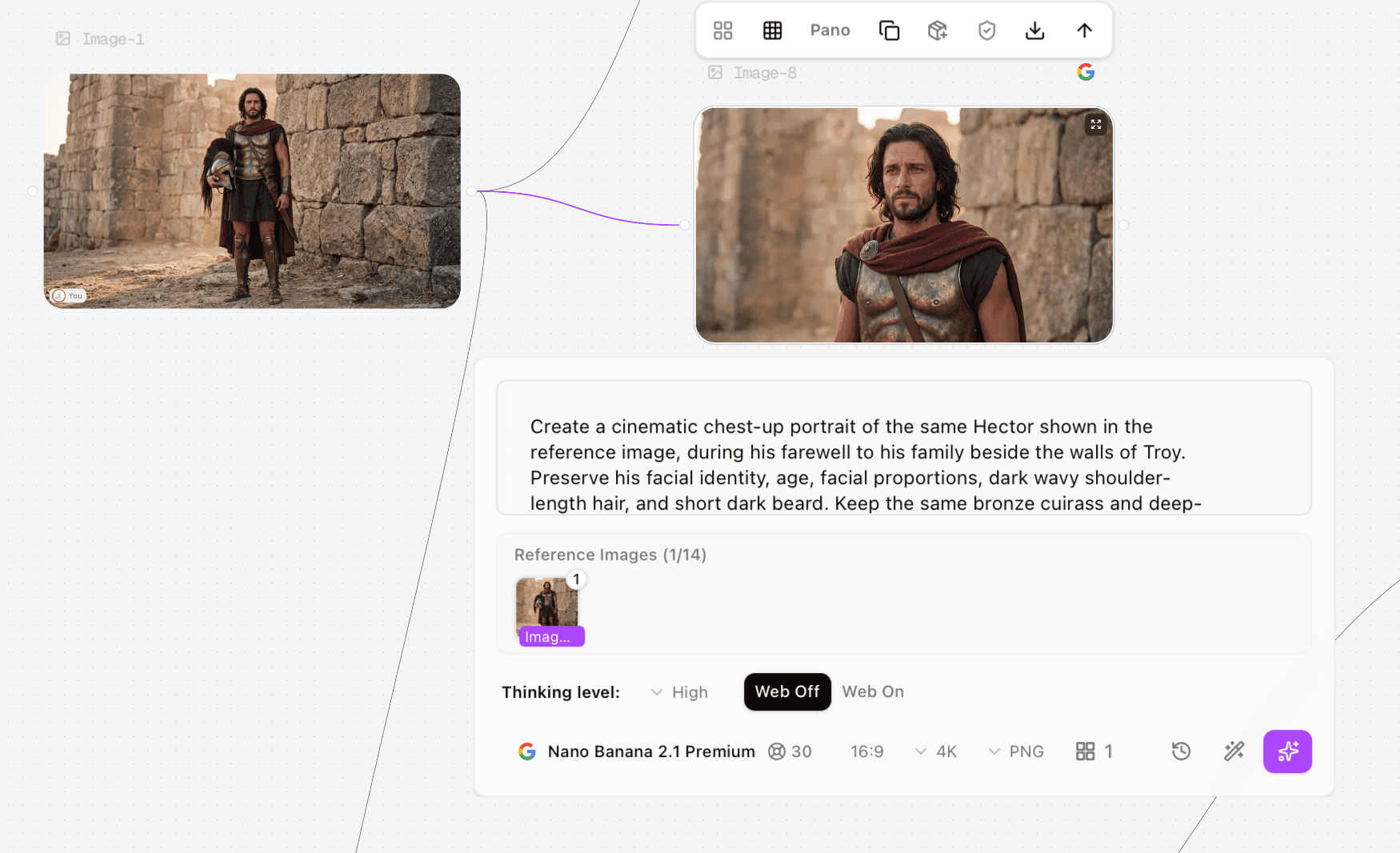
Process screenshot 3. Image-1 directly feeds the portrait node Image-8. The reference thumbnail and prompt excerpt confirm that the portrait bypasses the intervening family edits.
The portrait keeps the hair length, beard, red cloak, round clasp, armor and diagonal strap in a recognizable combination. It is largely near-frontal, with only a mild turn, despite the requested gentle three-quarter view. The original face occupies a small part of Image-1, so the close-up contains more facial information than the reference can establish. Familiar appearance is supported; identical facial proportions are not demonstrated.
Build a reusable reference workflow
Choose an approved image with a clearly visible face and the clothing you intend to reuse.
Keep a short continuity sheet naming the hair, beard, garment colors, clasp and signature prop.
Connect the reference to a new Image node and verify that it appears in the reference list. [2]
Write the new action and frame separately from the details to preserve.
Branch from the original for a new camera view; branch from an approved family scene when relationships between several characters matter.
Compare source and result at similar face sizes, then inspect the full frame before downloading the selected output.
For this sequence, a separate approved close portrait of Andromache and a clear view of the child would improve the next test. Their identities are otherwise carried by a single group shot. That recommendation has not been tested here.
Recorded tests and settings
The table identifies the selected files reviewed in this article. Clara executed the tests in Astorie. A selected result is not a complete count of generation attempts.
Output and date | Input role and prompt record | Selected settings and quote |
Image-1 and Image-4; 10 Oct | Original single figure; Image-1 then supplies the family scene. Original inputs partially retained. | 2.1; 16:9, 4K, PNG, High, Web Off; 30 credits |
Image-5; 11 Oct | Image-4 source; complete revised input above | Same 2.1 settings; 30 credits |
Image-7; 11 Oct | Image-5 character reference; complete child-holding input above | Same 2.1 settings; 30 credits |
Image-8; 11 Oct | Image-1 identity reference; complete portrait input above | Same 2.1 settings; 30 credits |
Record | Evidence retained |
Exact host labels | Nano Banana 2.1 Premium |
Prompt availability | The revised helmet, child-holding and portrait inputs are printed in full. The initial single-figure and family inputs are not reconstructed. |
Generated candidates and failures | One selected supplied output per listed node; total attempts and failures not recorded |
Timing basis | Queue time, generation time and total elapsed time not recorded |
Actual account debit | Not recorded; displayed credits are quotes |
Downloaded files | Original PNGs; 2048 × 1143 each |
Audio review | Not applicable to these still-image tests |
Rerun status | Image-5 uses a revised input from Image-4 after Image-6; other proposed fixes were not retested |
Frequently asked questions
Does the same prompt preserve the same person?
A name and outfit description establish a type, not an identity reference. Use a source image when the visual identity matters.
Should every scene use the latest output?
Not automatically. A chained edit can carry forward an accidental costume or face change. Reuse the original reference when the new scene does not depend on the latest arrangement.
Can these pictures prove a consistency score?
No. They document one small scene sequence without repeated trials, a formal scoring protocol or a face-matching measurement.
Use the model for recognizable continuity, then approve the face, wardrobe and props separately. A coherent sequence still needs editorial selection.
For the node setup and download controls, see the Astorie Image Node guide.
Ready to try it on the canvas?
Open Astorie and fan your prompt across every frontier model in one workflow.