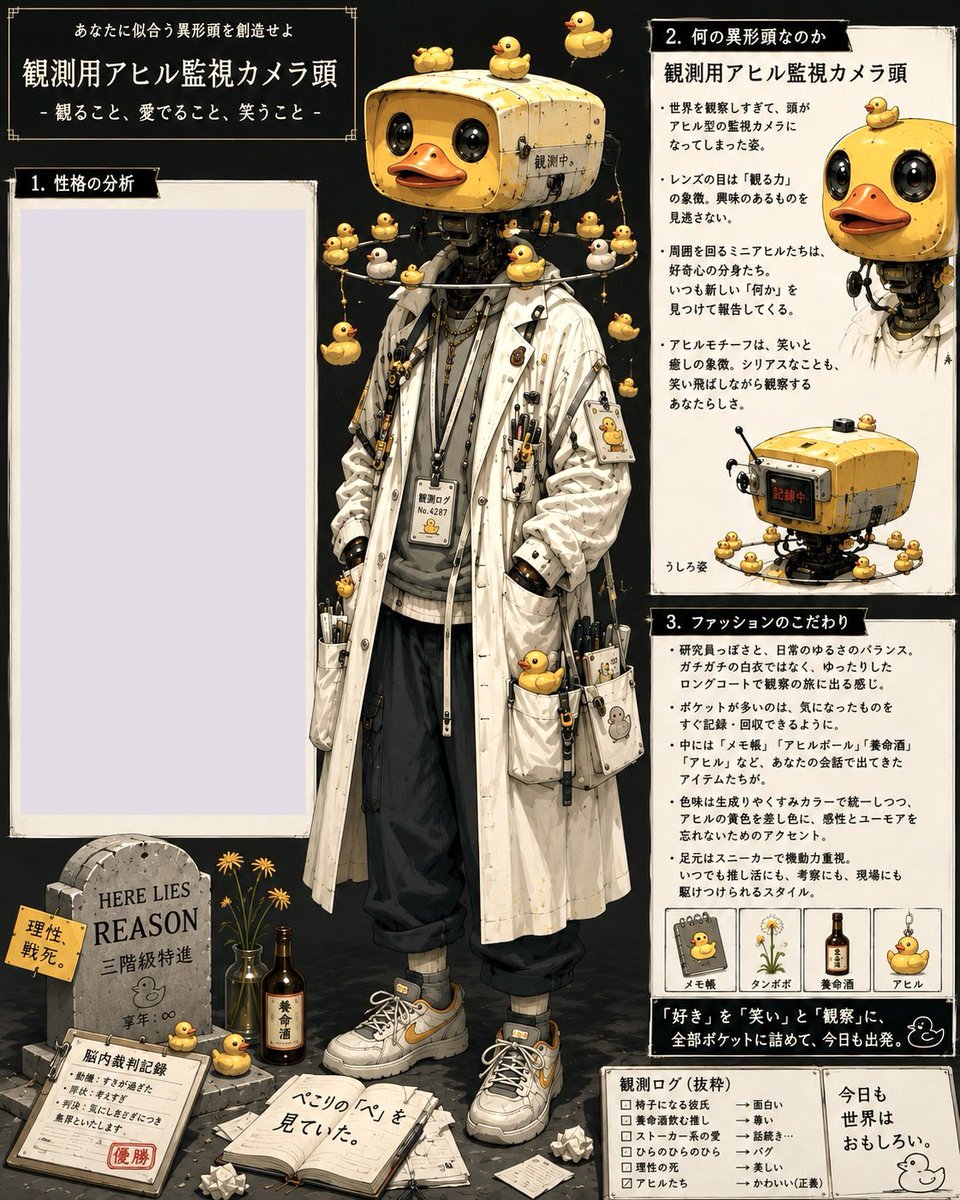
Goal: Create a dense vertical Japanese character-design prompt sheet for an eccentric humanoid with a rubber-duck surveillance-camera head, combining fashion reference, personality analysis, lore notes, and small prop diagrams.

Canvas: Square 1:1 poster, aged cream paper panels on a dark charcoal background, hand-drawn editorial layout with thin black borders, corner ornaments, tape-like edges, ink speckles, and vintage field-notebook texture. Use detailed semi-realistic anime illustration with watercolor, gouache, ink linework, warm yellow accents, and high object detail.

Main subject: Center a full-body standing character named {argument name="character name" default="Observation Appareil Surveillance Camera Head"}. The figure has a yellow rectangular retro security-camera head shaped like a cute toy machine, with two glossy black lens eyes, an orange duck bill mouth, small screws, seams, metal wear, and a tiny Japanese status label. The character wears a long off-white stained lab coat over a gray hoodie, black loose cropped pants, gray socks, chunky white sneakers with yellow accents, lanyards, chains, pens, clips, ID badges, small tools, miniature devices, and duck-themed charms. Pose is relaxed, hands in coat pockets, facing forward, whimsical but mysterious.

Text content: At the top left, place the headline {argument name="headline text" default="あなたに似合う異形頭を創造せよ"}, a large title {argument name="main title" default="観測用アヒル監視カメラ頭"}, and a subtitle {argument name="subtitle" default="- 観ること、愛でること、笑うこと -"}. Keep the typography Japanese, using white text on black header boxes and black text on cream panels.

Layout and panels: Use exactly 3 numbered information panels plus small footer cards. Panel 1 is a large empty pale lavender writing area on the left titled {argument name="left panel title" default="1. 性格の分析"}. Panel 2 is the upper-right lore panel titled with Japanese text meaning “What kind of abnormal head is it?” and includes a small cropped portrait of the duck-camera-headed figure at the top right plus a small device diagram at the bottom. Panel 3 is the mid-to-lower-right fashion panel titled with Japanese text meaning “Fashion preferences,” containing bullet-point Japanese body copy and a row of 4 small labeled item cards.

Discrete repeated elements: Include exactly 38 visible rubber-duck motifs total: 3 on top of the camera head; 1 small duck on the top-left head corner; 1 hanging at the upper left; 1 hanging at the upper right; 8 clustered around the shoulders and chest; 4 on necklace or lanyard charms; 2 attached to coat pockets; 1 printed on a chest ID badge; 1 printed on a sleeve patch; 2 on dangling side straps; 3 near the character’s feet and floor props; 1 in the top-right panel corner; 8 surrounding the small camera-device diagram; 2 in the four fashion item cards. Also include exactly 4 fashion item cards in panel 3: a duck memo pad, a dandelion specimen, a medicinal drink bottle, and a hanging duck charm.

Foreground props: Bottom left shows a small graveyard-like still life: a stone tombstone engraved {argument name="tombstone text" default="HERE LIES REASON"}, yellow flowers in bottles, a brown medicinal drink bottle, a clipboard with red stamp, scattered papers, crumpled paper balls, and an open notebook with handwritten Japanese notes. Bottom right includes two small boxed footer cards: one checklist-style observation log and one quote card with a simple duck doodle.

Style constraints: Make it look like a finished concept-art character sheet rather than a clean infographic. Preserve the asymmetrical magazine layout, off-white panels, black section headers, tiny Japanese annotations, decorative border corners, worn paper texture, and meticulous accessories. Avoid photorealism, avoid 3D render style, avoid extra characters, and do not add any English captions except the tombstone inscription.
Using the uploaded photo, create a 3:4 vertical poster split into top and bottom halves that touch seamlessly, with no white line, gap, or border between them.

Top: the original photo, full-bleed.

Bottom: a warm off-white textured paper background. The main subject is cut out, enlarged, and centered. Behind it, a thin horizontal rectangle shows a blurred crop of the original scene, and the subject breaks out of the frame (3D pop-out). The subject's base fades softly into the paper with natural particles, shadow, or reflection. Add small uppercase serif text in light grey with wide spacing: 3 short poetic lines at top-left and 2 lines with a "—" at bottom-right. Minimal gallery-poster style, photorealistic.
Create a premium 3:4 vertical photography and impasto oil painting comparison poster using the uploaded photograph.

### LAYOUT
Divide the canvas into two perfectly equal horizontal sections (50/50):
- Top: Original photograph.
- Bottom: Artistic impasto oil painting interpretation.

Both sections must connect directly with a clean horizontal boundary, without gaps, gradients, or overlapping.

### TOP SECTION — PHOTOGRAPHY
Preserve the original subject's identity, quantity, pose, proportions, silhouette, details, composition, perspective, lighting, and natural colors. Apply only subtle premium color grading. Do not redraw, distort, duplicate, reposition, or alter the subject. No text or decorations.

### BOTTOM SECTION — ARTISTIC INTERPRETATION
Reimagine the same subject as a sculptural impasto oil painting micro-landscape. Use thick layered paint, palette-knife textures, handcrafted forms, raised edges, and expressive brushstrokes.

Keep the subject recognizable, centrally or slightly off-center, surrounded by generous warm-white negative space. Introduce a single color band inspired by the original photograph, transformed into a ground, water, pathway, or abstract landscape element.

### COLORS & TEXTURES
Extract a harmonious, limited color palette from the original photograph. Preserve the subject's natural color character while adding subtle brightness and luminosity. Use rich paint textures selectively, with refined subject details and delicate matte paper texture.

### TYPOGRAPHY
Add a short, elegant English title and one small supporting line within the lower section's negative space. Use thin, minimal typography. Generate text based on the actual subject or mood. Avoid invented dates, locations, logos, signatures, and unnecessary annotations.

### AESTHETIC
Quiet, minimal, sophisticated, and editorial. Create a collectible fine-art publication aesthetic through negative space, sculptural depth, material textures, and balanced composition.

### AVOID
Photo collages, altered subjects, unrelated scenes, illustrated photography, extra title bars, clutter, excessive decorations, incorrect text, watermarks, cartoon styles, neon colors, oversaturation, muddy tones, plastic-looking 3D, and cheap CGI.
A nostalgic, vintage-style photograph of a young woman sitting in a lush green field. She has short, dark bobbed hair with bangs and is looking down with a pensive, melancholic expression. She wears a black, long-sleeved top with a deep V-neckline featuring ruffled edges. The background shows a vast expanse of tall grass or crops stretching toward distant hills under a clear sky. The image has a distinct retro aesthetic, characterized by film grain, warm color tones, scratches, and dust spots typical of old analog photography from the Showa era.
A vintage-style photograph of a young woman sitting in a retro Showa-era cafe. She has dark hair tied back with loose strands framing her face, wearing round wire-rimmed glasses and a delicate floral sundress under an off-the-shoulder white cardigan. She is holding a small pastry up to her mouth, looking directly at the camera with a soft, candid expression. In front of her on the wooden table sits a cup of black coffee in a patterned ceramic cup and saucer, along with a sugar dispenser. The background features warm wood paneling, shelves with glassware, and another patron blurred out, creating a nostalgic atmosphere. The image has a grainy film texture, faded colors, and light leaks typical of 1970s Japanese photography.
Transform the uploaded reference image into a charming, whimsical 2D storybook illustration while preserving the original image’s exact composition, camera angle, perspective, framing, subject identity, facial features, hairstyle, pose, clothing, proportions, expressions, and all object placements. Do not redesign, remove, or rearrange any elements. Keep the main subject photorealistic or softly realistic, while transforming the surrounding background into a delicate hand-drawn illustration.

Create a beautiful mixed-media aesthetic combining realistic photography with minimal black-ink doodles on a warm cream-colored textured paper background. Add cute hand-drawn decorative elements inspired by the scene, such as tiny flowers, stars, snowflakes, butterflies, trees, hearts, grass, little characters, animals, and playful illustrations. Keep the doodles simple, delicate, and naturally arranged around the subject without covering important details.

Use a soft pastel and warm earthy color palette, subtle paper grain, pencil-like sketch marks, fine imperfect black outlines, and a cozy vintage journal aesthetic. Add elegant handwritten cursive text that complements the scene, with small arrows, decorative lines, hearts, and playful annotations.

The final result should look like a creative scrapbook page, a nostalgic illustrated diary, and a beautiful lifestyle editorial combined. Maintain the original subject as the main focus, with a clean cream background and balanced negative space.

Style: Mixed-media photography, hand-drawn doodle art, vintage scrapbook, cozy illustrated journal, minimalist ink sketches, textured cream paper, whimsical storybook aesthetic.

High-quality details, natural lighting, beautiful composition, vertical 9:16 format.
STYLE AND COMPOSITION: Create an ultra-realistic, photorealistic, cinematic fantasy portrait in a vertical 9:16 composition. A beautiful young adult woman sits gracefully on a minimalist white cylindrical stool in a softly illuminated modern interior. She wears a light-blue button-up shirt with rolled-up sleeves, fitted blue denim jeans, and clean white sneakers. Her long, voluminous dark-brown wavy hair cascades naturally over her shoulders. Her makeup is soft and natural, with realistic skin texture, delicate facial features, and a gentle, dreamy expression.

MAIN SUBJECT — POSE AND EXPRESSION: The woman sits with her legs crossed elegantly, her torso slightly turned toward the right. She gazes upward with wonder and affection at a miniature version of herself floating above her hands. Both arms extend forward, with her palms open and gently cupped as if magically supporting the tiny figure. Her fingers are naturally positioned, anatomically correct, and delicately illuminated by the golden glow.

MINIATURE SELF — HIGHEST PRIORITY: A perfectly recognizable miniature duplicate of the same woman floats approximately 20–30 centimeters above her open palms. The tiny figure has the same facial features, hairstyle, skin tone, blue button-up shirt, fitted jeans, and white sneakers as the seated woman. Show the miniature woman in a full-body view, hovering weightlessly with her arms slightly extended outward, legs gently crossed at the ankles, and head tilted gracefully upward. Her expression is peaceful and joyful. The miniature must appear three-dimensional, realistically proportioned, and physically integrated into the scene, with no visible platform, strings, or support.

MAGICAL EFFECTS: Surround the floating miniature with delicate golden sparkles, glowing particles, tiny luminous stars, and elegant circular ribbons of warm golden light spiraling around her body. Add fine glitter trails and subtle lens flares, with the brightest golden glow concentrated around the miniature’s silhouette and feet. The light softly illuminates the woman’s hands, face, hair, and clothing. Keep the magical effects elegant, ethereal, and realistic rather than cartoonish.

BACKGROUND AND LIGHTING: A warm taupe-gray interior wall with strong natural sunlight entering from a large off-camera window on the left. Distinct geometric window-frame shadows stretch diagonally across the wall and pale floor, creating a sophisticated architectural pattern. Soft afternoon sunlight, warm rim lighting around the woman’s hair, gentle shadows, natural skin highlights, and a creamy neutral color palette. A subtle shallow depth of field adds cinematic depth without obscuring either subject.

CAMERA AND QUALITY: Full-body environmental portrait, vertical composition, slightly low camera angle, 50mm portrait lens, f/2.8, realistic perspective, balanced framing, professional fashion photography, high dynamic range, lifelike skin pores, individual hair strands.