

MiniMax H3 vs Kling AI Video Quality Features and Pricing
MiniMax H3 vs Kling AI is primarily a choice of controls and delivery options: H3’s public API offers mixed image, video and audio references at 768p or 2K, while Kling VIDEO 3.0 offers element references, explicit multi-shot controls, native-audio modes and a separate 4K option. H3 requests last 4–15 seconds; Kling 3.0 supports 3–15 seconds. The supplied clips do not establish a general picture-quality winner. [1, 2, 5]
In Astorie, the project owner kept the source artwork and both model branches in one canvas. Use that arrangement to check a specific brief—such as a recurring character, an audible atmosphere or a planned cut—before changing the production workflow. The comparison below separates official capabilities, actual exported files and creative recommendations.
MiniMax H3 vs Kling AI features and output options
Criterion | MiniMax H3 | Kling VIDEO 3.0 |
Video inputs | Text; first/last frames; mixed references | Text; image; start/end frames; element references |
Reference organization | Up to 9 images, 3 videos, 3 audios; 12 files total | Reusable elements from image sets or character video |
Shot control | Multi-shot intent and ordered references | Single, automatic Multi-Shot and Custom Multi-Shot |
Audio | Native audio; audio-reference route | Native/No Native Audio; character voice controls |
Duration | 4–15 whole seconds | 3–15 seconds |
Output route | 768p or 2K public API | 720p/1080p modes; separate native 4K offering |
Kling VIDEO 3.0 Omni is a distinct model line descended from VIDEO O1; the ordinary VIDEO 3.0 guide is the proper evidence for the table. The Astorie screenshot says “Kling 3.0,” PRO and Single. PRO is the selected quality tier in that interface; the label by itself does not prove an Omni run or justify importing every Omni-only claim. Likewise, H3 Max is separate from H3. [1–3]
The newer official Kling 4K announcement expands the output options beyond the 720p/1080p pricing table in the original VIDEO 3.0 guide. It is a distinct mode with its own cost; neither the PRO label nor an ordinary 1080p result proves that 4K was used. For a high-resolution deliverable, select and budget that mode explicitly. [2, 5]
What differs in references, consistency and shot control?
H3 is a candidate when a shot needs several media types in one reference request. A subject image can guide identity while a video or audio example supplies another cue, subject to the provider’s file and length rules. First/last-frame generation is a different route: choose it when the required endpoint composition matters more than a general visual reference. [1]
Kling VIDEO 3.0’s guide describes elements built from two to four images or a character video. Its shot interface separates a single shot, automatically arranged multiple shots and custom shot instructions. That gives a director an explicit place to describe framing and timing. It is a reason to evaluate the interface for recurring characters or dialogue scenes, not a guarantee of perfect identity retention. [2]
For either route, consistency means more than a similar face in one still. Follow the character through occlusions and cuts, check whether clothing and props persist, and inspect interaction with the environment. A reference system is a control mechanism; its success still depends on the particular output.
How do picture quality and motion compare?
There is insufficient matched evidence here to rank sharpness, realism, motion or prompt adherence. The two exported examples are useful for judging this illustration, but their lengths, resolution and input roles differ. A 4K specification increases the available raster size; it does not establish that hands, texture or motion will look better than a lower-resolution competitor.
The project owner reported that H3 preserved the recognizable watercolor setting without obvious deformation, but its motion was restrained and not fully natural. They reported a blink and modest movement in Kling. Those observations support reviewing each requested action; one successful blink is not evidence that Kling is generally better for portraits.
Case record | H3 in Astorie | Kling in Astorie |
Displayed model/mode | MiniMax H3; Omni | Kling 3.0; PRO; Single |
Input role shown | Reference Image | Start image |
Downloaded MP4 | 1344 × 768; 8.0s | 1920 × 1080; about 10.04s |
Audio-stream inspection | Audio stream present | No audio stream in this downloaded file |
Recorded charge | 112 Astorie credits deducted | 250 Astorie credits deducted |
Creative report | Restrained movement; ambience and sigh | Blink and modest movement |
These are project-owner runs, not writer-operated tests. The exact test dates and separate audio-switch states were not logged, and the two source files were not independently byte-matched for this review. The H3 original prompt is confirmed; a complete matching Kling submission is not available in the current record. The costs are confirmed completed-job debits, not equal-setting price benchmarks.
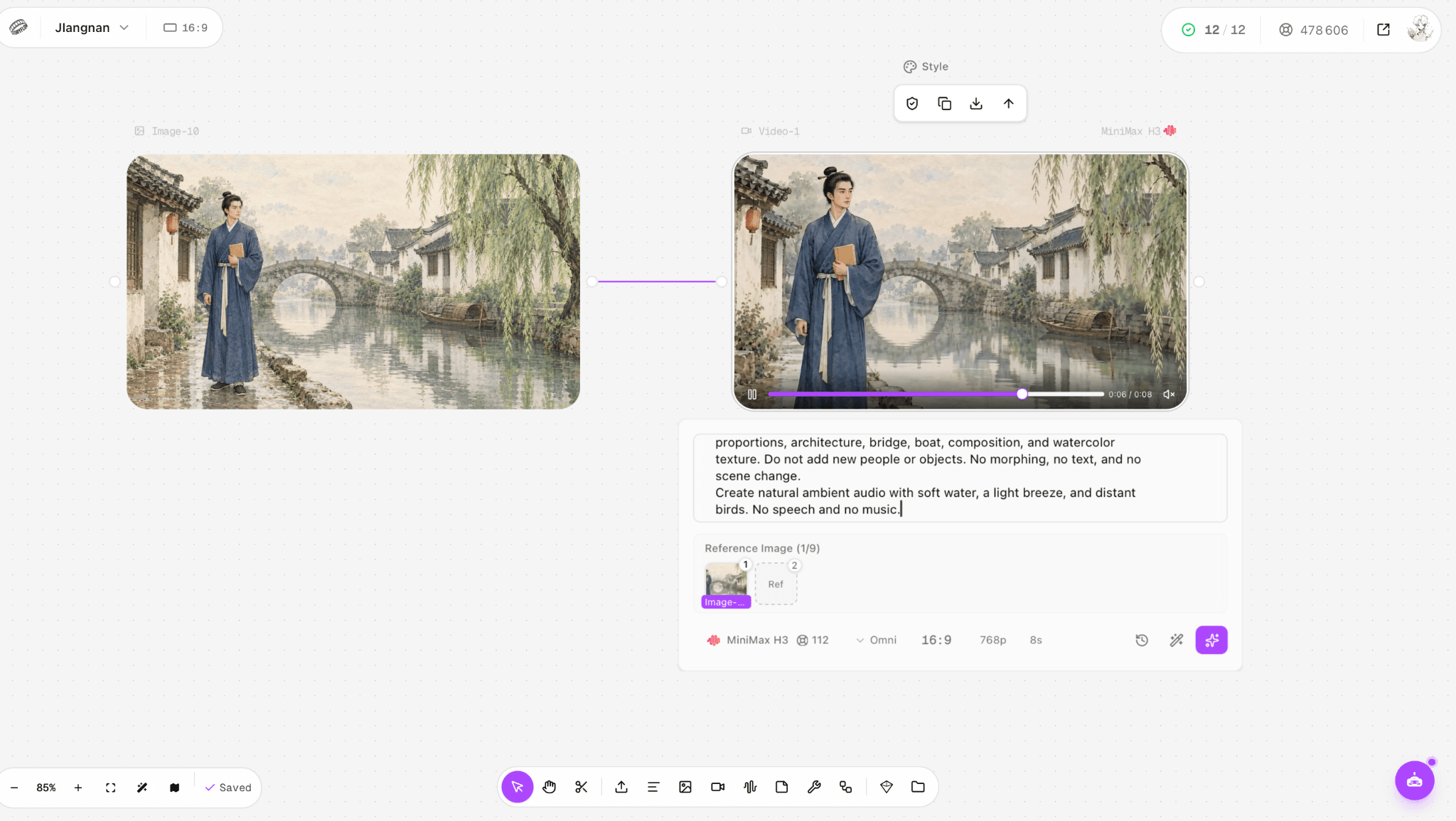
Figure 1. The H3 example: one watercolor still, 16:9, eight seconds at 768p; the tester reported ambience and an unwanted sigh.
Watch the original MiniMax H3 clip
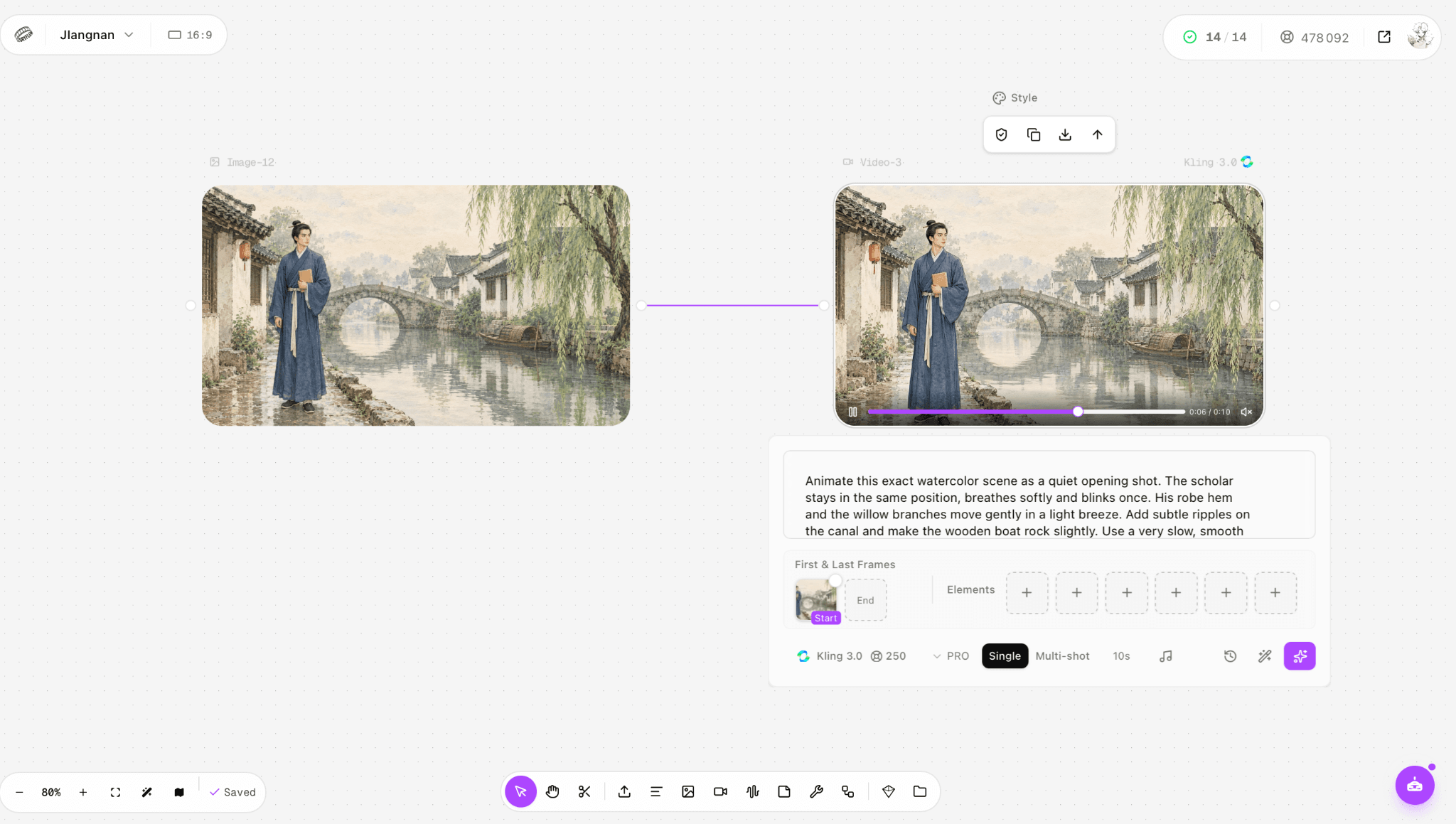
Figure 2. The separate Kling 3.0 PRO Single run at ten seconds, with start image and completed result in Astorie.
Watch the original Kling 3.0 result
Which audio controls matter?
The downloaded Kling MP4 has no audio stream; the H3 file has one. This resolves what is present in these particular exports, but does not reveal which Kling sound setting was selected or show that Kling lacks native audio. Its official guide explicitly offers Native Audio and No Native Audio, with different charges. [2]
The H3 tester heard environmental sound plus an unwanted sigh. The original request included “breathes softly” and banned speech and music, not audible breathing. That distinction matters when diagnosing prompt response. Kling’s absent track also cannot be called cleaner ambience: there is no generated ambience to compare in that file.
For a dialogue scene, Kling’s voice and speaker controls may be a useful reason to try it. For a shot driven by an existing sound reference, H3’s audio-reference route is relevant. In both cases, judge synchronization, intelligibility and unwanted sound on the exported file. Neither example here is a matched audio-quality test.
What does each route cost?
MiniMax H3’s API output is $0.08 per second at 768p or $0.13 at 2K. Eight seconds costs $0.64 or $1.04 before paid inputs. The first five images and input audio are free on that schedule; additional images cost $0.04 each, and input video is billed at the selected resolution’s per-second rate. [4]
Kling’s official product guide publishes the following VIDEO 3.0 charges in Kling credits. These are not Astorie credits or MiniMax API dollars. The table gives an actual generation budget in the provider’s stated unit without pretending that unrelated currencies are equivalent. [2]
Kling VIDEO 3.0 mode | Kling credits/second | 8-second request |
720p without native audio | 6 | 48 |
720p with native audio | 9 | 72 |
1080p without native audio | 8 | 64 |
1080p with native audio | 12 | 96 |
Voice control add-on | +2 | +16 |
Separate 4K planning rate [5] | 30 | 240 |
At the same duration and resolution, the published native-audio rate is 50% higher than the no-native-audio rate. Decide whether sound is actually part of the deliverable before generating. The 4K planning rate comes from Kling’s later cost guide; it should not be silently substituted for an ordinary 1080p request. [2, 5]
Kling’s published Standard first-subscription offer is $6.99 for a month with 660 credits, with the next monthly renewal shown as $8.80. At 96 credits per eight-second 1080p native-audio request, six requests use 576 credits and leave 84, before any other activity. The advertised video-count examples on a plan are therefore not universal counts for every model and setting. The page lists commercial use and watermark removal for paid Standard, while Basic is personal/noncommercial. [5]
Within the actual Astorie project, H3 consumed 112 credits and Kling 250. The latter delivered a longer 1080p video, and the former delivered an eight-second 768p video with audio. Neither the raw totals nor a credits-per-second division measures equal output value. Price the intended configuration before allocating a batch.
Which model fits your next job?
Need | Route worth trying | Reason to move and cost of moving |
Several reference media types in a short video | H3 reference generation | Consolidate cues; prepare roles and review soundtrack |
Recurring characters and planned shot changes | Kling VIDEO 3.0 elements and custom shots | More explicit shot setup; rebuild elements and shot prompts |
Native 4K delivery | Kling 3.0 4K mode | Documented output option beyond cited H3 API; higher generation cost |
An already approved H3 or Kling scene | Keep the current branch | Avoid losing approvals unless a specific requirement fails |
Switch when a required control or delivery size is unavailable, or when a comparable trial solves a repeatable failure with fewer revisions. Keep the current model when its output already passes. The migration cost is concrete: source preparation, reference or element setup, prompt adaptation, reruns and a new picture-and-sound approval pass.
FAQ
Does Kling 3.0 support audio?
Yes, Kling’s VIDEO 3.0 official guide documents native audio. The current tester’s inability to hear useful ambience does not negate the feature. [2]
Are Kling 3.0 and Kling 3.0 Omni the same model?
No. The official product guide differentiates VIDEO 3.0 from VIDEO 3.0 Omni. “PRO” in a host’s output selector is a quality tier, not proof of Omni. [2, 3]
Which sample had sound?
File inspection found an audio stream in the H3 MP4 and none in the downloaded Kling MP4. The audio switch used for Kling is not established, so this is an export observation, not a model limitation.
Which is cheaper?
H3 API dollars, Kling product credits and Astorie credits describe different purchasing routes. The tables provide their actual units and conditions; the unmatched project jobs cannot settle an equal-specification cost comparison.
Sources
Official specifications and prices checked September 27, 2026. Creative judgments are the project owner’s reports; exported stream metadata was checked for this revision.
1. MiniMax H3 routes and limits
2. Kling VIDEO 3.0 official user guide
3. Kling VIDEO 3.0 Omni separate user guide
4. MiniMax H3 official API pricing
Ready to try it on the canvas?
Open Astorie and fan your prompt across every frontier model in one workflow.