

MiniMax H3 vs Wan 3.0 Features and API Costs
MiniMax H3 vs Wan 3.0 comes down to output requirements and input controls: H3’s public API offers 4–15-second video at 768p or 2K; Wan 3.0 standard preview offers 2–30 seconds at 480p, 720p or 1080p, with an audio-off switch and documented editing and extension routes. For Wan with video input, the input and final output durations together must not exceed thirty seconds. [1, 2]
If your approved illustrations already feed an H3 branch in Astorie, keep that work while checking whether a new requirement actually calls for Wan. A longer shot, a different reference combination or an explicit audio-free export may justify a separate trial. Moving models also means adapting the input pack and repeating the approval process.
MiniMax H3 vs Wan 3.0 capabilities
Public API criterion | MiniMax-H3 | wan3.0-video standard |
Availability in cited docs | Pay-as-you-go API | Preview; enabled region, workspace and key required |
Video duration | 4–15s | 2–30s without video input; input video + output ≤30s |
Resolution choices | 768p, 2K | 480p, 720p, 1080p |
Text and start/end stills | Both available | Both available |
Mixed reference maximum | 9 images, 3 video, 3 audio; 12 total | 10 reference images, 5 reference videos, 5 reference audios, with combination rules |
Audio | Native stereo; audio references in reference mode | audio true/false output switch; audio reference in reference mode |
Edit and extend | Video editing described in H3 guide; check route | Pass original as reference_video and write editing/extension intent |
This comparison concerns MiniMax-H3 and standard wan3.0-video, not H3 Max or wan3.0-video-prime. Prime is a separate accelerated Wan model with its own rates. Alibaba currently labels Wan 3.0 preview, so region, workspace and access matter as well as the model name. The completed hands-on case is H3 only; Wan controls below are documented capabilities, not tested quality claims. [1–3]
How long can the output actually be?
Wan can request thirty output seconds when no video is supplied. When video is supplied, add all input-video durations and subtract that total from thirty to find the remaining ceiling. Reference video itself is capped at fifteen seconds combined. The output must also fit the normal duration rules. [2]
Total reference-video duration | Maximum final output under combined rule | Example use |
0s | 30s | Text or still-led long shot |
5s | 25s | Short movement reference or source clip |
10s | 20s | Longer video-guided request |
15s | 15s | Largest permitted combined video input |
For extension, “output duration” means the final returned clip, including the source segment where applicable—not just the newly added seconds. Alibaba’s example extends a five-second source by two seconds with duration set to seven, or lets the model choose with −1. That request counts five input seconds plus seven output seconds toward the combined rule. [5]
H3’s cited hosted route tops out at fifteen output seconds regardless of a longer local workflow shown elsewhere. If a deliverable needs one continuous twenty-second shot, Wan’s documented range is relevant. If it needs two separate ten-second shots, either model’s duration ceiling may fit, and the choice can instead focus on controls, quality and cost.
Which reference combinations are supported?
Input goal | H3 documented route | Wan 3.0 documented route |
Anchor opening or ending | First/last-frame generation | first_frame / last_frame; frame mode only |
Guide subject, motion and sound together | Mixed references; 12 total files | reference_image / reference_video / reference_audio combinations |
Image capacity in reference mode | Up to 9 | Up to 10 |
Video and audio capacity | Up to 3 each; separate 15s totals | Up to 5 each; separate 15s totals |
Use a document or public page | Not established in cited H3 video guide | One file or one link; not both; prompt extension required |
Wan numbers images, videos and audio separately in the media array: Image 1 and Video 1 can coexist without referring to the same position. Use those names to state which source supplies identity, action or sound. Its frame-anchored mode cannot simply be mixed with reference audio; select the reference mode when that combination is required. [2, 5]
For document or page input, the source must be publicly accessible without login. Turning a page into video is a documented Wan route, but it does not ensure every fact or layout is preserved. Review the generated script and visuals against the source, especially when the video is explanatory rather than atmospheric. [2]
How do audio, editing and extension work?
Wan’s audio parameter defaults to true; false produces a video with no audio track. Its prompt_extend setting also defaults to true. That rewriting option is required for document/page inputs and can affect prompt handling and latency. H3 accepts sound references and describes native sound generation; the tested H3 route produced an audible soundtrack. [1, 2]
For Wan editing, pass the existing clip as reference_video and describe the change to it. For a continuation, pass the same role and explicitly request continuation after the ending, content before the opening, or both. Use adaptive ratio to retain the source shape, and set duration to the desired final clip length. These instructions identify the operation; they are not a guarantee of pixel-exact replacement or seamless motion. [5]
A practical edit brief identifies the source, the change and the protected content: for example, replace a subject’s coat color while retaining the action and camera. This is a proposed brief, not a performed Wan test. Check boundaries, identity and continuity in the result. If exact protected pixels are essential, a conventional masked composite remains a separate production option.
What did the actual H3 case show?
The project owner connected one approved 16:9 Jiangnan watercolor still to an Astorie H3 node and selected Omni, 768p and eight seconds. The sole submitted job succeeded, deducted 112 Astorie credits and took roughly two minutes by their estimate. The tester found the composition recognizable, with some motion that did not look fully natural, no obvious deformation and ambient audio plus a human-like sigh. The original prompt asked the scholar to breathe softly and did not ban breathing sound, so the sigh is an aesthetic fault, not demonstrated disobedience in this task. The full original source can be reviewed below.
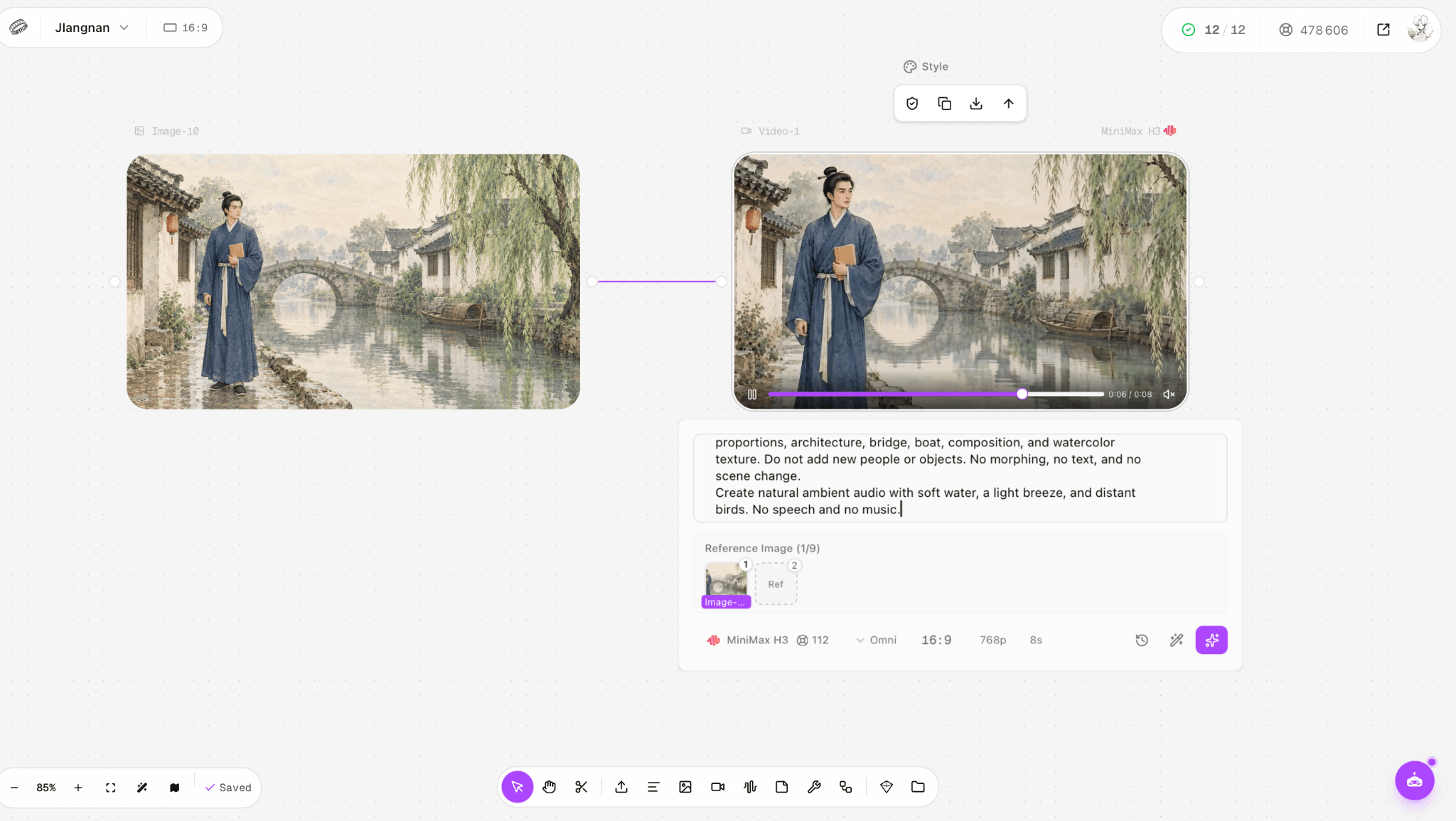
Figure 1. Completed H3 768p eight-second case; this is H3 evidence only and does not depict a Wan 3.0 generation.
Watch the original H3 clip with its audio
The H3 original prompt and successful debit were confirmed by the project owner. The downloaded MP4 is eight seconds at 1344 × 768 with an audio stream. Exact run date and audio-switch state were not logged. No Wan 3.0 output was produced, so there is no evidence here to declare a winner on realism, motion, sound quality, consistency or generation speed.
What does an eight-second API request cost?
Route | Base output rate | 8s output, no billable input video |
H3, 768p | $0.08/s | $0.64 |
H3, 2K | $0.13/s | $1.04 |
Wan 3.0 standard, Singapore, 720p | $0.10/s list | $0.80 list; $0.56 if the posted 30% discount applies |
Wan 3.0 standard, Singapore, 1080p | $0.20/s list | $1.60 list; $1.12 if discount applies |
The Wan numbers are for standard wan3.0-video in Singapore, checked September 27, 2026. Alibaba shows a limited-time 30% discount on standard pricing: the 720p rate becomes $0.07 per second and 1080p $0.14 when the offer applies. It bills both input and output video seconds; the table assumes no reference video. H3 examples assume at most five still inputs and no input video. [3, 4]
Ten seconds of reference video plus eight output seconds at Wan 720p is eighteen billable seconds: $1.80 at list price or $1.26 with that discount. For H3 768p, the same video durations cost $0.80 input plus $0.64 output, or $1.44 before extra-image fees. The arithmetic is comparable, but 720p and 768p are not identical output specifications.
Wan’s documented Singapore free quota is thirty combined input/output video seconds for eligible activation, valid for ninety days under the page’s stated timing rules. Access and quota are account-dependent; the project owner’s account required payment before a Wan test. The pricing page says failed Wan requests are not billed and do not consume that quota. That policy should not be generalized to a different provider or intermediary. [3]
H3 charges $0.04 for each input image above the first five; input audio is free on the public H3 schedule. Wan’s published video bill is based on input/output video seconds. Astorie’s confirmed 112-credit H3 job is a separate host charge, not either provider’s API dollar invoice. [3, 4]
Which model should you choose?
Requirement | Better documented fit for this requirement | Trade-off |
2K output within a 15s request | H3 public API | Shorter output ceiling than Wan |
More than 15s final video | Wan 3.0, if combined-duration rule allows | Preview access and new prompt validation |
Explicitly omit the output audio track | Wan audio:false | No generated sound; supply audio separately if needed |
Document/page-driven video or source-video continuation | Wan documented reference/edit/extend route | Input preparation and review of factual/visual continuity |
An acceptable existing H3 branch | Continue the approved H3 workflow | Review and repair specific defects rather than assuming a new model solves them |
Choose a new route for a specific unmet requirement, then verify its actual output before migrating a series. Moving from H3 to Wan may provide a longer deliverable or a useful control, but costs a new input pack, integration or host setup, and fresh approvals. Moving to H3 for its documented 2K route similarly requires accepting a fifteen-second hosted ceiling. Neither recommendation is a claim about untested visual superiority.
FAQ
Can Wan 3.0 make a thirty-second clip?
The preview API allows up to thirty seconds without input video. With video input, input plus output must not exceed thirty seconds; separate reference-video limits apply. [2]
Can Wan 3.0 suppress output audio?
Its API exposes audio:false. In first/last-frame mode you cannot simultaneously pass reference audio, whereas reference mode has audio-input combinations. [2]
Is Wan 3.0 currently cheaper than H3?
For the specified Singapore standard 720p eight-second output-only example, $0.80 list or $0.56 if the limited 30% offer applies, versus H3 768p $0.64. They are different resolutions and billing systems; input video, free quota and access can reverse an individual invoice. [3, 4]
Which model has better picture quality and motion?
The available evidence does not establish a winner. The H3 case documents one watercolor scene; no matched Wan 3.0 export was evaluated. Resolution and reference limits can guide a shortlist, but neither proves more natural motion or stronger character consistency.
Sources
Official specifications and prices checked September 27, 2026. Wan features are documented, not hands-on findings; H3 creative observations are tester reports.
1. MiniMax H3 public specifications
2. Alibaba Wan 3.0 preview API and media rules
3. Alibaba current Wan 3.0 regional model pricing
4. MiniMax H3 pay-as-you-go pricing
Ready to try it on the canvas?
Open Astorie and fan your prompt across every frontier model in one workflow.