

Post-Production Schedule Template for AI Revisions and Client Delivery

A post production schedule template should connect each deliverable to an owner, a dependency, an approval gate and a deadline. For AI revisions, reserve time for candidate generation, review, a limited retry and final quality control. A model finishing its job does not mean the shot is ready for delivery.
Use the blank template below for a real project, or adapt the completed two-day example. Every time, role and allowance in the example is illustrative. It is not a report of Clara’s generation speed, project cost or client response time.
Build a post production schedule template around approval gates
Begin with the delivery deadline and work backward. Separate internal decisions from client decisions, and make the handoff condition explicit. “Review” is too vague if nobody knows which version is being reviewed, who decides or when a reply is due.
Before scheduling individual tasks, map the wider video production pipeline. Then use this template for the post-production portion: source lock, revisions, feedback, finishing, QC and delivery.
Gate | What must be true before work continues |
Source lock | Correct source file, shot ID, frame rate and approved action range recorded |
Revision brief lock | Requested changes and protected elements approved by one decision-maker |
Candidate selection | One version selected with timecoded notes; alternatives remain archived |
Picture approval | Visual changes accepted and edit points locked |
Delivery approval | Exported picture, audio, specifications and package checked |
A dependency is a condition, not just a date. Finishing can begin after picture approval; it should not quietly start on an unapproved candidate because the calendar says it is time.
Copyable task template
Duplicate one row per task. Fill the bracketed fields before committing the delivery date. “Done when” should name an observable file or decision, not a percentage complete.
ID and task | Owner | Depends on | Due and time zone | Done when |
[01 Source audit] | [Editor] | [Source received] | [Date time zone] | [Correct source and usable range logged] |
[02 Brief lock] | [Producer and client] | [01] | [Date time zone] | [Change list and protected elements approved] |
[03 Revision candidate] | [AI operator] | [02] | [Date time zone] | [Named candidate exported with settings] |
[04 Internal review] | [Editor or QC owner] | [03] | [Date time zone] | [Timecoded accept or reject notes attached] |
[05 Client round one] | [Named client approver] | [04 accepted] | [Date time zone] | [One consolidated response on one version] |
[06 Reserved retry] | [AI operator] | [05 scoped notes] | [Date time zone] | [One revised candidate or fallback selected] |
[07 Picture approval] | [Client approver] | [06 or accepted 05] | [Date time zone] | [Written approval tied to version ID] |
[08 Finish and QC] | [Editor and QC owner] | [07] | [Date time zone] | [Export checked against delivery brief] |
[09 Delivery] | [Producer] | [08 passed] | [Date time zone] | [Package uploaded and receipt confirmed] |
Add a status column in your working copy if useful: Not started, Blocked, In progress, In review, Approved or Delivered. Keep the reason beside a blocked task, such as “waiting for source approval,” so a delay is visible before it reaches delivery.
A completed example for one commercial revision
This example assumes one short commercial shot, one localized visual change, one client approver, one formal feedback round and one reserved revision attempt. It assumes the original project and a usable fallback are already available. The delivery target is Thursday, November 12, 2026 at 17:00 Europe/Paris. All times below use that time zone.
The schedule allocates working windows rather than measured generation durations. It includes human review and possible waiting inside those windows. It does not promise that an AI task will finish within a particular number of minutes.
ID and planned window | Owner | Dependency | Output and approval condition |
01 Wed Nov 11 09:00–09:30 Source audit | Editor | Source received | SH010 source and 00:00–00:06 usable range logged; original project retained |
02 Wed 09:30–10:00 Brief lock | Producer and client approver | 01 | Remove one distraction; protect product, performance, camera and original audio; brief approved by 10:00 |
03 Wed 10:00–12:00 Candidate window | AI operator | 02 | SH010_v01 exported; actual settings and file properties recorded |
04 Wed 12:00–12:30 Internal review | QC owner | 03 | Target, protected regions and file specifications checked; reject unsuitable candidate before client review |
05 Wed 13:00–15:00 Client round one | Client approver | 04 accepted | One consolidated, timecoded response on v01 by 15:00 |
06 Wed 15:00–17:00 Reserved retry and review | AI operator and QC owner | 05 | One scoped revision, v02, checked; fallback decision if unsuitable |
07 Thu Nov 12 09:00–10:00 Picture approval | Client approver | 06 or accepted v01 | Written approval of the selected version by 10:00 |
08 Thu 10:00–12:00 Finish | Editor | 07 | Approved picture conformed; original audio restored or separately approved; delivery master exported |
09 Thu 13:00–14:30 Final QC | QC owner | 08 | Watch, listen and verify the exported master; sign off or raise a specific defect |
10 Thu 14:30–16:00 Delivery buffer | Editor and producer | 09 | Repair export/package issues only; repeat affected checks |
11 Thu 16:00–17:00 Upload and receipt | Producer | 09 passed | Master, review copy and version manifest uploaded; recipient confirms access |
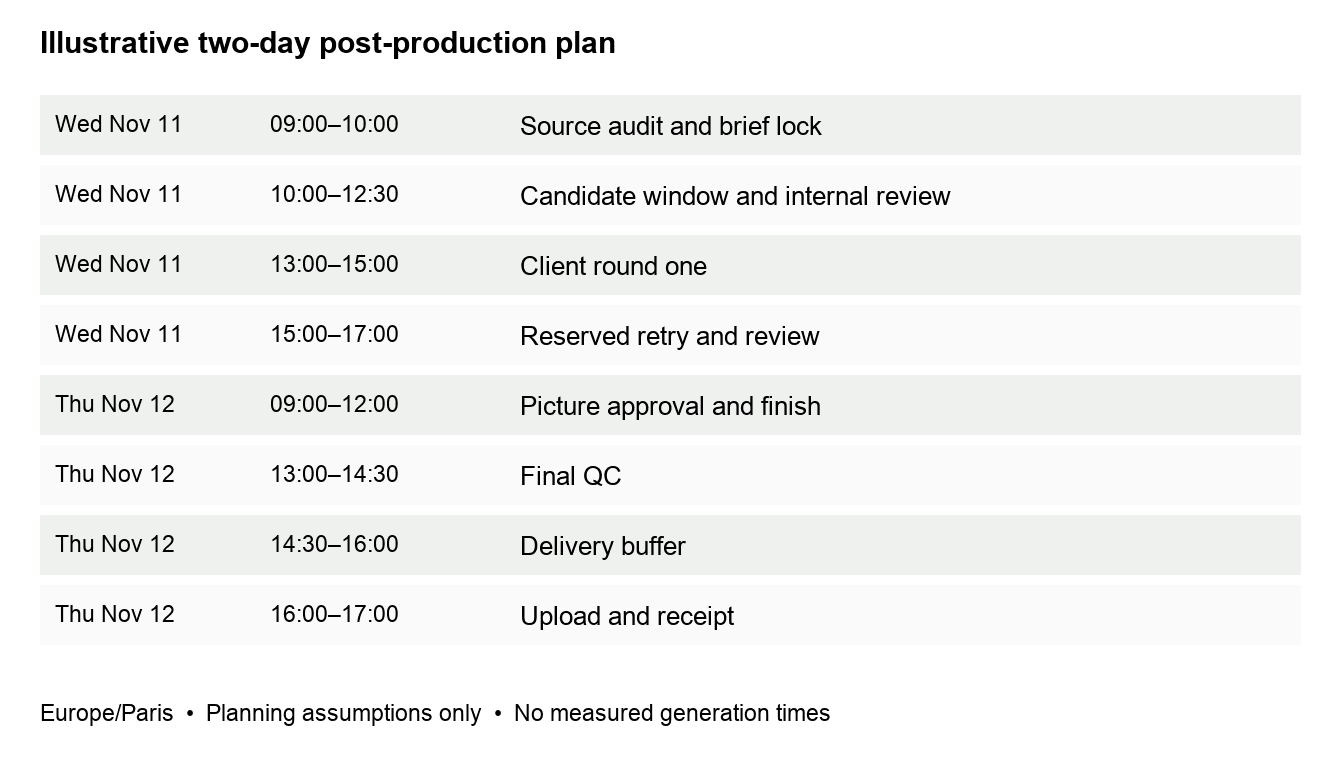
Figure 1. The completed example separates candidate work, feedback, a reserved retry and final delivery checks. Times are illustrative planning windows, not measured test results.
The critical dependency chain is brief lock → candidate → internal review → client response → revision or acceptance → picture approval → finishing → QC → delivery. The retry window is conditional. If v01 is approved, keep that time as protection rather than automatically generating another version.
Set revision limits before opening review
A useful revision agreement states how many rounds are included and what each round covers. In the example, round one addresses the agreed local change. The reserved attempt addresses consolidated notes on that change. A new camera angle, new performance or new product variant is a scope change that needs a revised plan.
Rule for the example | Decision owner | Action when the rule is exceeded |
One client approver consolidates feedback | Producer | Resolve conflicting notes before revising |
Round-one feedback due Wednesday at 15:00 | Client approver | Producer reforecasts approval and delivery; no assumed acceptance |
One reserved retry window | Producer and editor | Choose a usable fallback, controlled repair or revised deadline |
Picture locked Thursday at 10:00 | Client approver | Later visual changes reopen finishing and QC dependencies |
Buffer covers delivery defects | QC owner | New creative requests require a separate estimate |
Review systems can keep feedback attached to a specific version. Adobe’s Frame.io review workflow is one documented example. [2] Whatever tool you use, put the version ID in the approval message. “Looks good” without a file reference can leave two different candidates in circulation.
Budget for a retry without inventing a cost
Keep a separate allowance for generation, operator work and finishing. If one candidate generation is planned and one additional generation is reserved, the allowance is up to two candidate-generation runs. A retry may also require fresh review and a new export; those tasks belong in the schedule even if the model’s job itself is short.
Use this planning equation with your own current rates: allowance = initial generation quote + reserved generation quote + operator time + review time + finishing and delivery time. Quotes and actual charges are separate records. Do not convert an interface credit quote into a cash cost unless the applicable plan and conversion are known.
The example above supplies no currency amount because no project rate card or actual-charge record was provided. Its useful commitment is the review and fallback boundary, rather than an invented total.
Reforecast delays instead of hiding them in the buffer
When a task slips, update every dependent gate. If client notes arrive after the reserved retry window, ask the producer to choose among three concrete options: move delivery, reduce the requested change or use the approved fallback. Do not silently consume final QC time.
If a candidate changes the performance, duration or required product detail, reject it before client approval. A local repair may be quicker to schedule than another broad generation, but that is a project decision to estimate, not a general speed claim.
Keep final QC separate from candidate review. Candidate review asks whether the change is right. Final QC asks whether the actual exported master is the approved, technically correct file. An export mistake can occur after picture approval.
Delivery handoff checklist
Before marking the final row Delivered, confirm that the recipient has the approved master, a convenient review copy, the correct version ID and a short change record. Record the export specifications from the delivery brief and the actual file. Keep editable project files and source media according to the project’s agreement.
If video publishing is a separate task, give it its own owner and deadline. Uploading a review file is not proof that the website or campaign placement has been published correctly.
Frequently asked questions
How much retry buffer should I add
Base it on the task’s uncertainty and the available fallback. The example reserves one revision window; it is a planning assumption, not a benchmark. Complex contact, reflection or identity work may need a different allowance or method.
Can feedback and finishing overlap
Only when the producer accepts the rework risk and defines what can safely proceed. Do not treat an unapproved visual candidate as a locked master.
What if the client misses the approval deadline
Record the missed dependency and issue a revised schedule. Time passing is not approval, and the original delivery deadline should not remain an unqualified commitment.
Should every generated candidate go to the client
No. An internal check should reject obvious defects and specification mismatches first. Send a clearly identified candidate that is ready for a meaningful decision.
Sources and planning scope
This is a reusable planning template and a fully filled illustrative example. It contains no claimed real-project timings, charges, client feedback or completed delivery. Dates and roles are examples; replace them before using the schedule as a commitment.
[1] TeamGantt guide to video production schedules, checked November 11, 2026. General scheduling context; the AI revision gates and example are author recommendations.
[2] Adobe guide to team review with Frame.io, checked November 11, 2026. Referenced for version-specific collaborative review, not as a claim that Astorie provides a scheduling or approval system.
Ready to try it on the canvas?
Open Astorie and fan your prompt across every frontier model in one workflow.