

Seedance 2.5 vs Seedance 2.0 Hands-On Test: Which Model Is Better?
Seedance 2.5 gave us the more natural person in this five-second test; Seedance 2.0 gave us the faster and cheaper mechanical test. The 2.0 clip made the flywheel, steam, and push-in easier to see, but the inventor looked less natural. I preferred the 2.5 clip because her breathing, posture, and pace felt closer to a real person.

Key takeaways
Seedance 2.5 produced more natural breathing, posture, and pacing in this character-led test.
Seedance 2.0 produced faster mechanical motion, stronger steam, and a more pronounced camera push-in.
Seedance 2.0 generated faster and displayed a substantially lower credit cost in this Astorie run.
Seedance 2.5 stayed closer to the original pose, clothing, face, and machine details.
This was one five-second 480p test, so the findings are useful observations rather than a universal benchmark.
Seedance 2.5 vs Seedance 2.0: Results at a Glance
I ran both generations in Astorie from the same source image and copied the same prompt into both nodes. Each clip used 16:9, 480p, and five seconds; Seedance 2.0 used its Standard setting. The model version was the only planned change.
| Test area | Seedance 2.5 | Seedance 2.0 |
|---|---|---|
| Human movement | More natural breathing and pacing | More visible movement, but less natural |
| Mechanical motion | Controlled and relatively subtle | Faster flywheel and stronger steam |
| Source consistency | Closer to the original pose and scene | More change in pose and machine details |
| Generation time | About two minutes | About thirty seconds |
| Displayed job cost | 180 credits | 57 credits |
| Best fit from this test | Character realism and final-quality shots | Fast iterations and lower-cost tests |
Seedance 2.5 vs Seedance 2.0: What Changed Officially
ByteDance's official launch notes position Seedance 2.0 as a multimodal audio-video model built around motion stability, physical accuracy, and controllable generation. It accepts text, images, audio, and video as references, with support for up to nine images, three video clips, and three audio clips. The official release also supports up to 15-second multi-shot output.
Seedance 2.5 keeps that multimodal base but expands the production scope. ByteDance lists up to 30 seconds in a single generation, stronger continuity across longer sequences, and a larger reference pool of up to 30 images, 10 video clips, and 10 audio clips. Its release notes also highlight timestamp-based edits, green-screen work, camera-perspective changes, and multi-round extensions.
Those published upgrades give 2.5 more room for longer, reference-heavy, and editing-intensive work. Seedance 2.0 still covers the basic image-to-video task used in this test. Platform controls can vary, so the comparison below only describes the options available in Astorie when I ran it.
How I Set Up the Seedance 2.5 vs 2.0 Test
The source image showed a steampunk inventor beside a brass engine. The shot was useful for comparison because it combined a hand-to-object action, a change in gaze, moving machinery, steam, and a camera move in five seconds.
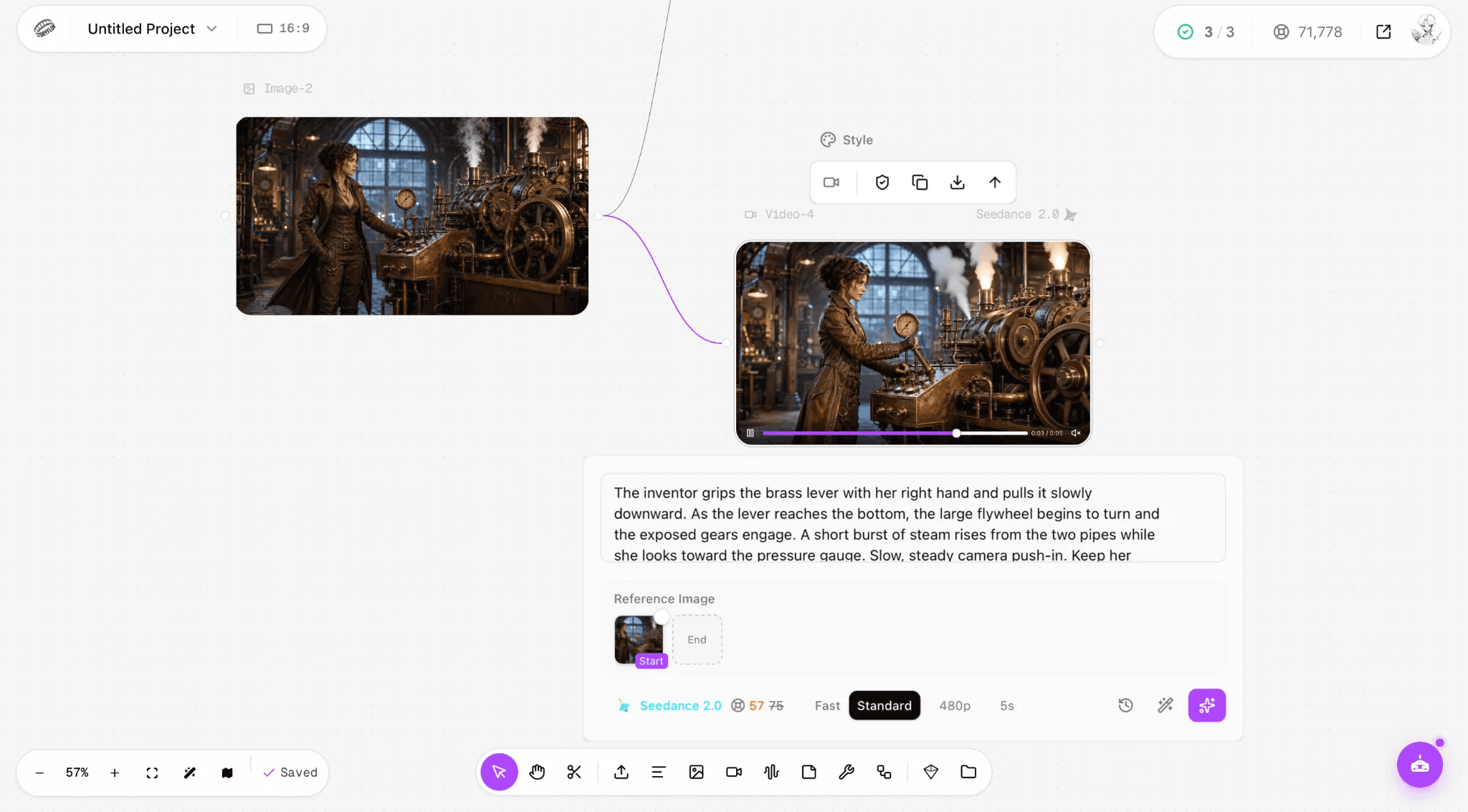
I generated two five-second clips using the following prompt. It is included in full because the wording is part of the test, not a detail that can be reconstructed from a cropped screenshot.
Prompt used for both generations:
The inventor grips the brass lever with her right hand and pulls it slowly downward. As the lever reaches the bottom, the large flywheel begins to turn and the exposed gears engage. A short burst of steam rises from the two pipes while she looks toward the pressure gauge. Slow, steady camera push-in. Keep her face, hands, clothing, machinery, lighting, and the original steampunk style consistent. Smooth, realistic mechanical motion.
| Setting | Seedance 2.5 | Seedance 2.0 |
|---|---|---|
| Source | Same Image-2 | Same Image-2 |
| Prompt | Identical | Identical |
| Aspect ratio | 16:9 | 16:9 |
| Resolution | 480p | 480p |
| Duration | 5 seconds | 5 seconds |
| Model setting | Omni input mode | Standard quality |
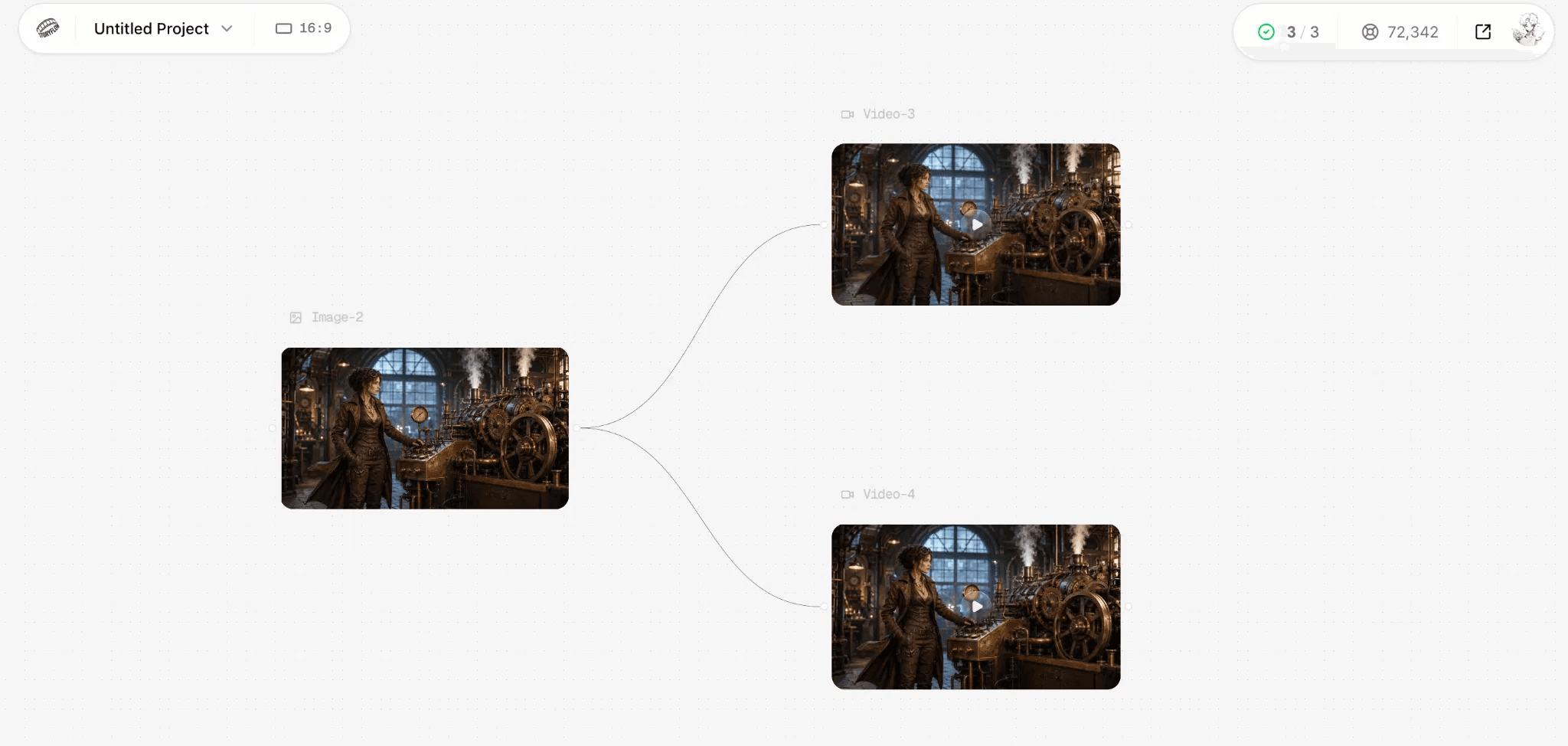
One source image feeding the completed Seedance 2.5 and Seedance 2.0 video nodes on the same Astorie canvas.
Seedance 2.5 and Seedance 2.0 Test Settings
The Seedance 2.5 node used Omni, while the Seedance 2.0 node used Standard. Both jobs used the same image and prompt at 16:9, 480p, and five seconds.
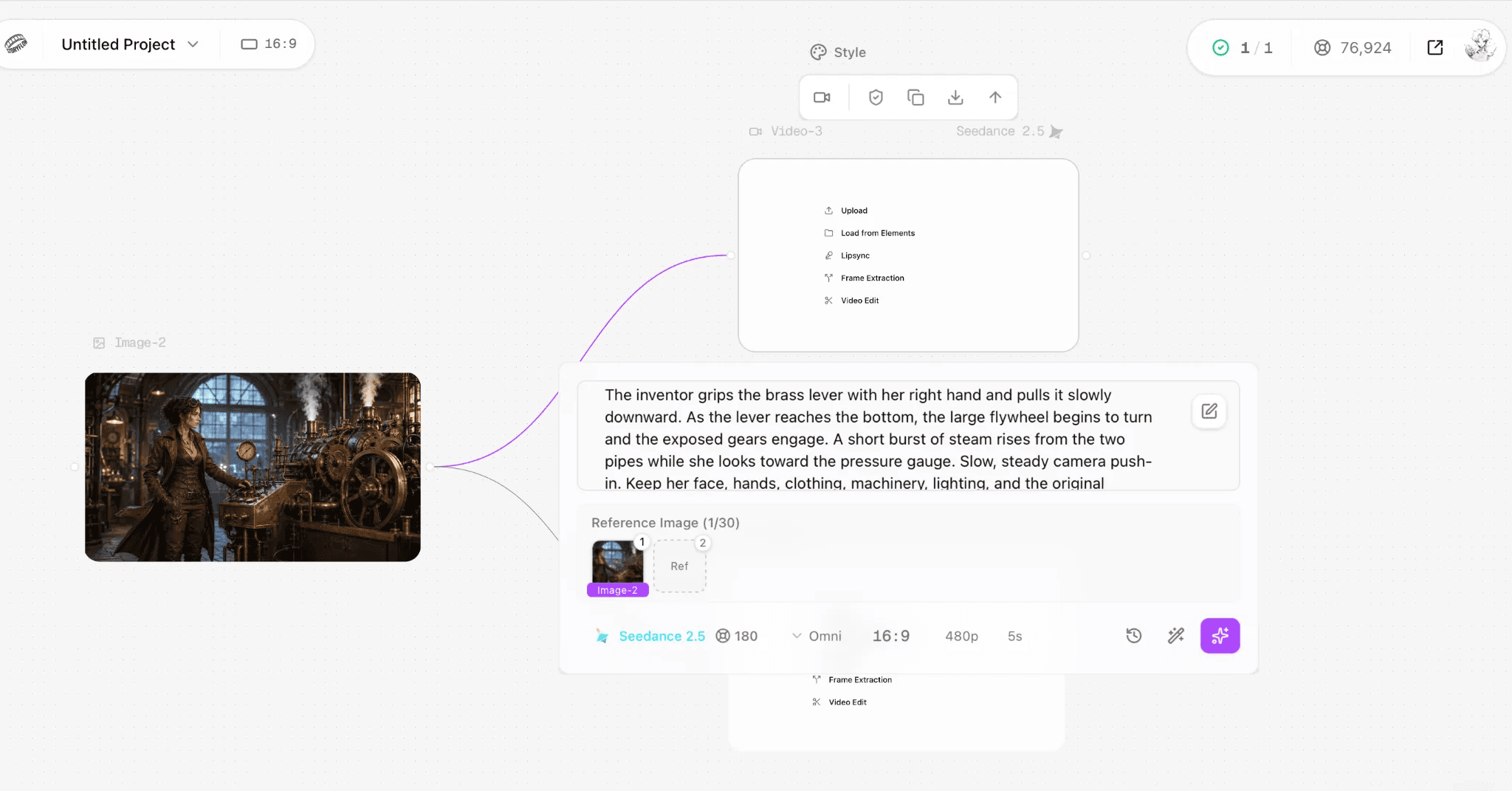
The Seedance 2.5 setup before generation: the shared source image and prompt, 16:9, 480p, five seconds, and a displayed cost of 180 credits.
For Seedance 2.0, I selected Standard rather than Fast. That kept the test on its regular quality setting instead of the lower-cost speed mode.
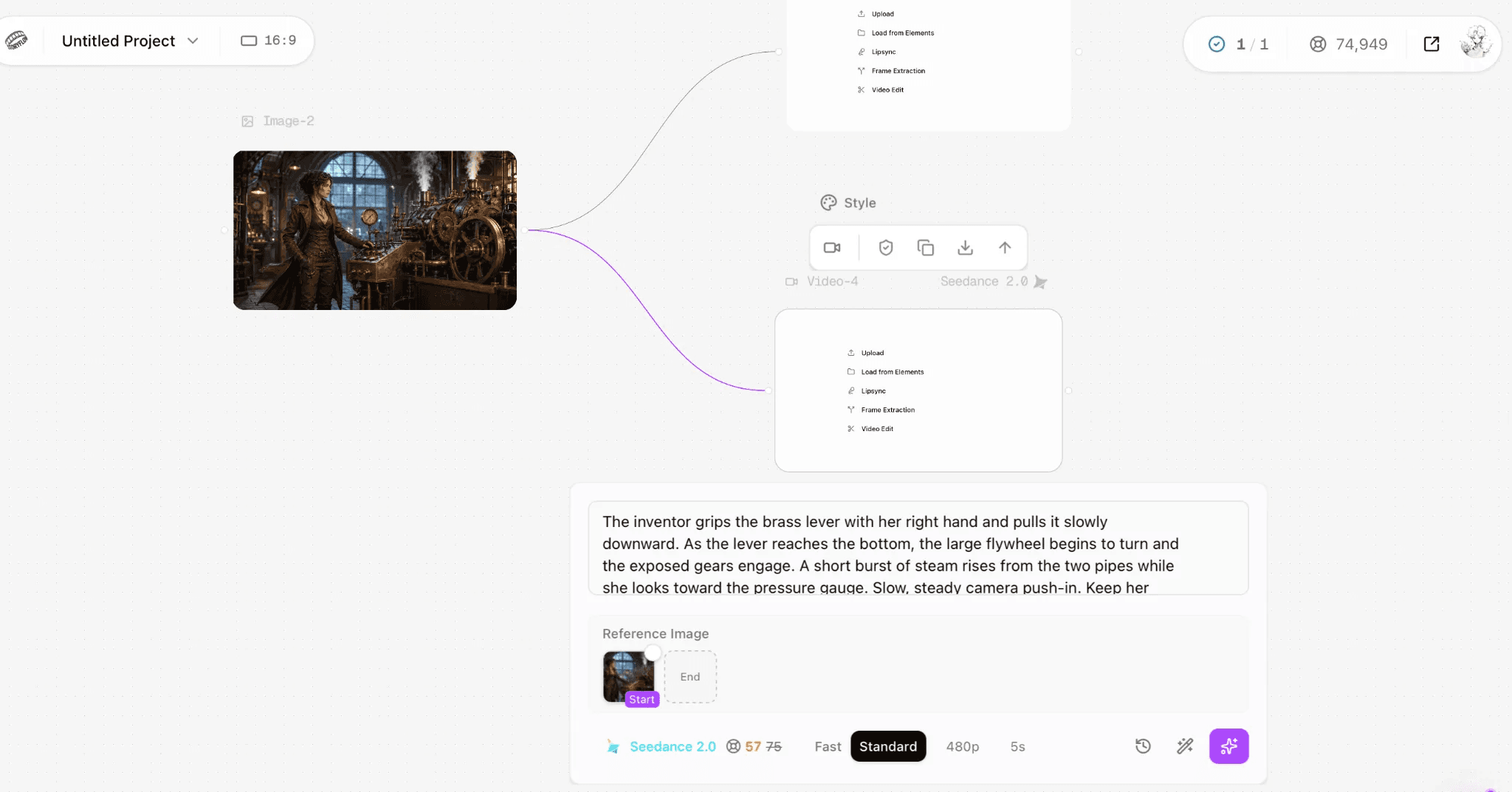
The Seedance 2.0 setup used Standard quality with the same source, prompt, 16:9 format, 480p resolution, and five-second duration.
What Seedance 2.5 Did Better in This Test
Seedance 2.5 made the inventor feel more like a person. I could see a small breath and a gradual change in posture, and the push-in moved at a believable pace. Her face, clothing, and the machine stayed close to the source. This was the clip I preferred.
It was less decisive with the machinery. The lever pull was hard to read, and the flywheel and steam were quieter than in the 2.0 clip.
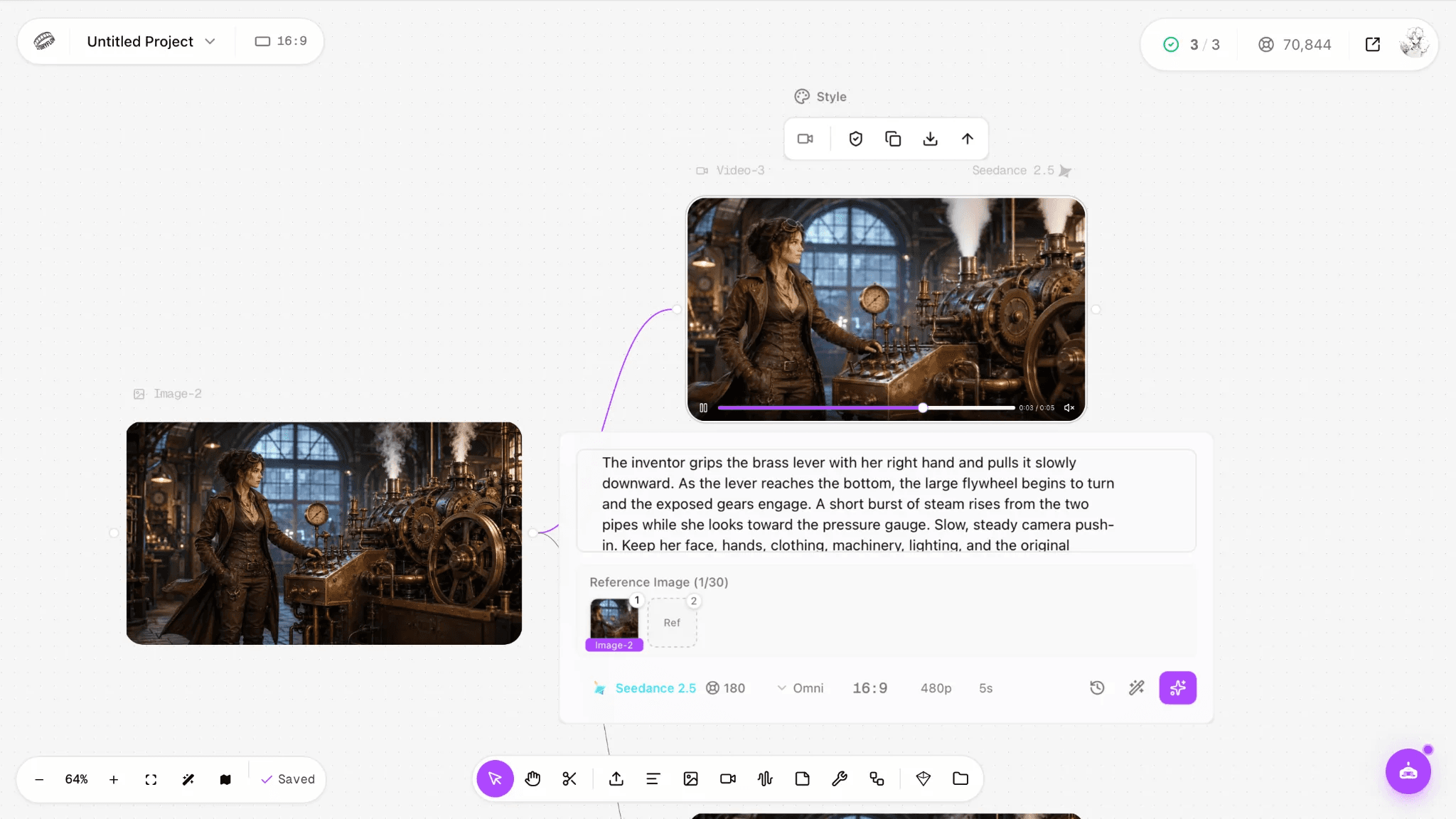
Seedance 2.5 at approximately three seconds: the push-in is visible while the character, clothing, and machine remain close to the source frame.
What Seedance 2.0 Did Better in This Test
Seedance 2.0 made the requested machinery easier to notice. The flywheel turned faster, the steam burst was stronger, and the camera push-in was more pronounced.
The inventor was less convincing. Her body turn and arm movement looked stiff, and the contact between her hand, the lever, and the nearby controls changed as the shot developed.
Seedance 2.0 at approximately three seconds: the flywheel, steam, and character action are more pronounced, but the pose and control interaction change more substantially.
Should You Use Seedance 2.5 or Seedance 2.0?
Based on this test, choose Seedance 2.5 when:
- The person is the focus of the shot.
- Natural breathing, posture, and pacing matter more than dramatic movement.
- You are preparing a result that is closer to a final take than a rough motion test.
Based on this test, choose Seedance 2.0 when:
- You need to test an idea quickly or try several prompt variations.
- Credit cost matters more than subtle character performance.
- The shot needs obvious object, steam, or camera movement.
Limits of This Comparison
This was one five-second image-to-video test at 480p with one image and one prompt. Another subject, seed, or generation attempt could change the result. The findings apply to this mixture of human motion, machine interaction, steam, and camera movement; they are not a universal benchmark.
Frequently asked questions
- Is Seedance 2.5 always better than Seedance 2.0?
No. Our character-led shot favored 2.5, but another subject or motion brief may favor 2.0. Run the short test that matches the shot you actually need.
- Is Seedance 2.0 cheaper than Seedance 2.5 in Astorie?
Yes, in this run. The displayed price for the Seedance 2.0 job was less than one-third of the Seedance 2.5 job. Check the live node because prices and discounts can change.
- Which model generated faster?
Seedance 2.0 finished first in this run. The exact queue time can change with demand, so the observed times in the results table are not service guarantees.
Related reading
Seedance 2 Handbook: Variants, Best Workflows, and How to Use It on Astorie
Hands-on guide to Seedance 2 — variants, strengths, and the production workflows it fits on Astorie's canvas.
GPT Image 2 Guide: Workflows, Strengths, and Where It Fits on Astorie
How GPT Image 2 fits product, text, and reference image workflows on Astorie's multi-model canvas.
Nano Banana 2 Workflows for Multi-Image Reference and Character Consistency
Multi-image reference and character consistency workflows on Astorie using Nano Banana 2.
Ready to try it on the canvas?
Open Astorie and fan your prompt across every frontier model in one workflow.