

Shot Reverse Shot: Examples and How to Build a Dialogue Scene
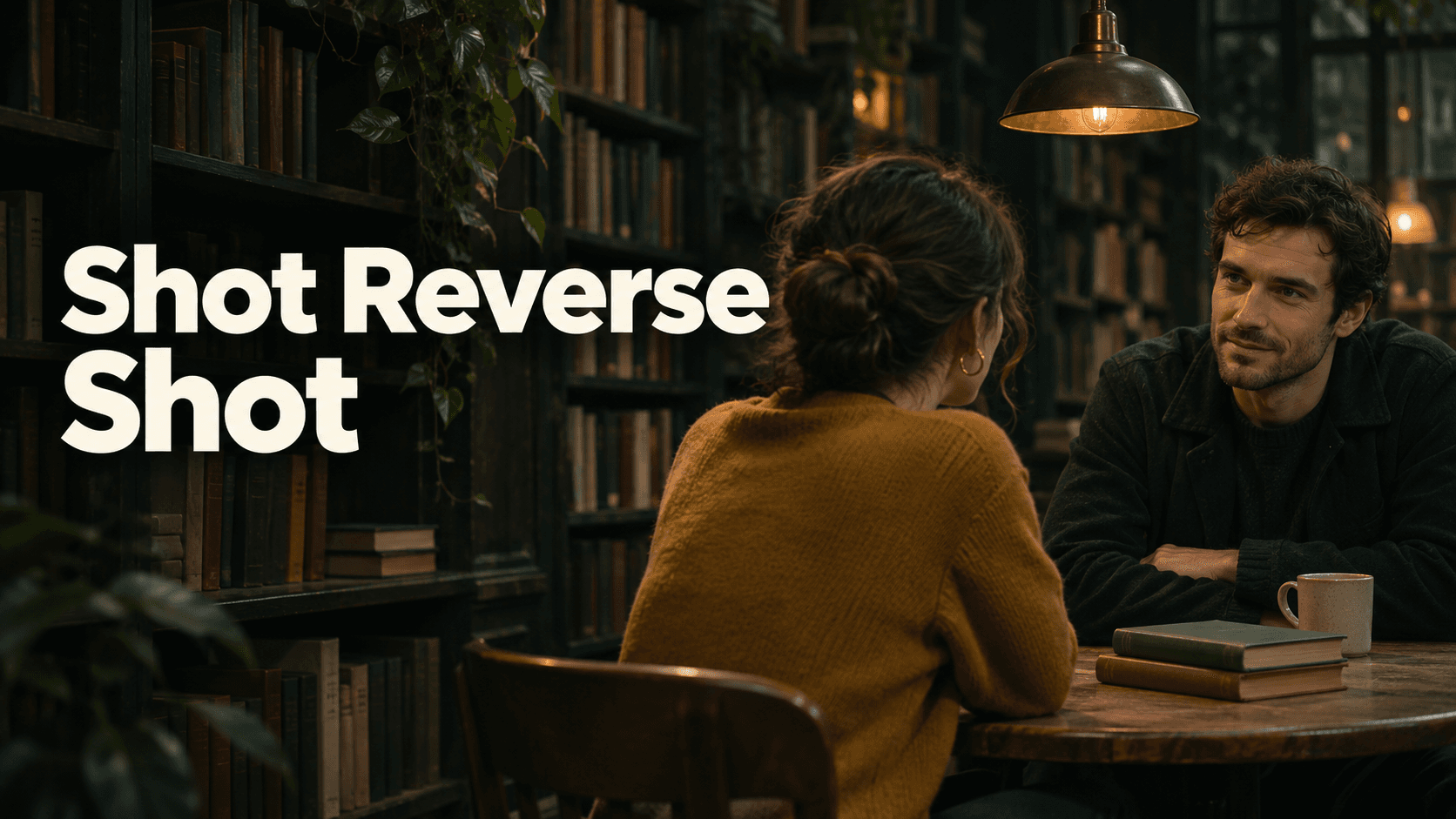
Shot reverse shot alternates between related views of two people, usually a speaker and a listener. The reverse view shows the other side of the exchange, while screen direction, eyelines and performance help the audience understand that both people share the same space.
Start with clear scene geography, prepare complementary singles, then choose the cuts around the exchange. AI can supply missing coverage from a shared visual brief; a convincing first frame alone cannot establish a coherent dialogue scene.
What shot reverse shot looks like
A common pattern is a master showing both people, a single of person A, then a single of person B. The editor may return to either person several times. The listener can remain onscreen during the other person’s line, so the technique is more than switching to whoever is speaking.
Clean singles exclude the other actor. Over-the-shoulder views retain part of the near actor as a spatial cue. Either can work if the reverse angles describe a plausible relationship. “Reverse” does not mean horizontally flipping a clip or simply placing the camera on the opposite side of the action axis.
Coverage | What it contributes | Check before cutting |
|---|---|---|
Master / two-shot | Establishes positions, distance and shared props | Can the viewer tell who sits where? |
Person A single | Shows A’s speech, reaction or attention | Does the look point toward B’s established position? |
Person B reverse | Supplies B’s side of the exchange | Do direction, target and action remain compatible? |
Return or reaction | Changes emphasis or lets a response land | Does the cut add a story beat rather than arbitrary alternation? |

Figure 1. Shared bookstore reference reused from Clara’s earlier eyeline exercise: woman screen-left, man screen-right, with the table and red book between them.
Keep the axis and the eyelines readable
Imagine a line joining the two actors. Keeping the camera positions on one side usually preserves their screen relationship across the singles. In the bookstore reference, the woman’s attention should generally lead toward screen right, and the man’s toward screen left.
This is the convention described by the Columbia Film Language Glossary’s 180-degree rule. A deliberate axis crossing can be expressive, but an accidental crossing can make the pair appear to swap positions. Establish the new relationship when you intentionally change it.
Direction and target height are separate checks. Two actors can look in reciprocal directions yet appear to look above one another. Matching the vertical position of their eyes on a screen ruler does not reconstruct the three-dimensional eyeline. The eyeline match examples cover that narrower diagnosis.
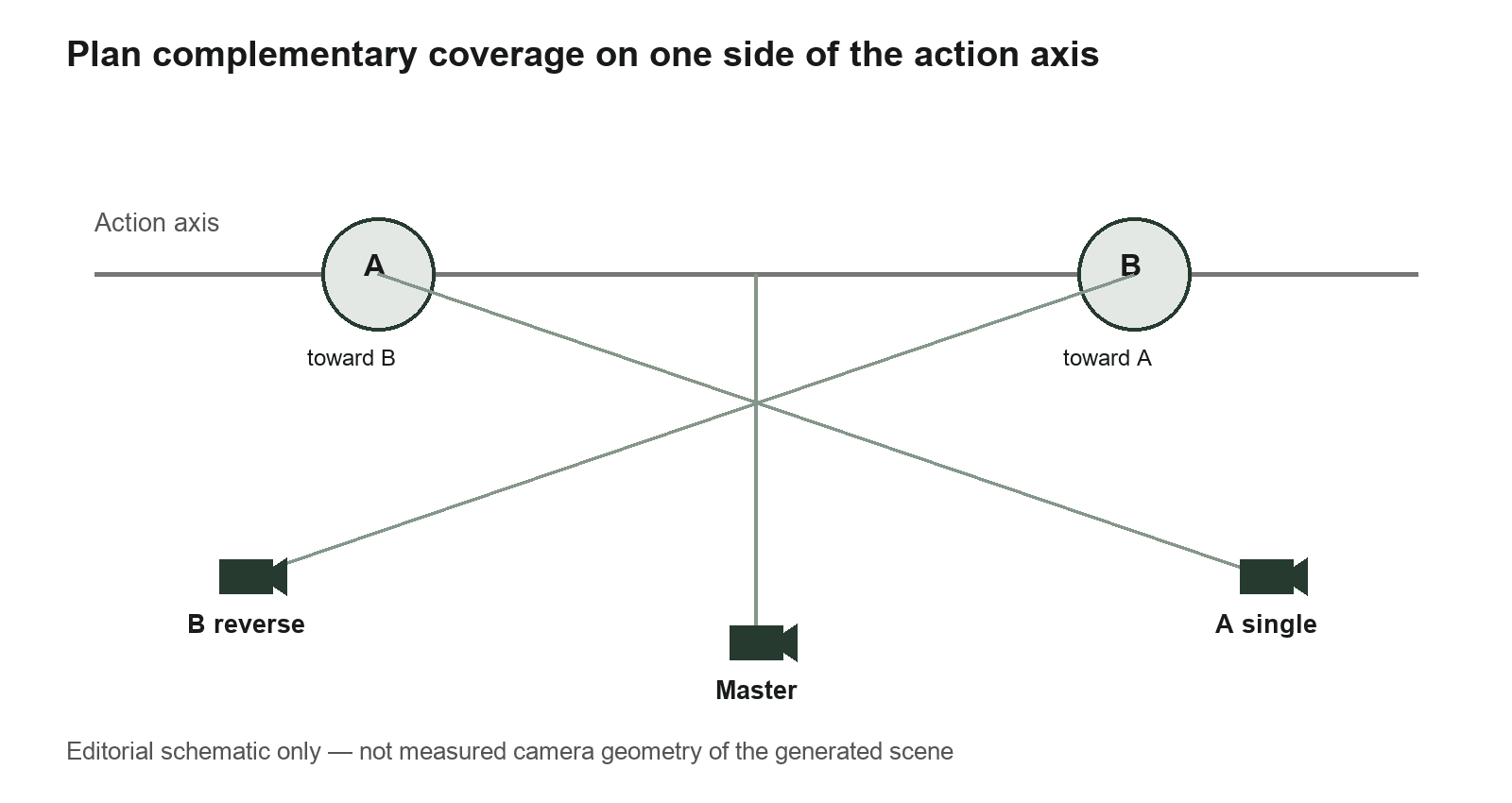
Figure 2. Coverage-planning schematic showing two actors and camera positions on one side of an action axis. This is an editorial diagram, not a reconstruction of the generated bookstore’s camera geometry.
Build the coverage brief before generating
Write down actor identity, wardrobe, seating, the shared prop, light direction and intended look targets. Describe the person’s screen position as well as the partner they should face. Avoid an instruction such as “look the other way,” which can refer to actor-left, camera-left or screen-left.
Use one shot to establish the relationship before asking for closer coverage. When preparing multiple AI shots, keep the reference assets and character descriptions available in the same project. The connected-shot planning guide explains that broader preparation; this article concentrates on the master and reverse views.
The bookstore case and the actual model route
Clara already had two Kling O3 singles from the earlier exercise. Rather than regenerate both, she supplied one new five-second master using Seedance 2.0. The visible node used Standard, 720p and 5s, with the image in the Start slot and the End slot empty. The full original Start Frame prompt and one-run count were confirmed by Clara.
The earlier planning suggestion named another model; it is the executed node and confirmation that determine the test record. These three clips are coverage candidates from different generations, not synchronized performances or a model-quality comparison.
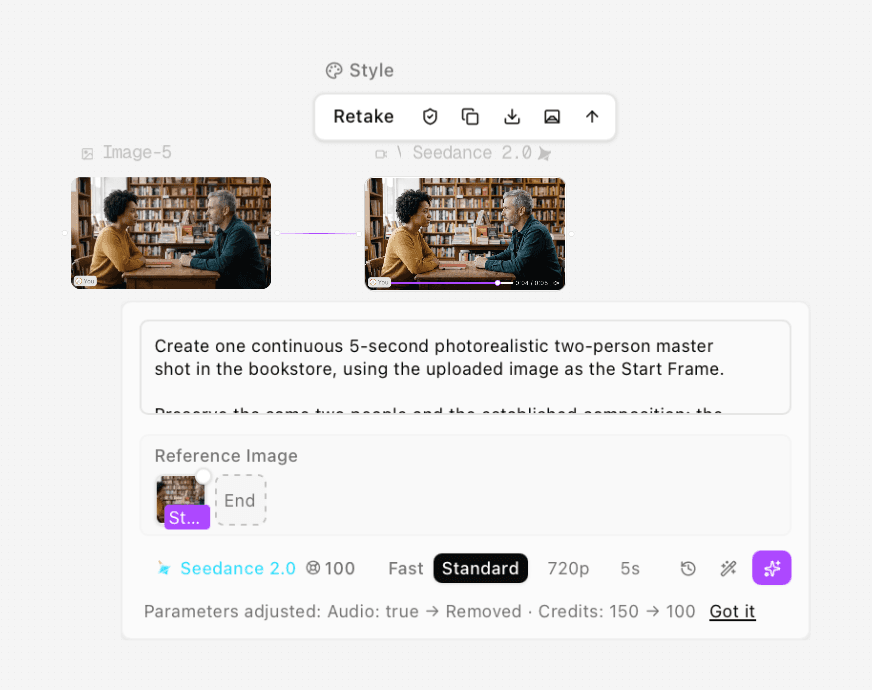
Figure 3. Clara’s actual master-shot run: Seedance 2.0 Standard, 720p and 5s, with a Start image and empty End slot. The displayed quote was 100 credits; actual itemized charge was not verified.
Original master-shot prompt confirmed by Clara
Create one continuous 5-second photorealistic two-person master shot in the bookstore, using the uploaded image as the Start Frame.
Preserve the same two people and the established composition: the woman with short natural curly hair and a mustard sweater sits on screen left, facing right toward the man; the gray-haired, bearded man in a dark teal shirt sits on screen right, facing left toward the woman. Keep their facial features, ages, hairstyles, clothing and seated positions recognizable. Both remain visible together across the wooden table.
They quietly hold their attention on each other's face at seated eye level, with only natural blinks, subtle breathing and very small relaxed facial movements. Keep their mouths relaxed and closed. Keep their forearms resting on the table. The closed red notebook and black pen remain stationary between them; neither person picks anything up or makes a large hand gesture.
Use a locked-off eye-level camera on the same side of the table as the starting image. Maintain the left-right relationship, soft window light from the left, warm wooden shelves and consistent exposure. No camera movement, zoom, reframing, cuts, angle changes or focus pulls. Do not mirror the image, swap the people, add another person, change the props, or add text, logos or watermarks.
Run and retain the complete master
In a canvas Video node, choose the actual model and available input mode, supply the shared two-person image in the Start slot, leave the End slot empty for this case, and enter the complete shot brief. Confirm the displayed parameters before generating once. After completion, inspect the preview and download the full MP4 from the video toolbar.
Check that both actors retain their sides and that the book and table remain plausible. Keep a separate record of requested duration and downloaded duration. This master is about 5.042 seconds at 1280×720 and 24 fps.
New Seedance 2.0 Standard master generated by Clara from the shared bookstore Start image; complete original output.
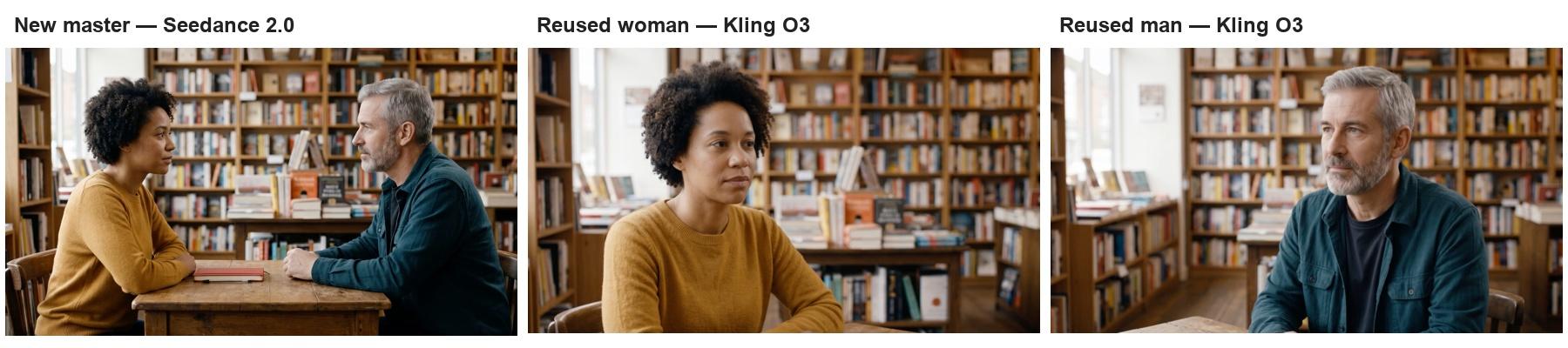
Figure 4. First sampled frames from the new master and the two reused singles. The layout compares coverage; it is not a timed cut, exact geometry measurement or proof of performance synchronization.
Reused Kling O3 woman single from Clara’s earlier eyeline test. Later samples include an upward glance, so the whole clip is not automatically approved for this exchange.
Reused Kling O3 man single from Clara’s earlier eyeline test. A bright foreground intrusion appears in later samples around 4–5 seconds.
Choose the cut from the moving clips
Use the master to establish geography, then audition a reaction or line in each single. Check the last frames before the outgoing cut and the first frames after the incoming cut. Faces, hands, book position, gaze target and head movement should connect in a way the scene can support.
Candidate | What the samples show | Proposed next editing check |
|---|---|---|
Master | Both actors keep broad left/right placement | Audition an opening interval around 0–2s |
Woman single | Early rightward attention; upward glance around 3–3.5s | Audition an early interval around 0–2.5s |
Man single | Early leftward attention; later lower-left intrusion | Audition an early interval around 0–2.5s |
Those ranges are approximate selections from half-second samples, not exact approved trims. No assembled conversation, dialogue track, lip-sync pass or final cut was made in this test. The old singles are 1284×716, while the new master is 1280×720; conform separate editing copies to a chosen timeline without overwriting originals.
For an example exchange, a master could establish the table, the woman’s single could hold a question, and the man’s reverse could hold a response. This is an editorial plan, not dialogue that these clips were proven to perform. Let the intended exchange determine whether to cut on a line, hold on a listener or return to the master.
Fix the smallest incompatible part
If a look drifts only near the end, first inspect whether a compatible earlier segment serves the beat. If the pair’s relationship remains unclear, add an establishing view. If no usable range exists, replace the affected shot with a brief that states the correct target and preserved scene anchors.
Reusing two supplied singles and adding one master avoided requesting all coverage anew in this case. It did not prove that one prompt can finish a conversation or that the platform automatically edits dialogue. Timing, sound, conforming and approval remain manual editorial decisions.
Frequently asked questions
Does shot reverse shot require two cameras?
No. It describes the relationship between views in the edit. A filmed scene can be covered in separate setups; independently generated AI shots also need matching geography and performance checks.
Is an over-the-shoulder shot the same thing?
An over-the-shoulder shot is one framing option. Shot reverse shot is the alternating relationship between views and can use clean singles or over-the-shoulder coverage.
Should I flip a shot to fix screen direction?
Check the scene first. A flip also reverses wardrobe details, props, text and light direction. Reframing or replacing a shot may be more appropriate.
Can these AI clips become a finished talking scene?
They provide visual coverage candidates. This test does not establish spoken dialogue, lip synchronization, complete movement continuity or a finished sound mix.
Test method and sources
Clara confirmed one unchanged run of the original master prompt. The master and two reused singles were received or recovered and checked on November 17, 2026. All three files decoded to 121 frames at 24 fps and about 5.042 seconds. Eleven frames per clip were visually sampled at 0.5-second intervals. No complete normal-speed performance or audio listening review was conducted. The master contains one audio track; the reused singles contain none.
The general continuity explanation follows the Columbia glossary’s eye-line match definition and its axis convention cited above. All generation observations are limited to the supplied bookstore files.
Ready to try it on the canvas?
Open Astorie and fan your prompt across every frontier model in one workflow.