GPT Image 2 prompts

Browse GPT Image 2 prompts for fashion portraits and graphic compositions. Compare how each prompt describes its subject and the way the image is arranged.

Explore prompts

10,039 prompts

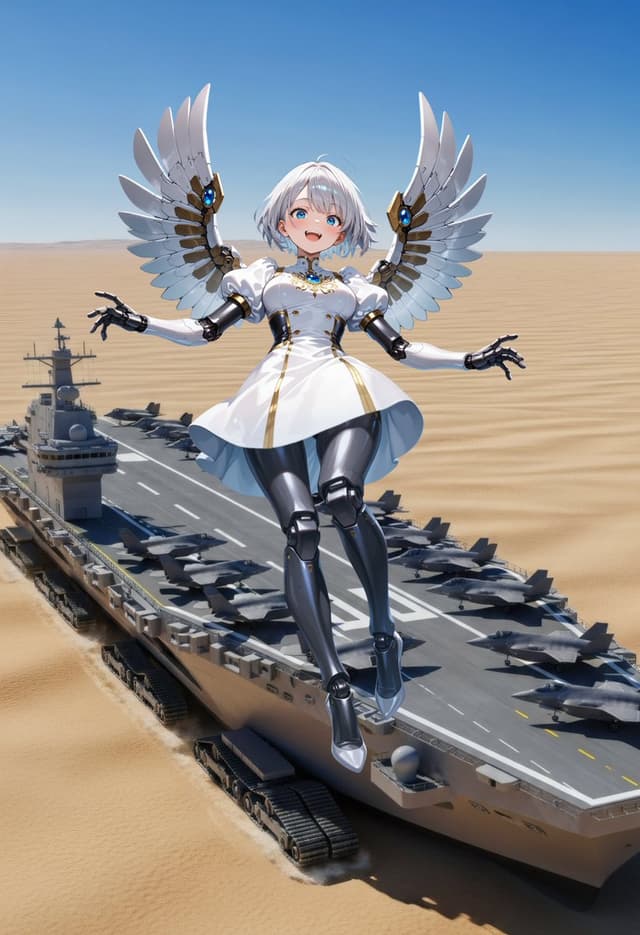
Comic / Storyboard - Angelic Android Over Land Aircraft Carrier — output

Comic / Storyboard - Angelic Android Over Land Aircraft Carrier

さとーGPT Image 2
Create a vertical 2:3 cinematic anime-style image of a futuristic angelic android girl hovering in front of a colossal land aircraft carrier driving across an endless desert. The main subject is {argument name="character name" default="an unnamed angelic android girl"}: a pale, slim young female cyborg with a short silver-white bob haircut, faceless or softly obscured face, floating pose, arms extended outward, black segmented mechanical forearms and hands, glossy black robotic legs, and a white puff-sleeved dress with gold trim, gold buttons, a flared skirt, and small blue jewel ornaments at the collar and chest. She has exactly 2 large mechanical feathered wings, one on each side, made of layered white and silver metal feathers with bronze inner struts and glowing blue circular cores near the shoulder joints. Behind and below her is exactly 1 gigantic tracked aircraft carrier adapted for desert travel, with a gray flight deck, white runway markings, an island superstructure on the left side, tan hull sides, and many heavy caterpillar tracks grinding through sand. On the carrier deck show exactly 12 dark gray stealth fighter jets parked in orderly rows along both sides of the runway, their shadows visible on the deck. The environment is a vast golden sand sea with subtle dune ripples stretching to the horizon under a clear blue sky. Use dramatic daylight, sharp shadows, realistic 3D rendering mixed with polished anime character design, high detail, clean composition, wide-angle perspective from above and in front of the carrier, with the android centered large in the frame and the land carrier receding diagonally from lower left to middle right. Emphasize the relationship between the hovering winged android guardian and the enormous desert aircraft carrier. No text, no watermark, no extra characters.
Infographic / Edu Visual - Japanese GPT Image 2 Swimsuit Report Poster — output

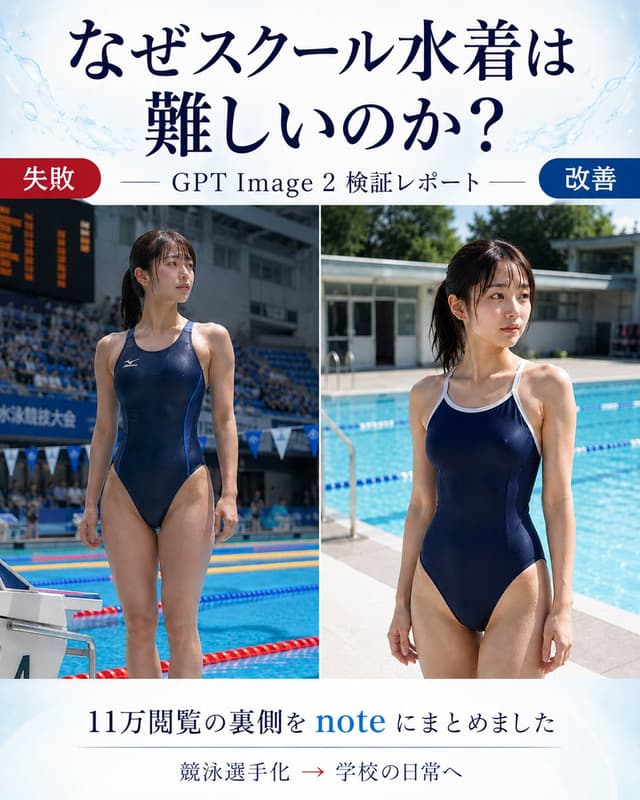
Infographic / Edu Visual - Japanese GPT Image 2 Swimsuit Report Poster

千田結穂(せんだゆいほ)GPT Image 2
Goal: Create a vertical Japanese promotional comparison poster for an article about why generating a school swimsuit is difficult in GPT Image 2, showing a before/after visual test report.

Canvas: Portrait 4:5 layout, clean editorial blog-thumbnail design, white background with pale blue watercolor splashes and subtle pool-water motifs near the top corners. Use elegant dark navy Japanese serif typography.

Header: Large centered headline text in Japanese: 「なぜスクール水着は 難しいのか?」 with the line break after 「は」. Below it, add a thin horizontal rule on both sides of the subtitle 「GPT Image 2 検証レポート」.

Main layout: Two large side-by-side photo panels separated by a thin white vertical divider. Use exactly 2 comparison images: left panel labeled as failure, right panel labeled as improvement. At the top-left of the image area, place a rounded red pill label reading 「失敗」. At the top-right, place a rounded blue pill label reading 「改善」.

Left photo panel: A realistic full-body poolside photo of an adult woman in a navy one-piece competitive racing swimsuit, standing at an indoor or stadium-like competition pool. Make it look like a sports meet or swimming competition: spectator stands, scoreboard, lane ropes, starting block, and official competition atmosphere. Her face should be intentionally obscured with a rectangular blur/mosaic block. The pose is upright and athletic, emphasizing that the generation became too much like a competitive swimmer.

Right photo panel: A realistic full-body poolside photo of an adult woman in a navy one-piece school-style swimsuit with white trim and shoulder straps, standing beside a bright outdoor school pool in daylight. Background includes blue pool water, lane ropes, pool deck, low school-building architecture, and greenery. Her face should also be intentionally obscured with a rectangular blur/mosaic block. The mood is casual school daily life rather than sports advertising.

Footer: Centered Japanese text in dark navy: 「11万閲覧の裏側を note にまとめました」 with the word “note” in bright blue. Under it, add a small line of text: 「競泳選手化 → 学校の日常へ」 with the arrow in red. Use a faint divider line above the small text.

Visual style: Realistic photography in the two panels, magazine/article cover composition, high contrast between the failed sports-ad look and the improved school-pool daily-life look. Keep the design polished and readable, with no extra logos or watermarks.

Customizable slots: Article headline may be {argument name="headline text" default="なぜスクール水着は難しいのか?"}; subtitle may be {argument name="subtitle text" default="GPT Image 2 検証レポート"}; left label may be {argument name="left label" default="失敗"}; right label may be {argument name="right label" default="改善"}; footer text may be {argument name="footer text" default="11万閲覧の裏側を note にまとめました"}.
Infographic / Edu Visual - Japanese Okonomiyaki Recipe Card — output

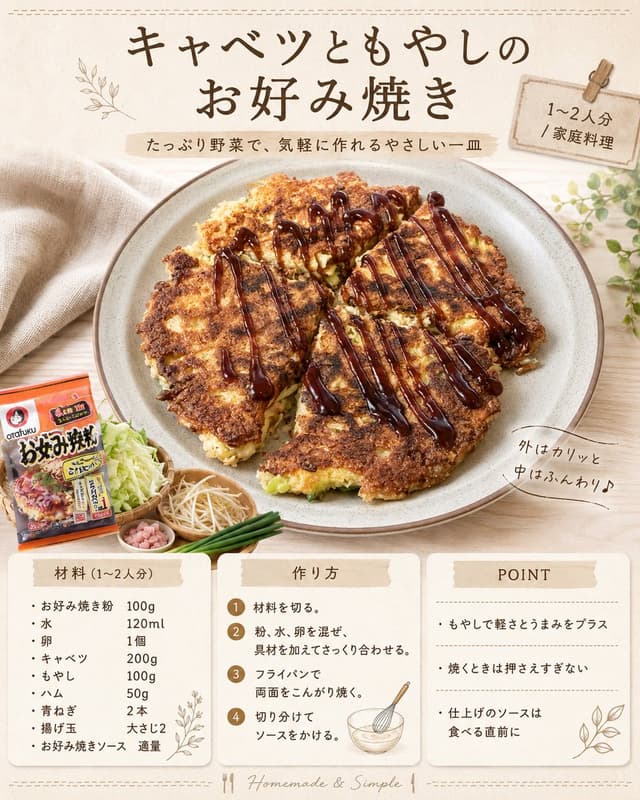
Infographic / Edu Visual - Japanese Okonomiyaki Recipe Card

Maki@Sunwood AI Labs.GPT Image 2
Goal: Create a cozy Japanese one-pan recipe card for {argument name="dish title" default="キャベツともやしのお好み焼き"}, showing a finished homemade cabbage-and-bean-sprout okonomiyaki as an appetizing magazine-style recipe image.

Canvas: Square 1:1 layout, warm beige paper background with subtle texture, light wooden tabletop, soft natural daylight, handmade café aesthetic. Add thin stitched/dashed decorative border lines near the top and bottom edges.

Main layout: Large centered hero food photo occupying the upper-middle area: a round ceramic plate holding one golden-brown okonomiyaki pancake cut into 5 visible wedges, crispy browned edges, pale cabbage and green bits visible inside, thick dark okonomiyaki sauce drizzled in many vertical glossy stripes across the top. Place a beige linen cloth on the left background and small green plant leaves on the right.

Top text area: Use large hand-brushed Japanese calligraphy for the headline {argument name="dish title" default="キャベツともやしのお好み焼き"}. Under it, add a small beige ribbon subtitle reading {argument name="subtitle text" default="たっぷり野菜で、気軽に作れるやさしい一皿"}. At the upper right, add a small paper tag clipped with a wooden clothespin reading {argument name="serving label" default="1〜2人分 / 家庭料理"}. Add a small botanical line drawing near the headline.

Food styling props: In the lower-left area beside the plate, include exactly 5 ingredient/prop elements: 1 orange okonomiyaki flour package, 1 small wooden bowl of shredded cabbage, 1 small basket of bean sprouts, 1 tiny dish of diced ham, and 1 bundle of green onions.

Handwritten side note: To the right of the plate, add a curved handwritten note reading {argument name="texture note" default="外はカリッと 中はふんわり♪"}.

Bottom information cards: Create exactly 3 rounded white recipe cards aligned horizontally across the bottom with soft shadows and beige masking-tape style headers.

Card 1, ingredients: Header 「材料(1〜2人分)」. List exactly 9 ingredients with amounts: 1 お好み焼き粉 100g, 2 水 120ml, 3 卵 1個, 4 キャベツ 200g, 5 もやし 100g, 6 ハム 50g, 7 青ねぎ 2本, 8 揚げ玉 大さじ2, 9 お好み焼きソース 適量. Add a small botanical line illustration in the lower right of this card.

Card 2, method: Header 「作り方」. Show exactly 4 numbered steps in small brown circles: 1 材料を切る。 2 粉、水、卵を混ぜ、具材を加えてさっくり合わせる。 3 フライパンで両面をこんがり焼く。 4 切り分けてソースをかける。 Add a small whisk-and-bowl line illustration.

Card 3, tips: Header "POINT". List exactly 3 bullet tips separated by dotted lines: 1 もやしで軽さとうまみをプラス, 2 焼くときは押さえすぎない, 3 仕上げのソースは食べる直前に. Add a small leaf line illustration.

Visual style: Photorealistic food with graphic recipe-card overlay, warm cream and brown palette, elegant Japanese handwritten fonts mixed with neat readable type, delicate paper collage accents, soft shadows, clean spacing, appetizing glossy sauce, no people, no watermark. Keep all visible Japanese text crisp and legible.
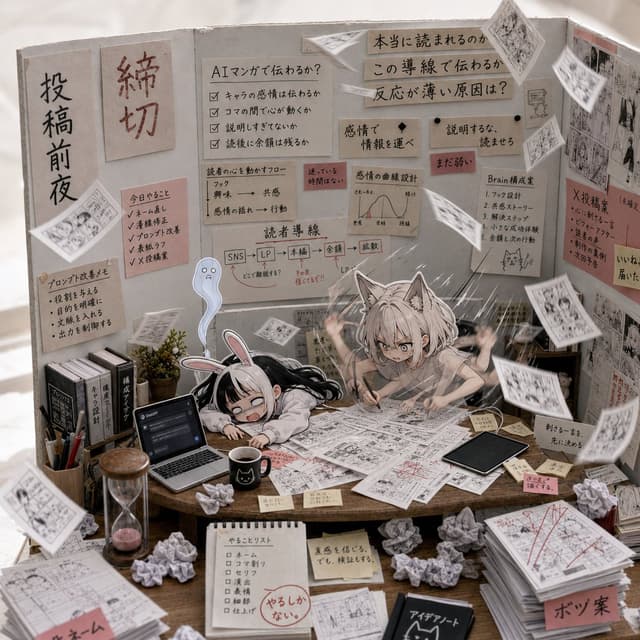
Comic / Storyboard - AI Manga Deadline War Room — output

Comic / Storyboard - AI Manga Deadline War Room

タダオ|AIマンガ家GPT Image 2
Goal: Create a highly detailed square anime illustration of the chaotic “inside of GPT image generation” as a manga production war room, halfway between rough imagination and realistic execution. The scene should feel like a frantic deadline night for AI-generated manga art.

Canvas: Square 1:1 composition, dense three-wall diorama perspective, warm indoor lighting, shallow depth of field but with many readable sticky notes and diagrams. The left side should feel more sketchy and conceptual, the right side more polished and realistic.

Main subjects: Show exactly 2 exhausted chibi anime girls at the center table: 1 black-haired bunny-ear girl slumped face-down on the desk, crying and overwhelmed, and 1 silver-haired cat-ear girl frantically drawing manga panels with both hands raised in panic. Add exactly 1 small translucent blue ghost mascot floating behind them, looking worried.

Environment and layout: A wooden worktable fills the foreground and center, covered with manga manuscripts, storyboard sheets, red correction marks, sticky notes, crumpled paper balls, coffee, pens, a laptop, a tablet, books, and a small plant. Behind the desk are three upright gray cardboard partitions covered in planning notes, workflow diagrams, manga references, and pinned sheets. The overall room should look handcrafted, like a miniature cardboard studio set photographed realistically.

Visible repeated elements to include: exactly 2 main anime characters, exactly 1 ghost mascot, exactly 3 vertical backdrop panels, exactly 1 open laptop on the left side of the desk, exactly 1 black tablet on the right side of the desk, exactly 1 black coffee mug near the front center, exactly 1 hourglass at the front left, exactly 1 potted plant near the left wall, exactly 1 tall stack of finished manuscript pages at the front right, exactly 9 crumpled paper balls scattered across the table and floor area, and many loose manga pages flying through the air.

Text and board details: Use Japanese handwritten labels and sticky notes as decorative worldbuilding. Include a large vertical sign on the left panel with {argument name="left wall headline" default="投稿前夜"}, a red deadline sign with {argument name="deadline sign" default="締切"}, central notes about whether AI manga can communicate emotion, reader guidance lines, emotion selection, and a pipeline diagram from SNS to landing page to final manuscript to review to diffusion. On the right wall, include signs about whether the work is truly readable, why reactions feel weak, and how to make the brain generate emotion. Add small red warning sticky notes, checklist boxes, and manga-panel thumbnails.

Style: Ultra-detailed anime diorama illustration, realistic tabletop materials, paper texture, pencil and ink manga pages, soft beige-gray cardboard walls, warm desk lighting, subtle motion blur on flying papers, expressive chibi faces, high-density visual storytelling, cozy but frantic deadline atmosphere. Use a mix of clean anime character rendering and realistic product-photography lighting.

Constraints: Keep the composition crowded but coherent, with the two characters clearly centered. Do not add extra main characters. Make the Japanese writing look handwritten on paper notes, not digital UI text. Avoid logos, watermarks, or modern interface overlays except for the single open laptop.
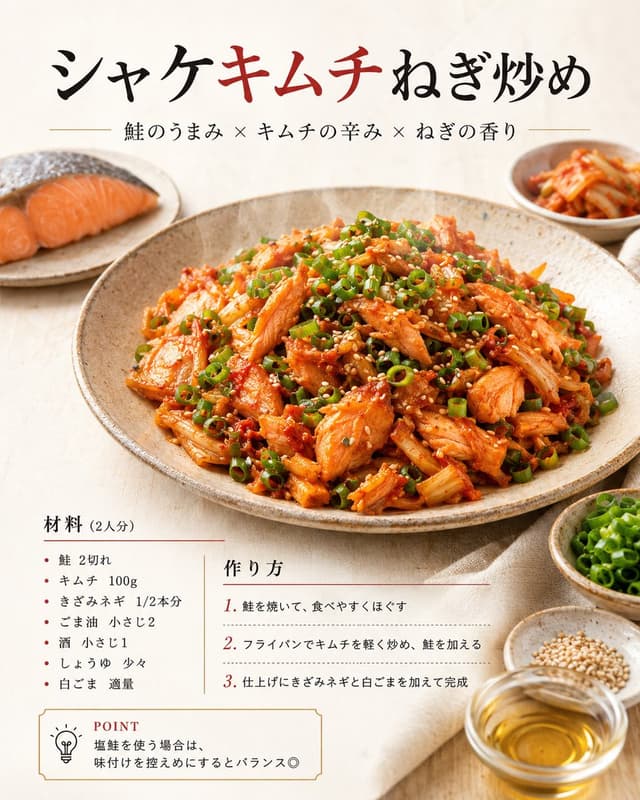
Infographic / Edu Visual - Japanese Salmon Kimchi Recipe Poster — output

Infographic / Edu Visual - Japanese Salmon Kimchi Recipe Poster

Maki@Sunwood AI Labs.GPT Image 2
Goal: Create a square Japanese recipe poster for {argument name="dish name" default="シャケキムチねぎ炒め"}, showing an appetizing home-cooked salmon, kimchi, and scallion stir-fry with clear recipe information.

Canvas: 1:1 square image, warm natural daylight food photography style on a pale wooden tabletop, soft cream background, high-resolution editorial recipe-card look.

Layout: Large brush-calligraphy Japanese title across the top; make the word “キムチ” red and the rest black. Under it, add a thin decorative horizontal line on both sides of the subtitle “鮭のうまみ × キムチの辛み × ねぎの香り”. Center the composition around one large shallow beige ceramic plate filled with the finished dish. Place small ingredient dishes around it: exactly 5 visible supporting items — 1 plate with two raw salmon fillets at upper left, 1 small bowl of kimchi at upper right, 1 small bowl of chopped green onions at lower right, 1 small bowl of white sesame seeds at bottom right, and 1 small glass bowl of golden cooking oil near the bottom right foreground.

Food details: The main dish should look glossy and spicy: flaked salmon pieces, red-orange kimchi strips, pale onion or scallion stems, many chopped green onion rings scattered on top, and toasted sesame seeds. Emphasize steam-free but freshly cooked texture, vibrant red kimchi sauce, moist salmon flakes, and rustic ceramic tableware.

Text content: Add a lower-left recipe section titled “材料(2人分)” with exactly 6 bullet ingredients: “鮭 2切れ”, “キムチ 100g”, “きざみネギ 1/2本分”, “ごま油 小さじ2”, “酒 小さじ1”, “しょうゆ 少々”, and “白ごま 適量”. Add a lower-middle preparation section titled “作り方” with exactly 3 numbered steps: “1. 鮭を焼いて、食べやすくほぐす”, “2. フライパンでキムチを軽く炒め、鮭を加える”, “3. 仕上げにきざみネギと白ごまを加えて完成”. Add a boxed note at the bottom left with a simple lightbulb icon, the label “POINT”, and the note “塩鮭を使う場合は、味付けを控えめにするとバランス◎”.

Visual style: Japanese cookbook magazine design, elegant minimal typography, black and dark red accents, thin rule lines, subtle beige paper texture, realistic food photography blended with clean graphic layout. Keep the text crisp and legible, with no extra labels, logos, watermarks, or people.
Profile / Avatar - Decorated Cheki Anime Portrait — output

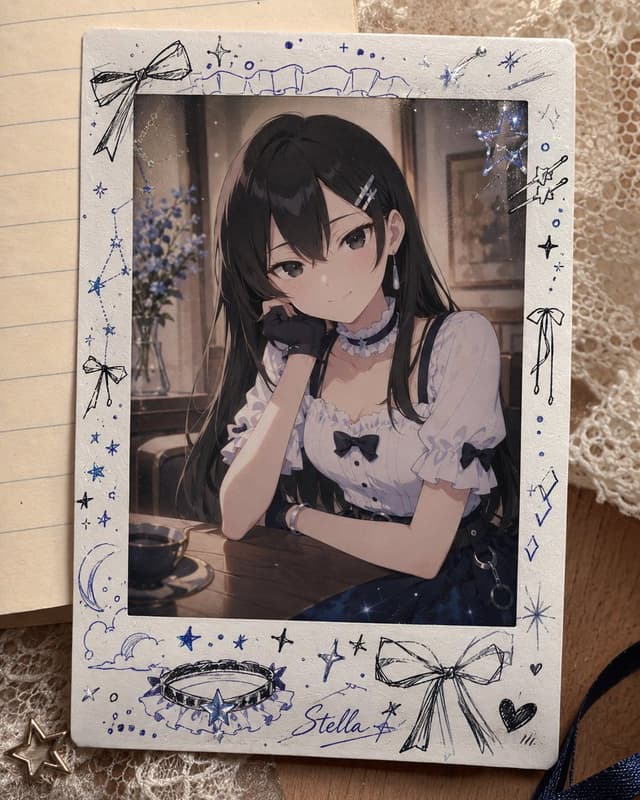
Profile / Avatar - Decorated Cheki Anime Portrait

23SenseiGPT Image 2
Create a realistic tabletop photo of a decorated instant-film cheki card featuring an anime-style portrait of {argument name="character name" default="Stella"}. The card is a vertical white Polaroid/Instax frame with rounded corners, lying slightly angled on a cozy desk surface over lined notebook paper and cream lace fabric. Inside the photo window, show a refined young anime girl with {argument name="hair color" default="long black hair"}, seated at a café table in a softly lit vintage interior; she wears a frilly white blouse with puff sleeves, black ribbons, a dark choker with a pale blue flower detail, dangling earrings, and a dark skirt or suspenders, resting one cheek on her gloved hand with her other arm folded on the wooden table. Keep the face area softly obscured or anonymized by a subtle square blur while preserving the outfit, hair, pose, and atmosphere. The cheki border is heavily hand-decorated in blue and black ink with exactly 21 distinct doodle elements: 3 bows (large top-left bow, small left-side bow, large bottom-right bow), 1 constellation on the left edge, 1 crescent moon with clouds at lower left, 1 jeweled choker/collar illustration at bottom center-left, 1 handwritten name label reading {argument name="handwritten name" default="Stella"} near the bottom, 3 star clusters/sparkle groups (top-right, right edge, bottom center), 2 shooting-star or wand-like motifs on the right, 2 heart doodles at lower right, 2 diamond/gem doodles on the lower right edge, 1 row of small dots at top center, 1 row of small dots at bottom left, 1 loose ribbon-string doodle on the right, 1 cloud-like outline across the top border, and 1 tiny star charm effect overlapping the upper-right corner of the inner photo. Use blue ballpoint pen and black fine liner strokes, slightly imperfect hand-drawn lines, scattered small dots and sparkles, and a faint glittery sheen on the photo. Background props include exactly 5 visible surrounding items: lined notebook paper on the left, cream lace cloth underneath, a small metallic star charm at bottom left, a strip of dark navy ribbon at bottom right, and a warm wooden surface edge. Lighting is warm, natural, and softly nostalgic, with shallow depth of field, realistic paper texture, mild shadows, and a handmade scrapbook aesthetic. No extra printed captions besides the handwritten name.
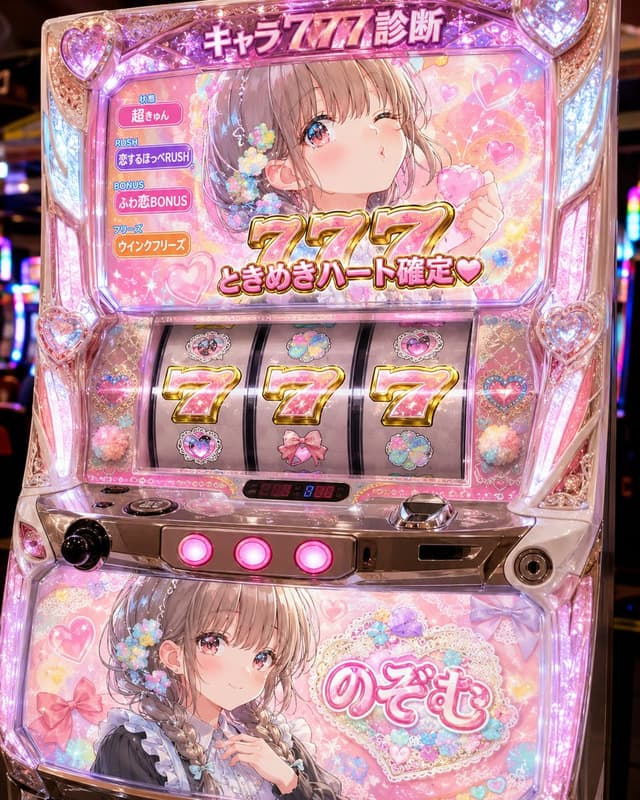
Product Marketing - Anime Character 777 Slot Machine — output

Product Marketing - Anime Character 777 Slot Machine

のぞむ*AIイラストGPT Image 2
Goal: Create a photorealistic, glossy Japanese pachislot / slot-machine cabinet themed as an official custom character machine for {argument name="character name" default="のぞむ"}, filled with pink heart motifs, sparkling LEDs, and anime idol romance energy.

Canvas: Vertical 4:5 image, front-facing slightly low angle, arcade/pachinko parlor background blurred with colorful lights. The entire slot machine fills the frame, cropped close at the sides, with no people outside the artwork.

Machine design: A luxurious translucent pink-and-silver cabinet with faceted acrylic trim, chrome edges, jewel-like decorations, lace patterns, holographic reflections, glitter, and bright pink/purple/blue LED illumination. Place 4 large heart-shaped jewel lamps on the frame corners/side areas: top left, top right, lower left side, lower right side. Add many small hearts, rhinestones, bows, flowers, and pastel rainbow sparkles throughout.

Top marquee and main screen: At the very top, show a glowing Japanese title sign reading 「キャラ777診断」 in large hot-pink neon letters. The main screen displays a soft anime girl illustration: a cute young woman with {argument name="hair color" default="ash-brown"} hair, big sparkling eyes, one eye winking, flushed cheeks, floral hair accessories, and a romantic pastel background full of hearts. She holds a pink heart-shaped object near her face. Over the screen, place a huge gold-and-pink 「777」 jackpot logo with shiny beveled edges, and underneath it the phrase 「ときめきハート確定❤」.

Left status panel on the screen: Include exactly 4 stacked rounded label boxes with Japanese text: 1) 「状態」 and 「超きゅん」, 2) 「RUSH」 and 「恋するぼRUSH」, 3) 「BONUS」 and 「ふわ恋BONUS」, 4) 「フリーズ」 and 「ウィンクフリーズ」. Make the labels small but legible, in cyan/blue headers with pink/orange content boxes.

Reel section: Below the screen, show exactly 3 vertical slot reels. Each reel stops on a large gold-and-pink number 7 across the center row, forming 777. Also show decorative reel symbols around them: exactly 2 heart jewel symbols, 2 pastel flower/clover symbols, and 1 pink bow symbol visible across the upper/lower positions. The reel window has chrome borders and reflective glass.

Controls and lower panel: Beneath the reels, include a small digital counter display with red/blue numbers, a black lever/knob on the lower left, a coin slot or chrome handle on the right, and exactly 3 glowing round pink buttons centered in a horizontal row. The lower cabinet artwork shows the same anime girl in a frilly outfit with braids and flowers, surrounded by pastel hearts, lace, bows, and candies. On the lower right, add a heart-shaped lace emblem containing the large Japanese name 「のぞむ」 in bubbly pink lettering. A square censor-like beige patch covers the center-left lower character face area, as if an image has been masked.

Visual style: High-detail photorealistic product shot mixed with polished anime illustration, saturated candy-pink palette, iridescent acrylic, glossy reflections, bokeh arcade background, magical girl romance theme, ultra-bright LED glow, realistic slot machine materials.

Constraints: Keep all visible Japanese text accurate, do not add extra English text, do not change the count of reels, buttons, corner heart lamps, or status labels, and make the image look like a real physical pachislot machine rather than a flat poster.
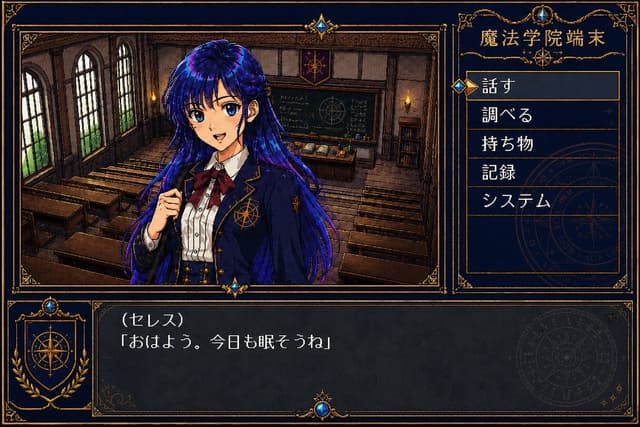
Comic / Storyboard - Retro Magic Academy Visual Novel UI — output

Comic / Storyboard - Retro Magic Academy Visual Novel UI

ないステGPT Image 2
Goal: Create a 1990s mid-era Japanese PC visual novel / adventure game screen in a 256-color dithered pixel-art style, like a fantasy magic academy mystery game.

Canvas: 16:9 landscape game screenshot, 1184×768 feel, dark navy interface with ornate antique-gold borders, low-resolution dithering, visible color banding, crunchy pixel texture, no modern UI polish.

Layout: Split the screen into three main areas: a large story scene panel on the upper left, a vertical command menu panel on the upper right, and a wide dialogue box across the bottom. Use elaborate gold filigree corner ornaments, thin double-line frames, small blue gemstone decorations at frame intersections, and faint magical compass-circle emblems in the UI background.

Main scene: Inside the upper-left scene panel, show an old European-style magic academy classroom with exactly 3 tall arched windows on the left wall, rows of wooden desks and benches, a chalkboard at the back with arcane diagrams and chalk writing, a teacher’s desk with books and bottles, wall sconces with warm candle flames, dark wood paneling, and a small academy crest banner above the chalkboard.

Character: In front of the classroom, centered slightly left, show one anime-style schoolgirl named {argument name="character name" default="Ceres"}. She has very long flowing {argument name="hair color" default="deep cobalt blue and violet"} hair with shiny pixel highlights, a navy academy blazer with gold trim and a golden magic-circle crest on the chest, a white pleated blouse, a large burgundy ribbon bow, and a formal fantasy school uniform. Her right hand is lifted near her chest as if shyly speaking. Cover her face with a centered square soft blur / mosaic censor block so the facial features are indistinct.

Right command menu: The upper-right panel title reads {argument name="location title" default="魔法学院端末"}. Under it, display exactly 5 stacked menu items in Japanese, each in its own horizontal row with gold separators: 1) 「話す」, 2) 「調べる」, 3) 「持ち物」, 4) 「記録」, 5) 「システム」. Highlight the first item 「話す」 with a brighter rectangular outline and a small gold triangular cursor plus blue diamond marker on its left.

Bottom dialogue box: A dark translucent navy text window spans the bottom. On the left, include a decorative crest panel with a golden compass/astrolabe symbol and laurel motif. In the main dialogue area, display the speaker line {argument name="speaker label" default="《セレス》"} and below it the dialogue {argument name="dialogue text" default="「おはよう。今日も眠そうね」"}. Use white pixelated Japanese bitmap font, clean spacing, and authentic retro text-window rendering.

Visual style: 256-color Japanese PC-98 / Windows 95 visual novel aesthetic, hand-drawn anime character over detailed pixel-art background, dark navy and antique gold palette, heavy dithering, subtle scanline-like roughness, ornate fantasy UI, crisp rectangular panels, no photorealism, no 3D render, no watermark, no extra menu items or extra characters.
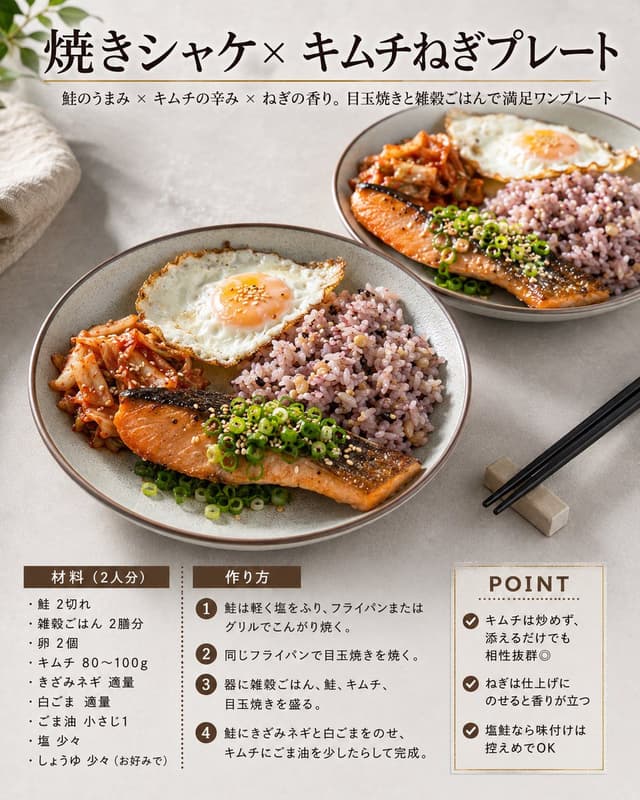
Infographic / Edu Visual - Japanese Salmon Kimchi Recipe Card — output

Infographic / Edu Visual - Japanese Salmon Kimchi Recipe Card

Maki@Sunwood AI Labs.GPT Image 2
Goal: Create a square Japanese recipe card for a plated meal, styled like a clean modern cookbook magazine page.

Canvas: 1:1 square image, warm natural daylight food photography, soft beige stone tabletop background, subtle shadows, high-resolution editorial layout.

Layout: The top third has a large Japanese headline centered-left, with a thin horizontal divider line beneath it and a smaller Japanese subtitle below. The middle half is dominated by two ceramic plates of food: one large main plate in the lower-left foreground and one smaller plate in the upper-right background. The bottom quarter contains three recipe information blocks: ingredients on the left, cooking steps in the center, and a boxed POINT tips panel on the right.

Text content: Use the headline {argument name="headline text" default="焼きシャケ×キムチねぎプレート"}. Use the subtitle {argument name="subtitle text" default="鮭のうまみ × キムチの辛み × ねぎの香り。目玉焼きと雑穀ごはんで満足ワンプレート"}. Bottom-left section title: 「材料(2人分)」. Bottom-center section title: 「作り方」. Bottom-right title: “POINT”. Keep all text crisp, black or dark brown, with brown label bars and a refined Japanese serif typeface for the headline.

Food subject details: Show exactly two matching round gray-beige ceramic plates. Each plate contains exactly four main food components: grilled salmon fillet with browned skin, a sunny-side-up fried egg with runny orange yolk, red kimchi, and a mound of purple multigrain rice. Garnish the salmon with sliced green scallions and white sesame seeds. The foreground plate should be largest and most detailed, angled slightly from above; the background plate should be smaller and softly receding.

Visible recipe text: Ingredients list must contain exactly 8 bullet items: salmon 2 fillets, multigrain rice 2 bowls, eggs 2, kimchi 80–100 g, chopped green onion as needed, white sesame as needed, sesame oil 1 teaspoon, salt a little, soy sauce a little if preferred. Cooking steps must contain exactly 4 numbered steps in brown circles: lightly salt and brown the salmon in a frying pan or grill; cook the fried eggs in the same pan; arrange multigrain rice, salmon, kimchi, and fried egg on plates; top the salmon with chopped green onion and white sesame, drizzle sesame oil over kimchi, and finish. POINT panel must contain exactly 3 checkmark tips: do not fry the kimchi, just add it for enough flavor; add green onion at the end so the aroma stands out; keep seasoning modest because salted salmon is flavorful.

Props and styling: Add a folded cream linen cloth in the upper-left corner, a few soft green leaves entering from the top-left edge, and black chopsticks resting diagonally on a small rectangular chopstick rest at the lower-right. Use an appetizing warm color palette: salmon orange, kimchi red, scallion green, egg white and orange, purple rice, beige ceramic.

Constraints: No people, no hands, no extra dishes beyond exactly two plates, no watermark, no logo, no excessive decorative graphics, maintain a premium homemade recipe-card aesthetic.
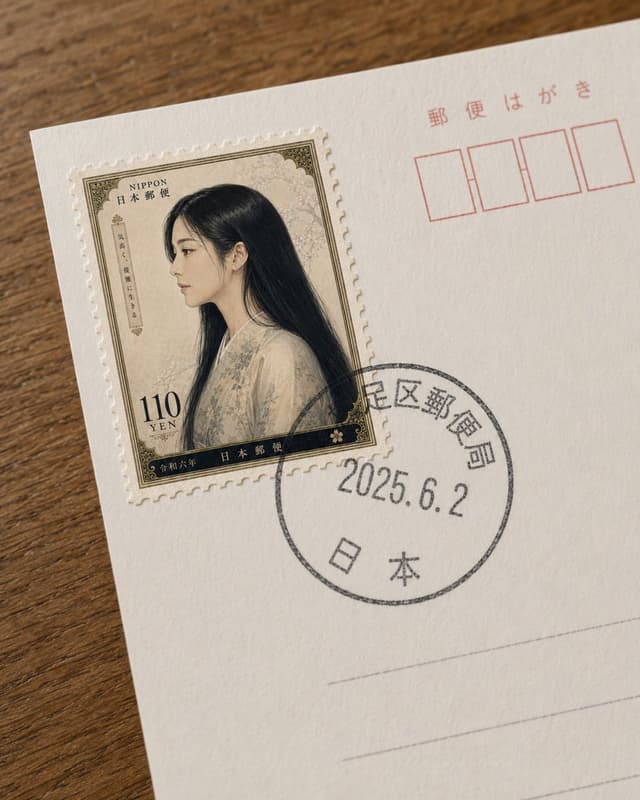
Product Marketing - Fictional Japanese Stamp on Postcard — output

Product Marketing - Fictional Japanese Stamp on Postcard

カーブミラーGPT Image 2
Create a realistic close-up photograph of the upper-left area of a Japanese postcard lying diagonally on a warm brown wooden tabletop. The postcard is off-white, lightly textured paper, cropped so only part of the card is visible. On the left side, place one fictional Japanese postage stamp with perforated edges, slightly raised like a real adhesive stamp. The stamp design is vintage and ornate, with an antique beige floral background, dark olive-black decorative border, and a portrait of {argument name="portrait subject" default="a young Japanese woman in profile with very long straight black hair, wearing a pale cream floral kimono"}; obscure the face with a soft rectangular blur for privacy. Include visible stamp text: “NIPPON” and “日本郵便” near the top, “110 YEN” at the lower left, “令和六年” along the bottom, plus small vertical Japanese label text on the left side. Overlap the lower-right of the stamp with a black circular postal cancellation mark printed on the postcard, containing Japanese postal characters around the ring, the date {argument name="postmark date" default="2025.6.2"} in the center, and “日本” near the bottom. In the upper-right of the postcard, print red Japanese postcard markings: “郵便はがき” above exactly four empty red postal-code boxes. Add faint gray horizontal address lines in the lower-right area. Use shallow depth of field, natural daylight, subtle paper fibers, realistic shadows, and a slightly handheld smartphone-photo perspective. Keep the composition minimal and documentary, with no extra stamps, no extra objects, and no watermark.
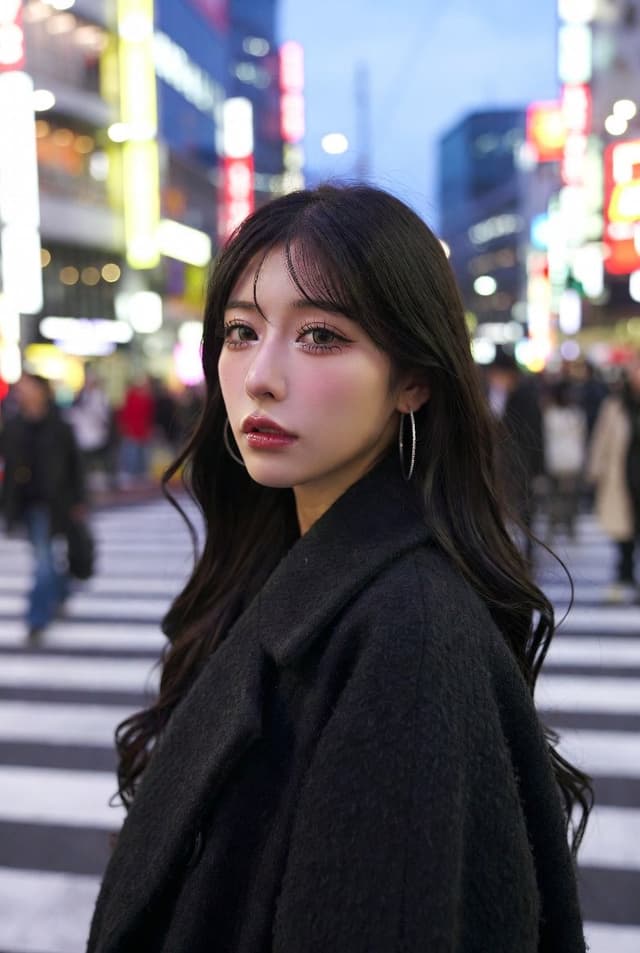
Profile / Avatar - Neon City Portrait With Face Block — output

Profile / Avatar - Neon City Portrait With Face Block

つたや@Pale AlgorithmGPT Image 2
Create a realistic vertical street-photography portrait of a young woman standing at a busy city crosswalk at dusk or early evening, in a neon-lit Japanese entertainment district resembling Shibuya or Shinjuku. She is shown from the chest up in a three-quarter side pose, looking toward the left side of the frame, with long wavy {argument name="hair color" default="dark brown to black hair"} falling over her shoulders. She wears a thick textured {argument name="coat color" default="black wool coat"} with a wide collar and a single long dangling silver earring visible on her right ear. Her face is deliberately covered by one centered opaque square privacy block, colored muted brown, hiding the entire facial area from forehead to chin. The background shows a zebra crossing with blurred pedestrians, tall buildings, glowing vertical shop signs, colorful red, yellow, blue, and white neon lights, and strong bokeh from a shallow depth of field. Use natural handheld photography, 50mm lens feel, soft ambient city light, realistic fabric texture, cinematic urban atmosphere, subject sharply focused while the background is heavily blurred. Vertical 2:3 composition, no text, no watermark, no extra people in focus.
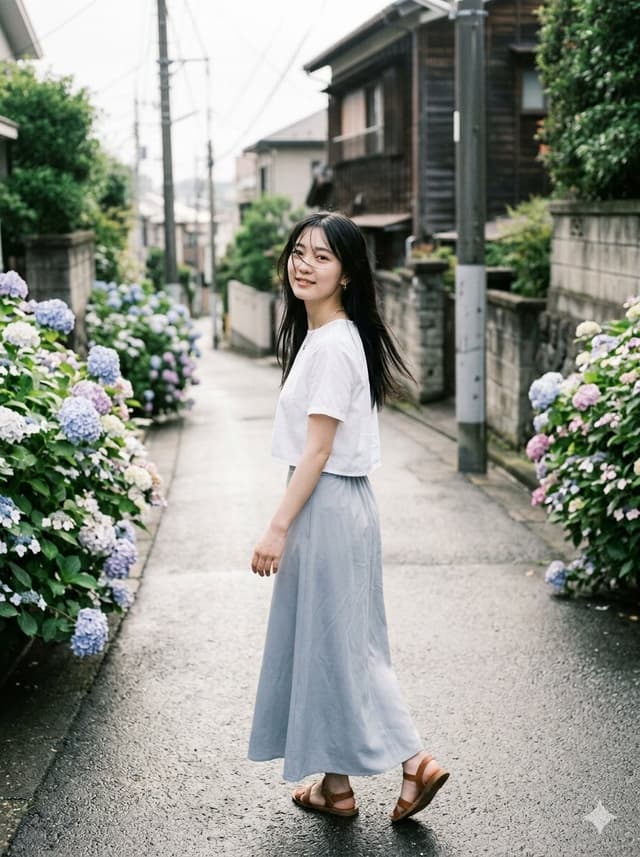
Social Media Post - Rainy Hydrangea Street Portrait — output

Social Media Post - Rainy Hydrangea Street Portrait

susumu_MindGPT Image 2
Create a realistic vertical lifestyle photograph of a young woman, {argument name="character name" default="anonymous woman"}, standing in profile on a narrow residential street in Japan after rain, surrounded by blooming hydrangeas. She is centered slightly right, mid-step, looking back toward the camera with her face intentionally softened/blurred for anonymity, long straight {argument name="hair color" default="black"} hair moving gently, wearing a loose cropped {argument name="top color" default="white"} short-sleeve T-shirt, a flowing ankle-length {argument name="skirt color" default="pale blue-gray"} skirt, and brown leather flat sandals. The street is wet and subtly reflective, with hydrangea bushes lining both sides: two prominent flower banks, one on the left foreground and one on the right foreground, with pastel blue, lavender, pink, and white blossoms. Background details include a quiet sloping neighborhood lane, concrete walls, utility poles and overhead wires, old wooden houses, greenery, and soft distant haze. Use natural overcast morning light after rainfall, shallow depth of field, soft film-like colors, gentle bokeh, realistic skin and fabric texture, 35mm documentary photography style, vertical 3:4 composition. Keep the mood calm, fresh, and nostalgic, with no visible text or watermark.
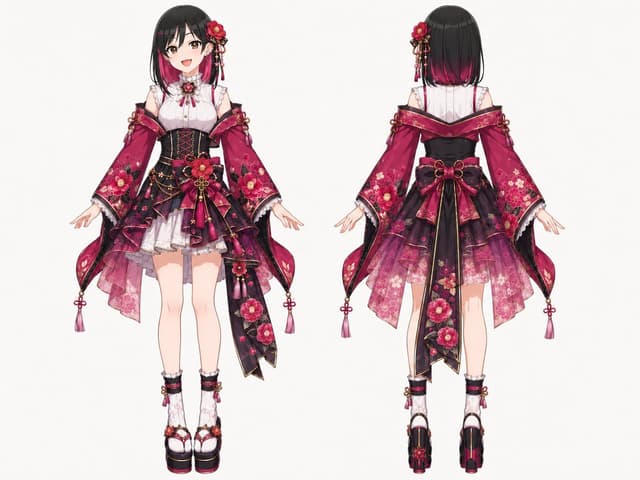
Comic / Storyboard - Wa-Modern Floral Idol Dress Sheet — output

Comic / Storyboard - Wa-Modern Floral Idol Dress Sheet

夜白(凡庸)GPT Image 2
Goal: Create a clean anime character outfit design sheet for an idol-style wa-modern floral dress, showing exactly 2 full-body views of the same young female character: 1 front view on the left and 1 back view on the right, both standing neutrally with arms slightly out to display the outfit.

Canvas: Landscape character-reference sheet on a plain white background, high-resolution digital anime illustration, centered composition with generous spacing between the two views. No scenery, no props, no text labels, no watermark.

Character: A slim young woman with pale skin and a petite idol silhouette. Use {argument name="hair color" default="straight black bob hair with vivid magenta gradient tips"}, chin-length hair with soft bangs. The face in the front view should be intentionally obscured by a soft square blur, while the rest of the outfit remains sharp and detailed.

Outfit concept: A glamorous Japanese floral kimono plus corset plus layered skirt idol costume in {argument name="main color palette" default="deep magenta, black, white, gold, and red camellia accents"}. The costume should feel ornate, festive, feminine, and stage-ready, blending traditional kimono sleeves with a modern idol dress silhouette.

Visible outfit pieces: Include exactly 12 major visible costume components: 1 white high-neck blouse with ruffled shoulders and a central flower brooch, 1 black waist corset with gold crisscross lacing, 1 short white inner skirt, 1 layered translucent magenta overskirt with floral patterns, 1 asymmetrical black-and-magenta waist sash panel hanging down the front and back, 1 oversized back bow, 2 detached kimono-style sleeves, 2 platform shoes, 2 white ankle socks. The front view should show the corset lacing, flower brooch, layered skirt volume, and decorative chains; the back view should show the broad off-shoulder kimono collar, large bow, long trailing sash, and transparent floral skirt layers.

Sleeves and skirt details: The detached sleeves are wide, flowing, off-shoulder kimono sleeves in deep magenta with black lining, gold trim, red camellia blossoms, tiny pale floral motifs, and tassels hanging from the sleeve tips. The layered skirt should be short in front, made of translucent organza-like magenta fabric with lace edging and floral print, with black panels trimmed in gold.

Ornaments: Add abundant but balanced decorative details: red camellia flowers, gold cords, dangling beads, tassels, small bells or knot ornaments, and delicate chains around the waist. Count the most prominent flower decorations as exactly 8: 1 hair ornament cluster on the character’s right side, 1 chest brooch, 1 large waist flower on the front, 1 large flower on the front hanging sash, 1 flower cluster on the back bow/sash area, 1 large flower near the lower back sash, and 2 shoe flower ornaments.

Footwear: Tall black-and-white platform mary-jane shoes with glossy black soles, magenta straps, gold accents, and red floral decorations; white patterned ankle socks with ruffled tops.

Rendering style: Polished Japanese anime game concept art, crisp linework, soft cel shading, delicate fabric transparency, intricate floral embroidery, clean white studio lighting, fashion-design-sheet clarity. Maintain consistent proportions and outfit design between front and back views.

Constraints: Show exactly 2 views and exactly 1 character design, no extra poses, no background objects, no labels, no additional characters, and keep the outfit symmetrical enough to read as a coherent costume while preserving asymmetrical sash details.
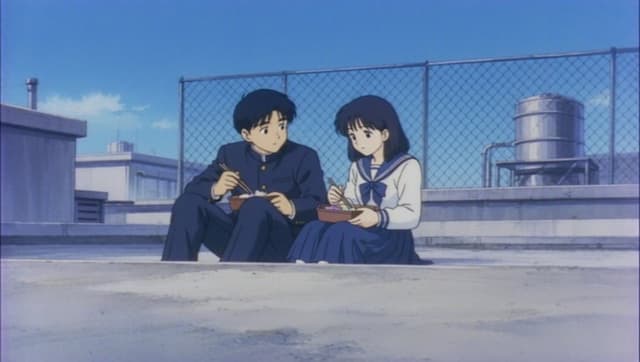
Comic / Storyboard - Retro Anime Rooftop Lunch Scene — output

Comic / Storyboard - Retro Anime Rooftop Lunch Scene

こば@AIBridge LabGPT Image 2
Create a nostalgic 1990s Japanese OVA anime cel scene on a school rooftop in a 16:9 frame, with soft analog film grain, slight VHS blur, muted blue color grading, hand-painted backgrounds, and thin ink outlines. Show exactly two teenage students sitting side by side on the concrete rooftop near the lower center of the image: one {argument name="male student uniform" default="dark navy gakuran school uniform"} boy on the left with short black hair, knees bent, holding chopsticks and a small lunch box, and one {argument name="female student uniform" default="cream sailor blouse with navy collar, large navy bow, and long blue pleated skirt"} girl on the right with shoulder-length dark hair, also holding chopsticks and a lunch box. Their faces are intentionally obscured by two soft square pixelated blur blocks, one over each face, while their poses remain natural and calm. Behind them is a rooftop chain-link fence spanning the width of the frame, a low concrete parapet, distant school rooftop structures, a cylindrical silver water tank on a metal platform at the right, and a bright clear {argument name="sky color" default="deep blue"} sky with a few pale clouds. Use a low eye-level camera angle from across the rooftop ledge, leaving a large empty concrete foreground occupying the lower third. The mood should feel quiet, intimate, and retro, like a paused frame from a 90s slice-of-life anime OVA. Avoid modern digital sharpness, avoid text, avoid logos, and keep the composition simple with exactly two visible people and exactly two lunch boxes.
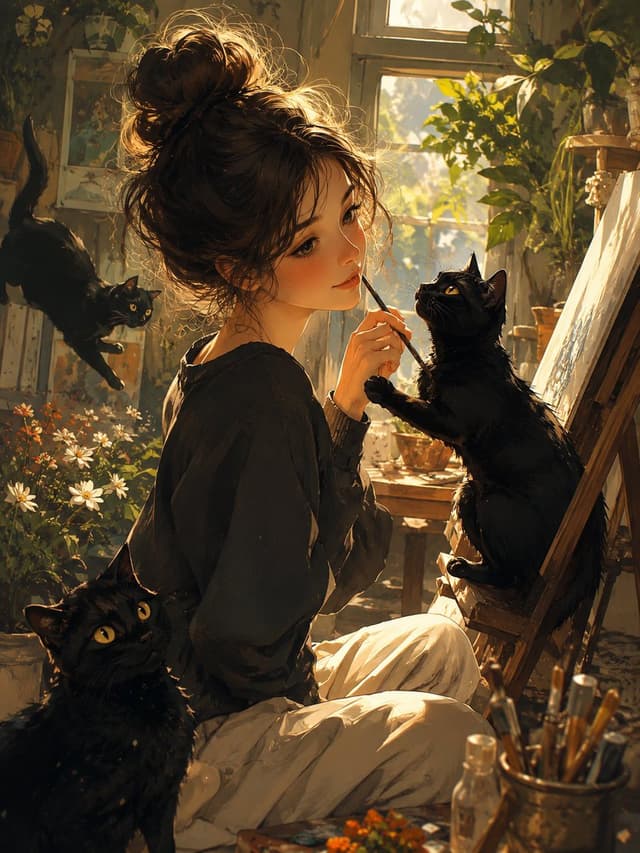
Comic / Storyboard - Rainy Studio Artist with Black Cats — output

Comic / Storyboard - Rainy Studio Artist with Black Cats

春永睦月 Harunaga MutsukiGPT Image 2
Create a warm cinematic vertical illustration of {argument name="character name" default="a young female artist"} sitting in a cozy, plant-filled painting studio on a rainy day, surrounded by exactly three black cats. The artist is shown in three-quarter profile from behind/side, seated on the floor beside a wooden easel, with a large messy high bun of {argument name="hair color" default="chestnut brown hair"}, wearing a loose dark charcoal long-sleeve blouse and a cream skirt or loose cream trousers. Her face is intentionally obscured by a simple centered square block of flat medium brown color, covering the facial features while leaving the hair, neck, hand, and pose visible. She holds a thin paintbrush near her mouth with one hand, while the cat on the easel reaches up and touches or bats at the brush with one paw. Include exactly three black cats: one in the lower left foreground looking up with large golden eyes, one on the left midground leaping or stretching near a doorway with tail raised and bright yellow eyes, and one on the right perched on the easel ledge, gazing at the brush with one raised paw. The studio is lush and atmospheric, with many potted green plants around a tall sunlit window, a wooden table with pots and flowers, white daisies blooming near the left side, an angled canvas on the easel at the right, jars and cups of paintbrushes in the bottom right foreground, and scattered warm painterly details. Use {argument name="weather mood" default="rainy-day golden window light"} with soft backlighting, glowing dust motes, wet reflective ambience, and a nostalgic quiet mood. Style should be detailed anime-inspired painterly realism, rich texture, dramatic golden-hour lighting, deep shadows, warm amber highlights, expressive cats, high detail, vertical 3:4 composition, no visible text, no watermark.
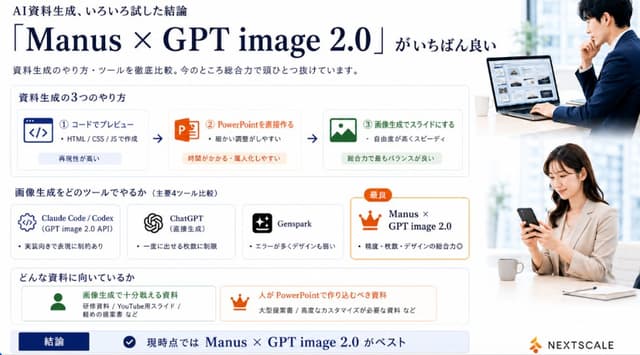
Infographic / Edu Visual - Manus GPT Image 2.0 Comparison Slide — output

Infographic / Edu Visual - Manus GPT Image 2.0 Comparison Slide

石丸真平 | AIの人《本当に仕事で使えるAIを発信》GPT Image 2
Goal: Create a polished Japanese business infographic slide comparing AI presentation-material generation methods and tools, with a corporate white, navy, orange, and green palette. The main message is that Manus × GPT image 2.0 is currently the best overall option.

Canvas: Wide 16:9 landscape slide, clean white background, thin light-gray card borders, deep navy typography, subtle blue-gray shadows. Leave a right-side vertical photo strip occupying about 24% of the canvas.

Header: At top left, small Japanese lead-in text using {argument name="small header text" default="AI資料生成、いろいろ試した結論"}. Below it, a very large elegant serif headline using {argument name="main headline text" default="「Manus × GPT image 2.0」がいちばん良い"}. Under the headline, add a smaller subtitle using {argument name="subtitle text" default="資料生成のやり方・ツールを徹底比較。今のところ総合力で頭ひとつ抜けています。"}.

Right photo area: Add exactly 2 realistic business lifestyle photos stacked vertically with soft bright office lighting. Top photo: a Japanese businessman in a navy suit working at a laptop showing slide thumbnails, seated near a window, face softly blurred. Bottom photo: a Japanese businesswoman in a beige blazer looking at a smartphone at a desk, face softly blurred. Keep the photos cropped cleanly with white margins, matching the slide’s corporate look.

Section 1 layout: Create a large rounded rectangle card titled "資料生成の3つのやり方". Inside it place exactly 3 horizontal method cards connected by two right-pointing arrows. Method 1: blue code icon, label "① コードでプレビュー", small text "HTML / CSS / JSで作成", bottom pill "再現性が高い". Method 2: orange PowerPoint icon, label "② PowerPointを直接作る", small text "細かい調整がしやすい", bottom pill "時間がかかる・属人化しやすい". Method 3: green image icon, label "③ 画像生成でスライドにする", small text "自由度が高くスピーディ", bottom pill "総合力で最もバランスが良い".

Section 2 layout: Below, add a title "画像生成をどのツールでやるか(主要4ツール比較)" and exactly 4 equal comparison cards in a row. Card 1: Claude Code / Codex, gear/code icon, sublabel "(GPT image 2.0 API)", bullet "実装向きで表現に制約あり". Card 2: ChatGPT, OpenAI knot icon, sublabel "(直接生成)", bullet "一度に出せる枚数に制限". Card 3: Genspark, sparkle icon, bullet "エラーが多くデザインも弱い". Card 4: highlighted best card with orange border and crown icon, small orange badge "最良", title using {argument name="best tool name" default="Manus × GPT image 2.0"}, bullet "精度・枚数・デザインの総合力◎".

Section 3 layout: Add a rounded box titled "どんな資料に向いているか" with exactly 2 side-by-side suitability cards. Left card with green person icon: title "画像生成で十分戦える資料", examples "研修資料 / YouTube用スライド / 軽めの提案書 など". Right card with orange crown icon: title "人がPowerPointで作り込むべき資料", examples "大型提案書 / 高度なカスタマイズが必要な資料 など".

Bottom conclusion bar: Full-width light-blue conclusion strip with a navy label box reading "結論", a circular check icon, and large conclusion text using {argument name="conclusion text" default="現時点では Manus × GPT image 2.0 がベスト"}.

Branding: Bottom right place a small orange abstract mark and the word "NEXTSCALE" in dark gray. Keep all text crisp and aligned, use Japanese business-slide typography, avoid clutter, and do not add any extra cards beyond the counted 3 method cards, 4 tool cards, 2 suitability cards, and 2 photos.
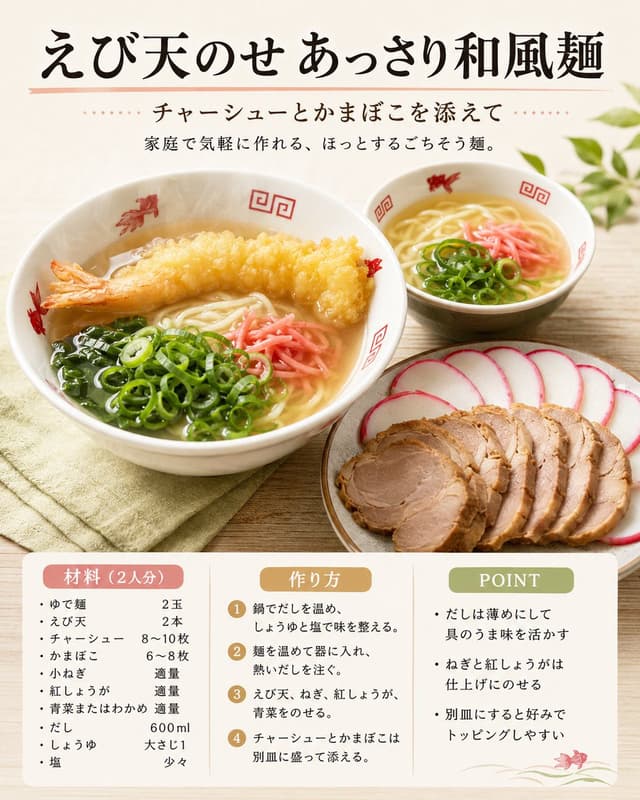
Infographic / Edu Visual - Japanese Tempura Noodle Recipe Card — output

Infographic / Edu Visual - Japanese Tempura Noodle Recipe Card

Maki@Sunwood AI Labs.GPT Image 2
Goal: Create a warm Japanese recipe-card style food image for {argument name="dish name" default="えび天のせ あっさり和風麺"}, presented like a polished magazine recipe poster with appetizing food photography and neatly typeset instructions.

Canvas: Square 1:1 image, soft natural daylight, cream and pale wood background, clean editorial composition. Use a light beige paper texture and muted pastel accents.

Layout: Large Japanese headline centered at the top in bold brush-calligraphy style. Under it, a thin salmon-pink divider line and a subtitle line with dotted decorations. Main food photo occupies the middle: a large bowl on the left foreground, a smaller bowl in the right background, and a plate of toppings on the lower right. Bottom third contains one rounded white recipe panel divided into exactly 3 columns.

Main image details: Show a clear light Japanese noodle soup in white ramen bowls with red decorative Chinese-style patterns. The large foreground bowl contains thin noodles, clear broth, exactly 1 large golden shrimp tempura laid across the top, sliced green onions, glossy wakame seaweed, and pink pickled ginger. The smaller background bowl contains noodles, sliced green onions, and pink pickled ginger. On the lower-right plate, show exactly 2 topping groups: neatly fanned round slices of pink-rimmed kamaboko fish cake and overlapping slices of chashu pork. Add a folded pale green cloth under the large bowl and a small leafy green plant blurred in the upper right.

Text content: Top headline: {argument name="headline text" default="えび天のせ あっさり和風麺"}. Subtitle: {argument name="subtitle text" default="チャーシューとかまぼこを添えて"}. Small description line: {argument name="description text" default="家庭で気軽に作れる、ほっとするごちそう麺。"}.

Bottom recipe panel: Use exactly 3 columns with rounded header pills. Column 1 header in salmon pink: 「材料(2人分)」. List exactly 9 ingredient rows: ゆで麺 2玉; えび天 2本; チャーシュー 8〜10枚; かまぼこ 6〜8枚; 小ねぎ 適量; 紅しょうが 適量; 青菜またはわかめ 適量; だし 600ml; しょうゆ 大さじ1; 塩 少々. Column 2 header in ochre: 「作り方」. Show exactly 4 numbered steps in gold circles: 1 鍋でだしを温め、しょうゆと塩で味を整える。 2 麺を温めて器に入れ、熱いだしを注ぐ。 3 えび天、ねぎ、紅しょうが、青菜をのせる。 4 チャーシューとかまぼこは別皿に盛って添える。 Column 3 header in olive green: 「POINT」. Show exactly 3 bullet points: だしは薄めにして具のうま味を活かす; ねぎと紅しょうがは仕上げにのせる; 別皿にすると好みでトッピングしやすい.

Visual style: High-key appetizing food photography blended with elegant Japanese cookbook graphic design, soft shadows, shallow depth of field, realistic textures for tempura, broth, noodles, pork, and kamaboko. Typography should be legible and balanced, with black headline text and warm accent colors. Add a tiny decorative red shrimp illustration and subtle green swoosh in the lower-right corner of the recipe panel.

Constraints: Keep the composition clean and calm, avoid clutter, no people, no watermark, no extra panels, no extra ingredients beyond those listed, and preserve the exact 3-column bottom panel structure.
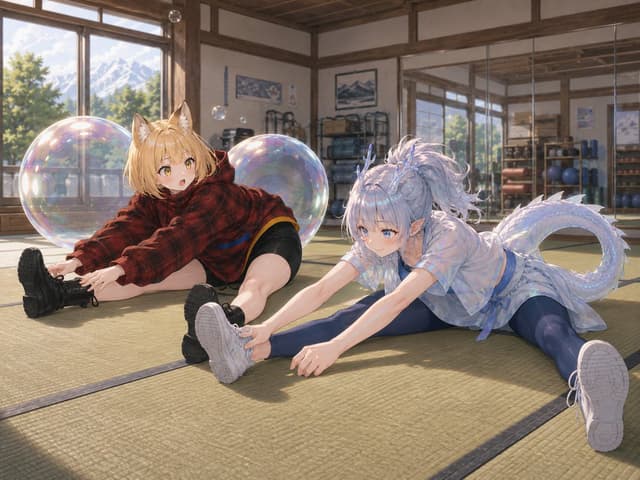
Comic / Storyboard - Bubble Dragon and Fox Stretching — output

Comic / Storyboard - Bubble Dragon and Fox Stretching

輝鳴紅葉🫧🌸シャボン玉のバーチャルビデオ屋GPT Image 2
Create a polished anime-style illustration of two fantasy humanoid characters stretching on tatami mats inside a sunlit traditional Japanese dojo or training room. The scene shows exactly two main characters sitting on the floor in wide-legged forward stretches: on the left, a fox-eared youth with messy blond hair, tan fox ears, a red-and-black oversized plaid hoodie, black shorts, and black lace-up boots, leaning forward to reach one boot; on the right, a pale dragon-themed youth with fluffy white hair, small translucent blue horns, pointed elf-like ears, a long iridescent white-blue dragon tail curled behind them, a semi-transparent pale blue patterned tunic tied with blue ribbons, dark blue leggings, and white sneakers, reaching toward one shoe. Use {argument name="left character" default="a blond fox-eared youth in a red plaid hoodie"} and {argument name="right character" default="a white-haired bubble dragon youth with a shimmering tail"}. Add exactly four visible soap bubbles: one large iridescent bubble behind the fox character, one large iridescent bubble behind and between the two characters, and two small floating bubbles above them. The room has wooden beams, sliding glass windows, mirrored wall panels, shelves with exercise equipment, posters, and a mountain landscape visible outside through bright windows. Lighting should be warm late-morning sunlight with long soft shadows, sparkling highlights on bubbles, and glossy iridescent reflections on the dragon tail and clothing. Composition is a wide horizontal 4:3 view from low floor level, emphasizing depth across the tatami mats. Style: high-detail modern anime, soft painterly rendering, realistic room perspective, delicate linework, airy atmosphere, whimsical fantasy slice-of-life mood. Leave both faces softly obscured or featureless with neutral skin-tone blurs, avoiding detailed facial features. No captions, no watermark, no extra characters.
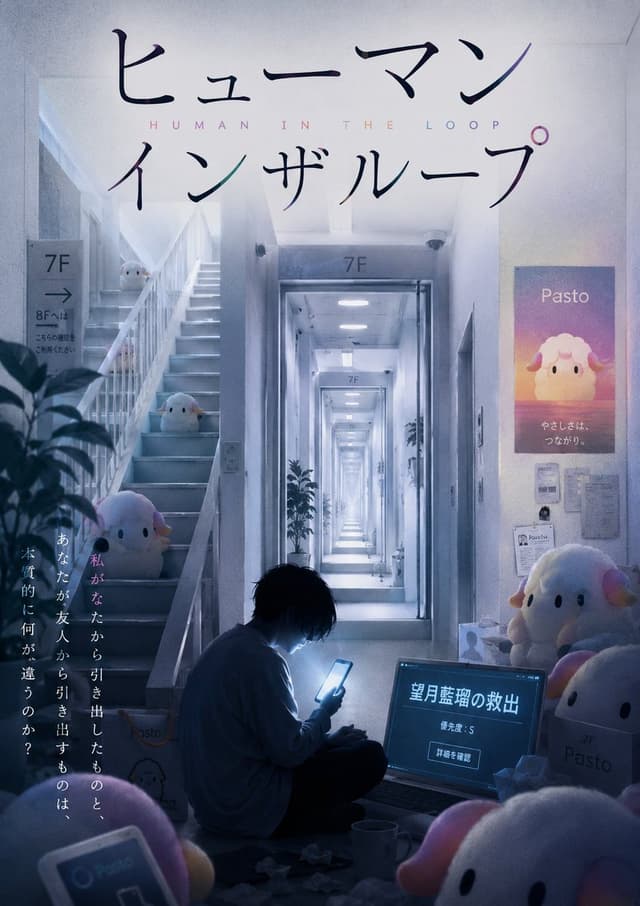
Product Marketing - Liminal Japanese Novel Cover — output

Product Marketing - Liminal Japanese Novel Cover

絹田屋GPT Image 2
Goal: Create an unsettling Japanese liminal-space novel cover for {argument name="book title" default="Human in the Loop"}, set in a sterile apartment-office corridor that feels infinite and quietly wrong.

Canvas: Vertical book-cover composition, 2:3 aspect ratio, cinematic photorealism with slight illustrated polish, cool blue-gray lighting, soft bloom, subtle film grain, deep perspective, high resolution.

Layout: Large Japanese title typography fills the top third in elegant black handwritten calligraphy, reading 「ヒューマン」 on the first line and 「インザループ」 on the second line. Between the two Japanese title lines, place small widely spaced roman letters reading “HUMAN IN THE LOOP” in pale pastel colors. The central vanishing point is a bright, endless 7F corridor seen through a doorway, with repeated ceiling lights and hallway frames receding into the distance. Foreground bottom center shows a lone person sitting on the floor in silhouette, hunched over and illuminated by a smartphone glow. Left side contains a stairwell rising upward; right side contains posters, documents, boxes, and plush mascots.

Subject details: The environment is a liminal institutional residential building: white walls, gray floor, fluorescent ceiling panels, stair railings, elevator-like corridor entrance, potted plants, posted notices, and signage. Add floor signs labeled “7F” above the doorway and on a left-side wall sign, with an arrow and small Japanese wayfinding text beneath it. The mood should be quiet, eerie, and emotionally lonely rather than overt horror.

Characters and objects: Include exactly 1 human figure: a young person with messy dark hair, wearing a loose pale shirt and dark pants, seated cross-legged on the floor, looking down at a glowing phone. Include exactly 7 visible physical sheep-like mascot plush toys named {argument name="mascot brand" default="Pasto"}: 3 on the stairwell at different heights, 2 on the right near cardboard boxes, 1 partial large plush in the bottom-right foreground, and 1 partial plush in the bottom-left foreground. The mascots are round, white, soft, with tiny black oval eyes, pink-and-yellow ears or horns, and a cute corporate-character look. Also include exactly 1 poster illustration of the same sheep mascot on the right wall.

Text content: The right wall poster should say “Pasto” at the top and include small Japanese text below, approximately 「やさしさは、つながり。」. A laptop or monitor on the floor at lower right displays Japanese interface text: large headline 「望月藍瑠の救出」, smaller line 「優先度:S」, and a rectangular button-like label 「詳細を確認」. Add a vertical Japanese tagline along the lower-left side in white and pink text: 「私があなたから引き出したものと、あなたが友人から引き出すものは、本質的に何が違うのか?」.

Visual style: Photorealistic cinematic cover art, cool desaturated palette with pastel pink and lavender accents, soft fluorescent glow, strong central perspective, shallow haze, clean but slightly uncanny corporate-residential atmosphere. Typography should feel refined and book-cover-like, with the Japanese title large and legible.

Constraints: Do not add extra humans. Do not add extra mascot plush toys beyond the 7 physical plush toys and 1 poster illustration. Keep all visible text integrated into the cover design. Avoid gore, monsters, weapons, or overt jump-scare imagery.
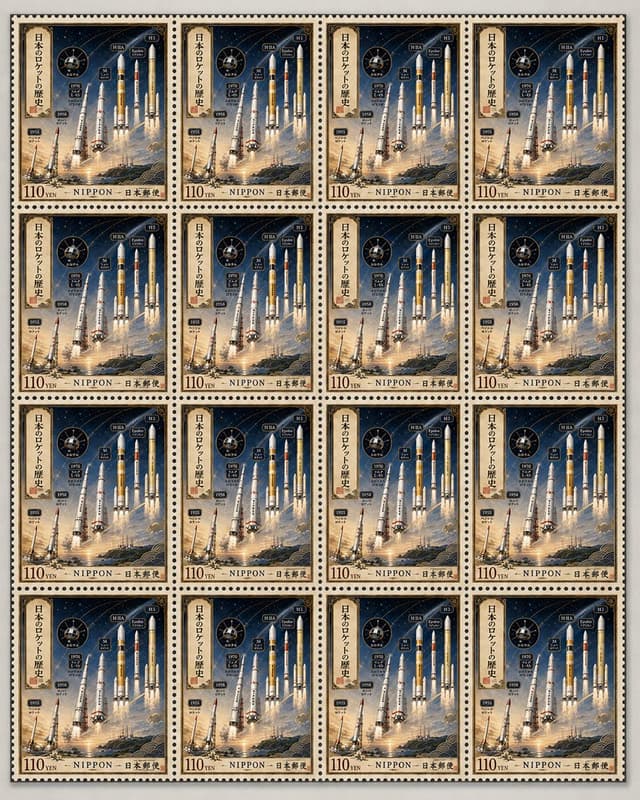
Product Marketing - Fictional Japanese Rocket Stamp Sheet — output

Product Marketing - Fictional Japanese Rocket Stamp Sheet

カーブミラーGPT Image 2
Goal: Create a realistic fictional Japanese postage stamp sheet themed around the history of Japanese rockets, like a collectible commemorative issue.

Canvas: Square image, straight-on view, showing one full perforated sheet on a neutral beige background. The sheet contains exactly 16 individual stamps arranged in a 4 columns by 4 rows grid, each stamp identical, separated by black circular perforation holes and cream paper gutters. Add a subtle paper texture, slightly aged off-white edges, and a printed lithograph feel.

Stamp design: Each of the 16 stamps is a vertical rectangle with a cream border and dark ink outline. Inside every stamp, depict a dramatic vintage space illustration: multiple Japanese rockets launching and standing upright in chronological progression, smoke clouds and orange launch glow at the bottom, a dark navy starry sky above, orbital arcs, a small satellite near the upper left, and small black date/name labels near the rockets. Use a nostalgic 1950s–1970s science poster style with muted navy, cream, sepia, gold, white, black, and warm orange tones.

Text content: On the left side of every stamp, include a vertical Japanese title reading {argument name="vertical title text" default="日本のロケットの歴史"}. Along the bottom border of every stamp, include the denomination {argument name="stamp denomination" default="110 YEN"}, then {argument name="country name" default="NIPPON"}, then Japanese postal text {argument name="postal text" default="日本郵便"}. Make the text small but visibly printed, with slight imperfections like real stamp ink.

Subject details: Include exactly six main rockets on each stamp, from a small early rocket at the lower left to taller white and gold launch vehicles toward the right. Add exactly one satellite illustration near the upper left of each stamp. Add several tiny black annotation plaques with years and rocket names, but keep them decorative and not overly readable.

Visual style: Highly detailed generated illustration, vintage Japanese commemorative stamp aesthetics, crisp perforations, warm aged paper, fine engraved linework, realistic printed texture, symmetrical sheet layout, museum-collector presentation.

Constraints: Show exactly 16 stamps, no extra stamps cut off at the edges, no modern logos, no watermark, no people, no photorealistic rockets outside the illustrated stamp artwork.
Profile / Avatar - Golden Hour Urban Portrait — output

Profile / Avatar - Golden Hour Urban Portrait

Scaling Tech HQGPT Image 2
Create a realistic vertical street portrait photo of {argument name="character name" default="an anonymous young man"} standing outdoors in an urban setting at golden hour. Frame him from mid-chest upward, centered, with his head and shoulders filling most of the image. He has short, curly dark brown hair with warm rim light catching the curls, light stubble on the jaw and neck, and a natural relaxed posture facing the camera. His face is intentionally obscured by one large solid rectangular censor block placed over the entire central face area from forehead to upper chin, colored as a soft brown skin-tone gradient, with clean sharp edges and no text. He wears a dark navy or black textured wool jacket with a collar and visible zipper over a plain {argument name="shirt color" default="charcoal gray"} crew-neck T-shirt. The background is a real city street with tall building walls close on the left, distant buildings and traffic lights on the right, heavily blurred into creamy bokeh. Use warm golden-hour side light coming from camera-right/back-right, daylight white balance around 5600K, realistic skin and fabric texture, natural contrast, shallow depth of field, and believable camera optics. Photographic settings: 85mm portrait lens, f/1.8, ISO 200, 1/500 sec, focus on the eyes area beneath the censor block. Vertical 4:5 composition, high-resolution editorial portrait style, no watermark, no extra people, no text.
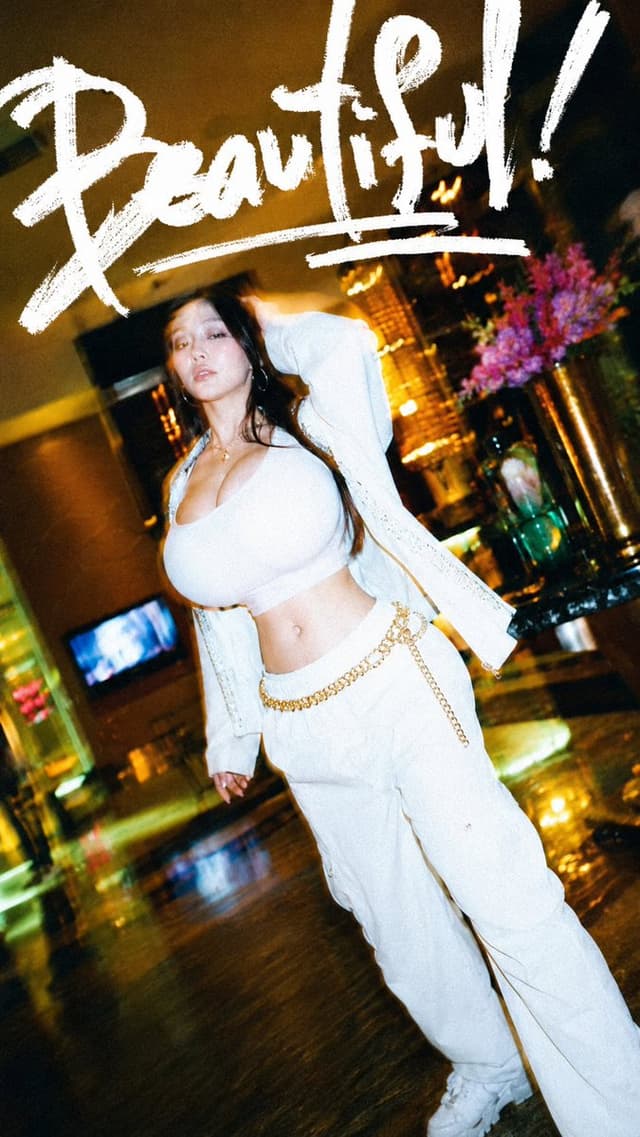
Social Media Post - Flash Nightlife Fashion Portrait — output

Social Media Post - Flash Nightlife Fashion Portrait

AI Girl's Photo StudioGPT Image 2
Create a vertical 9:16 flash-photography fashion nightlife shot in a luxurious dim lounge or hotel lobby, tilted with a dynamic Dutch angle and a gritty disposable-camera look. The subject is a curvy young woman posing full-body slightly off-center, walking toward the camera with one arm raised behind her head; her face is intentionally anonymized with a soft square blur. She has long dark wavy hair and wears an all-white streetwear outfit consisting of exactly 5 visible clothing pieces: a tight low-cut crop tank top, an open lightweight knit cardigan, loose white cargo pants, white sneakers, and a gold chain belt draped across the waist. Include exactly 3 visible accessories: a delicate gold necklace, large hoop earrings, and a small navel piercing. The background should be a glossy dark floor reflecting warm lights, a bar or lounge interior with golden ambient lighting, a small glowing screen on the left wall, and a tall vase of vivid purple flowers on the right. Add a huge hand-painted white brush-script word {argument name="headline text" default="Beautiful!"} across the top third of the image, with an energetic underline stroke beneath it, like a bold marker or paint pen. Use high contrast, motion blur, slight grain, oversaturated warm highlights, deep shadows, and paparazzi-style direct flash. Customize the outfit color with {argument name="outfit color" default="white"}, the belt color with {argument name="belt color" default="gold"}, the background setting with {argument name="background setting" default="luxury nightlife lounge"}, and the flower color with {argument name="flower color" default="purple"}. Keep the composition vertical, glamorous, candid, and editorial; no extra text, no watermark.
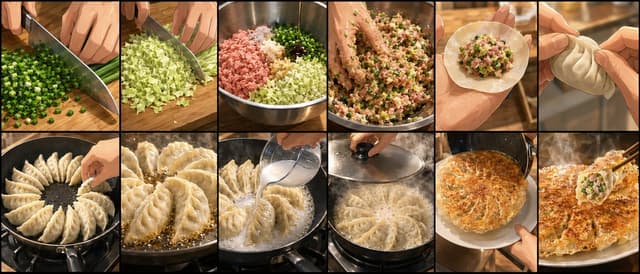
Comic / Storyboard - Gyoza Cooking Storyboard — output

Comic / Storyboard - Gyoza Cooking Storyboard

オズGPT Image 2
Goal: Create a cinematic cooking storyboard showing the step-by-step preparation of pan-fried Japanese gyoza dumplings, from chopping vegetables to serving the finished crispy dumplings.

Canvas: Wide horizontal storyboard image, 2 rows by 6 columns, exactly 12 rectangular panels separated by thick black borders. Use warm kitchen lighting, realistic food photography mixed with slightly polished cinematic illustration, shallow depth of field, close-up hands and ingredients, appetizing steam and oil shine.

Layout: Arrange the panels left to right, top row first, then bottom row, like a recipe process board. Every panel should be a close-up with no text labels, no captions, and no watermark.

Panel count and contents: Include exactly 12 discrete panels:
1. A chef's hands finely chopping green onions on a wooden cutting board with a large kitchen knife; many small green rounds pile up near the blade.
2. Hands chopping pale green cabbage into small pieces on the same wooden cutting board.
3. A stainless-steel mixing bowl containing separated piles of ingredients: pink minced pork, chopped cabbage, green onions, minced garlic or ginger, and a small dark sauce or seasoning.
4. A hand mixing the gyoza filling inside the metal bowl; the mixture is sticky and speckled with green onion and cabbage.
5. A round dumpling wrapper held in one hand with a spoonful of filling placed in the center.
6. Two hands folding and pleating a gyoza dumpling, pinching the crescent shape closed.
7. Raw gyoza arranged upright in a radial circle inside a black frying pan on a stovetop, with a hand placing the final dumpling.
8. Close-up of gyoza frying in bubbling oil, dumpling bottoms beginning to brown.
9. A hand pouring water into the hot pan around the dumplings, producing vigorous bubbles and steam.
10. A glass lid being placed over the pan to steam the dumplings; condensation and steam visible.
11. The finished dumplings inverted onto a white plate as one circular crispy lace-bottom disk, golden brown and caramelized.
12. Extreme close-up of a plated gyoza being lifted or broken open with chopsticks, showing juicy minced pork and green vegetable filling against the crispy golden skirt.

Subject details: The dish is {argument name="dish name" default="pan-fried gyoza"}; the filling uses {argument name="main filling" default="minced pork, cabbage, green onions, garlic, ginger, and soy-based seasoning"}; the cooking surface is {argument name="pan type" default="black nonstick frying pan"}. Use {argument name="lighting style" default="warm amber restaurant kitchen lighting"} and make the final texture {argument name="crispy finish" default="golden brown lacy dumpling skirt with steam"}.

Visual style: Highly detailed, appetizing, realistic close-up food cinematography with painterly polish, warm color grading, glossy oil highlights, visible knife motion, tactile hand gestures, shallow background blur, rich browns and greens, crisp black storyboard dividers.

Constraints: Exactly 12 panels in a 2x6 grid; no extra panels; no text; no logos; no decorative border beyond the black grid lines; keep the process visually readable and sequential.
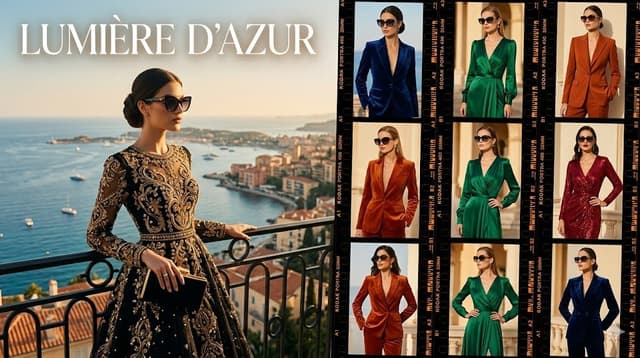
Product Marketing - Lumière d’Azur Fashion Lookbook Collage — output

Product Marketing - Lumière d’Azur Fashion Lookbook Collage

Cherry 2.OGPT Image 2
Goal: Create a luxury fashion editorial collage for a Riviera eveningwear collection titled {argument name="headline text" default="LUMIÈRE D’AZUR"}, combining one large cinematic lifestyle image with a film-contact-sheet of outfit variations.

Canvas: Wide horizontal 16:9 composition, split roughly 52% left hero image and 48% right lookbook grid. Use warm golden-hour lighting, high-end magazine styling, rich contrast, and a polished photorealistic fashion campaign look.

Layout: Left side shows one large editorial scene: an elegant woman standing on an ornate wrought-iron balcony above the French Riviera coastline, with blue sea, yachts, cliffs, harbor buildings, and hazy sunset sky in the background. Place the headline in very large white high-fashion serif capitals across the upper left, with subtle shadow and generous letter spacing. Right side shows a black analog film contact sheet with visible sprocket holes, orange Kodak-style edge markings, frame numbers, and thin black dividers.

Discrete elements: Include exactly 10 visible fashion model images total: 1 large hero model on the left and 9 smaller lookbook frames on the right arranged in a 3 by 3 grid. The 9 right-side frames are: top left navy blue deep-V velvet blazer suit; top center emerald green satin wrap dress; top right burnt orange tailored pantsuit; middle left rust orange velvet blazer suit; middle center emerald green wrap dress with hand on hip; middle right burgundy sequined wrap dress; bottom left copper-orange suit with hands on hips; bottom center emerald green flowing dress; bottom right navy blue suit jacket. Do not add extra frames.

Subject details: The left hero model is a poised adult woman with dark hair in a sleek low bun, wearing a dramatic black evening gown covered in ornate gold embroidery and beadwork, sheer long sleeves, a fitted bodice, and a full skirt. She holds a small black clutch with gold trim and wears subtle jewelry. Her face should be softly anonymized or intentionally blurred, as if privacy-protected, while the clothing and environment remain sharp. The right-side models also have softly blurred faces while outfits stay crisp.

Visual style: Cinematic photorealism, luxury resort fashion campaign, Vogue-style editorial, warm Mediterranean color palette, crisp fabrics, glossy highlights, shallow depth of field on the background, refined composition. Emphasize deep navy, emerald green, burgundy, rust orange, black, and metallic gold.

Text and details: The only prominent readable title is {argument name="headline text" default="LUMIÈRE D’AZUR"}. Film edge markings may resemble Kodak Portra 400 and small frame numbers but should function as decorative contact-sheet typography rather than main copy.

Constraints: Keep the split-screen collage structure, exactly 1 hero scene plus exactly 9 contact-sheet looks, no logos, no watermark, no extra headline text, no distorted hands, no duplicate limbs, no cartoon style.
Browse by model, style or topic

Find your next direction

ASTORIE CANVAS

Take the idea further.

Bring your prompts, references and results together in one creative space.

Open your canvas ↗