Profile / Avatar - Jakub Pachocki AI Innovator Infographic
Generated output: Profile / Avatar - Jakub Pachocki AI Innovator Infographic — output 1
A square tech-profile infographic presenting Jakub Pachocki with a portrait, career timeline, contributions, significance, and legacy for educational or social media use.
Goal: Create a polished square educational profile infographic for an AI innovator, featuring a watercolor portrait and biography panels about {argument name="character name" default="Jakub Pachocki"}.

Canvas: 1:1 square layout, white background with cobalt-blue and orange accent colors, clean tech editorial style, high-resolution vector-infographic finish with subtle watercolor textures.

Layout: Split composition with a large portrait on the upper left and the main name headline on the upper right. Use rounded rectangular content cards with thin blue borders, dotted dividers, simple line icons, and circuit/network decorations. Add a small footer label centered at the bottom.

Top left portrait: Semi-realistic watercolor head-and-shoulders portrait of a light-skinned man with very short brown hair, blue eyes, slight smile, wearing a dark navy crewneck sweater. Place him in front of blue watercolor splashes, dotted halftone accents, and curved circular orbit lines.

Header: Huge bold uppercase dark-blue name text reading {argument name="headline name" default="JAKUB PACHOCKI"}. Beneath it, a slim orange line and a credential row reading: OpenAI • Chief Scientist • GPT-4, RL & Reasoning. Add a small abstract molecule/network icon in the top-right corner.

Content cards: Use exactly 5 information panels:
1. “Who He Is” card at upper right with a blue circular person icon. Body text: “Jakub Pachocki is a computer scientist and AI researcher serving as Chief Scientist at OpenAI. Since joining OpenAI in 2017, he has led major research initiatives and previously served as Director of Research. His work spans large-scale deep learning, reinforcement learning, reasoning models, optimization, and frontier AI systems.”
2. “Career Timeline” card at lower left with a blue calendar icon and a vertical timeline. Include exactly 6 timeline entries: 2009: Silver medalist, International Olympiad in Informatics; 2010–2013: Computer Science, University of Warsaw; 2013–2016: Ph.D. in Computer Science, Carnegie Mellon University; 2017: Joined OpenAI; 2018–2020: Helped lead large-scale reinforcement learning efforts, including OpenAI Five; 2021–2024: Director of Research, OpenAI; 2024–present: Chief Scientist, OpenAI.
3. “Key Contributions” card at center right with an orange lightbulb icon. Include exactly 5 contribution rows, each with a small blue outline icon: trophy for “Large-Scale Reinforcement Learning,” GPT-4 badge for “GPT-4 Leadership,” rising chart for “Deep Learning Scaling,” head/brain network for “Reasoning Models,” and code brackets for “Theory Meets Systems.” Use short explanatory text after each bold blue contribution label, separated by dotted horizontal rules and orange bullet dots.
4. “Why He Matters” card at bottom left with a blue star icon. Include exactly 4 checkmark bullets: Connects theoretical rigor with real-world AI breakthroughs; Helped translate scaling into practical frontier-model progress; Influences LLMs, reinforcement learning, and reasoning research; Guides the scientific direction of one of the world’s leading AI labs.
5. “Legacy” card at bottom right with a blue classical-column icon. Add paragraph text explaining that he emerged as a key research leader in modern AI, from reinforcement-learning breakthroughs to GPT-4 and next-generation reasoning systems, combining scientific depth with engineering execution as Chief Scientist at OpenAI.

Bottom right illustration: Add a large blue isometric microchip with the OpenAI knot logo on top, connected to circuit traces, next to a glowing blue wireframe brain made of nodes and triangular mesh lines.

Footer: Centered small spaced uppercase text reading {argument name="footer text" default="AI INNOVATORS SERIES"}, flanked by tiny orange dots and thin blue circuit-line ornaments.

Visual style: Crisp modern infographic, deep cobalt blue typography, orange highlights, thin rounded cards, dotted halftone patterns, network-node motifs, clean sans-serif fonts, balanced white space, professional magazine-poster design.

Constraints: Keep all text legible and aligned; use exactly 5 content cards, exactly 6 timeline entries, exactly 5 contribution rows, and exactly 4 checkmark bullets; no extra logos except the OpenAI-style knot on the chip; no watermark.
Ancient Rylanor, the Ancient of Rites of the Emperor's Children, makes his final stand deep beneath the burned world of Istvaan III. He is facing Fulgrim, the Daemon Primarch of Slaanesh.
He stands defiant, battered and half-buried in the ruins of a subterranean vault, his surviving honourable soul burning with hatred for the Traitors. Around him lie the bones of his long-dead loyalist brothers.
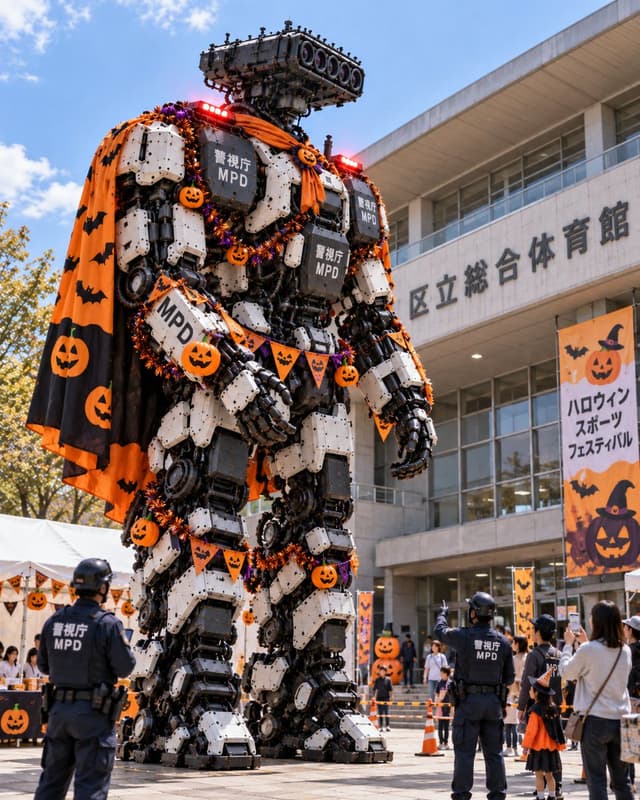
A photorealistic, vertical full-body shot of a massive, bipedal humanoid robot standing outdoors in front of a modern Japanese municipal sports hall. The robot is constructed from heavy-duty industrial machinery, featuring segmented white and black armor plating, exposed hydraulic pistons, and complex mechanical joints. Its head is a rectangular sensor array with multiple camera lenses and glowing red emergency lights on the shoulders. The robot is decorated for Halloween: it wears a flowing orange cape patterned with black bats and jack-o'-lanterns, and its body is draped with garlands of purple tinsel, small plastic pumpkins, and triangular bunting flags. Several chest plates are labeled with the text "警視庁" (Metropolitan Police Department) and "MPD".

In the foreground, two police officers wearing dark blue uniforms, tactical vests, and helmets stand with their backs to the viewer; their vests also bear the text "警視庁 MPD". To the right, a crowd of civilians includes a woman taking a photo with her smartphone and a child dressed in an orange witch costume with a pointed hat. The background features a large concrete building with glass windows and prominent signage reading "区立総合体育館" (Ward General Gymnasium). A tall vertical banner hangs on the right side of the building, displaying a cartoon pumpkin and the text "ハロウィン スポーツ フェスティバル" (Halloween Sports Festival). The scene is lit by bright, natural daylight under a clear blue sky.
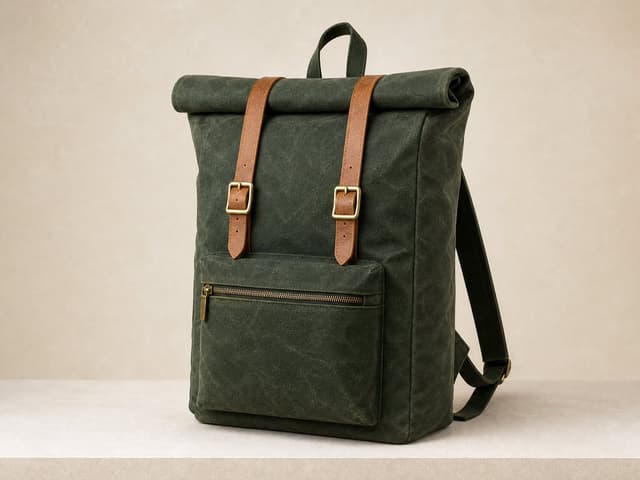
A high-resolution product photograph of a dark olive green waxed canvas roll-top backpack. The bag features two vertical tan leather straps with square brass buckles on the front, and a horizontal zippered pocket below them with a brass zipper pull. A matching fabric grab handle is visible at the top center. The backpack sits upright on a light beige stone surface against a plain, textured cream-colored wall background. Soft, diffused daylight illuminates the scene from the left, casting gentle shadows to the right.
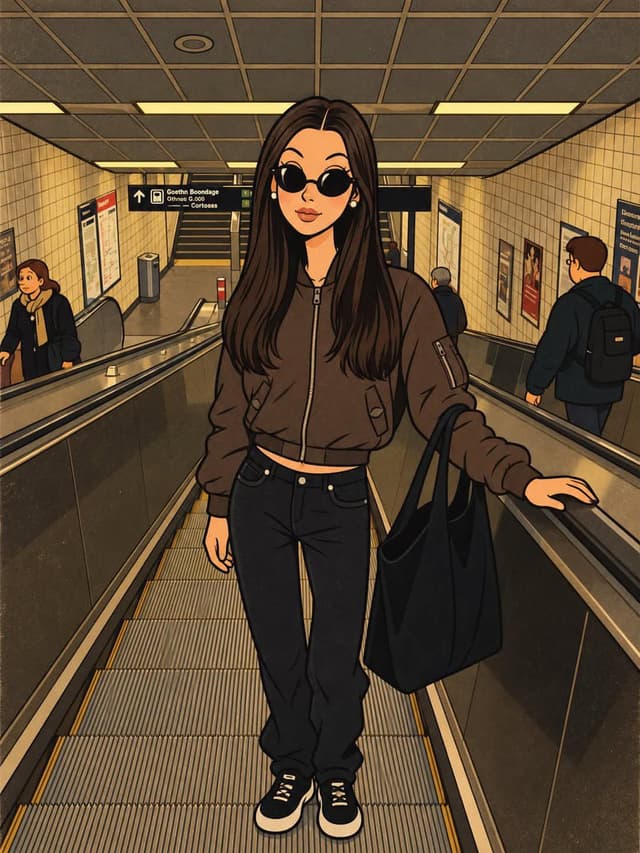
Transform the exact uploaded image into a full body illustration designed in a 1960s–1980s retro American cartoon style. Preserve the exact subject, facial identity, hairstyle, clothing, accessories, colors, proportions, pose, body language, facial expression, camera angle, framing, composition, perspective, lighting, and every visible detail from the original image. Do not redesign, reinterpret, simplify, replace, or invent any elements. The uploaded image must remain instantly recognizable, changing only the artistic style.

The character should feature exaggerated rubber hose proportions, expressive body language, a slightly oversized head, simplified anatomy, elastic limbs, large classic oval cartoon eyes with simple black pupils, thin expressive eyebrows, rounded hands, clean geometric shapes, and a playful vintage personality while preserving the exact likeness, expression, and silhouette of the original subject.

The illustration features thick bold black outlines, flat solid colors, minimal cel-style shading, subtle vintage film grain texture, slightly desaturated tones like old animation cels, smooth hand-drawn 2D linework, simple color blocking, soft retro print texture, and a classic mid-century American animation aesthetic.

Preserve the original background exactly as shown in the uploaded image unless otherwise specified.

Keep the original composition, framing, perspective, and camera angle exactly the same. Full body should remain visible if it is visible in the original image. High resolution, clean illustration, no realism, no 3D rendering, no anime, no Pixar, no Disney, no modern cartoon style, only authentic 1960s–1980s American retro animation aesthetics.
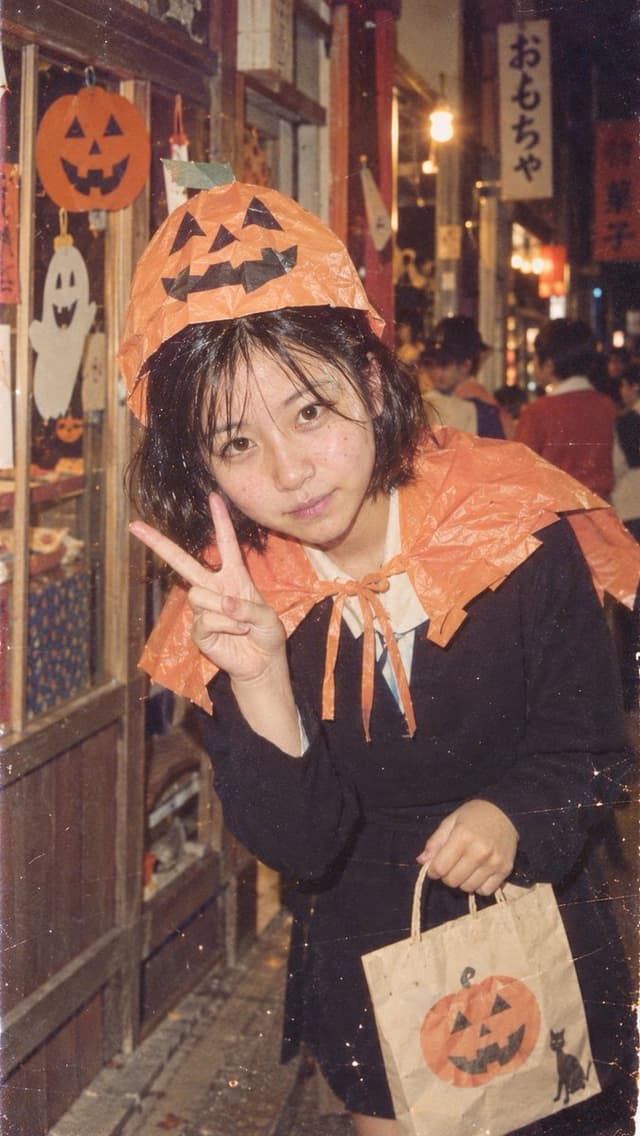
A vertical, medium-shot portrait of a young Asian woman with short dark hair and bangs, wearing a homemade Halloween costume consisting of an orange paper pumpkin hat and a matching jagged orange paper collar tied at the neck over a black long-sleeved dress. She is leaning slightly forward, making a peace sign with her right hand near her cheek, while holding a small brown paper bag decorated with a jack-o'-lantern and black cat in her left hand. The background is a narrow, dimly lit retro Japanese alleyway (yokocho) at night, featuring wooden storefronts, glowing lanterns, and blurred figures of other people walking away. On the left, there are hanging paper decorations including a jack-o'-lantern and a white ghost. On the right, a vertical banner reads 'おもちや' (Omo-cha). The image has a strong Showa-era retro aesthetic, characterized by warm, faded colors, visible film grain, scratches, dust spots, and soft focus typical of vintage instant photography.
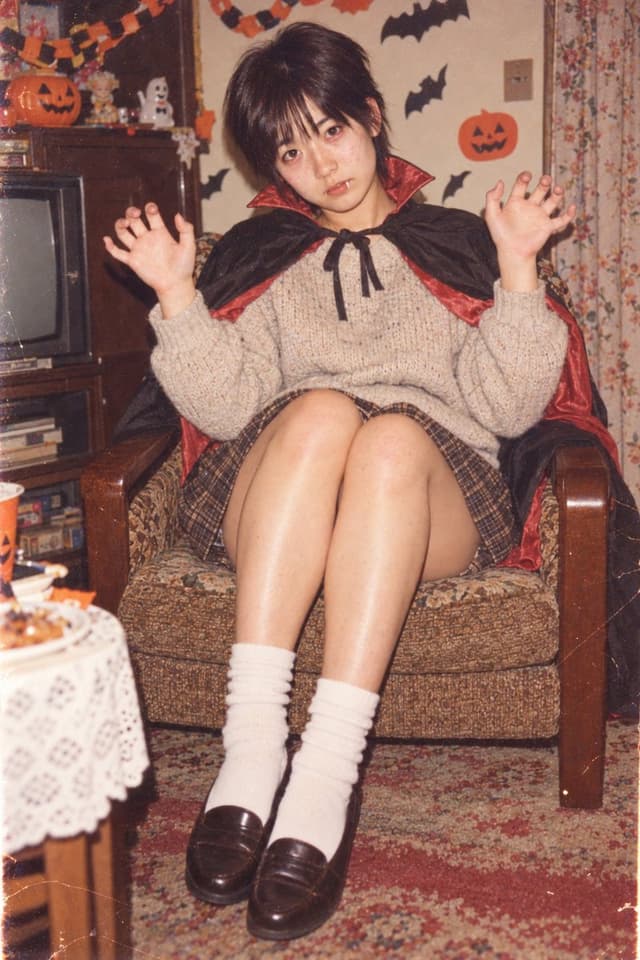
A retro-style photograph of a young Asian woman with short, messy dark hair sitting in a vintage floral armchair. She is wearing a beige chunky knit sweater over a plaid skirt, paired with slouchy white socks and brown loafers. A black velvet vampire cape with red satin lining is draped over her shoulders, tied at the neck with a ribbon. Her hands are raised in a playful claw gesture, and she has small fangs visible. The background features Halloween decorations including orange jack-o'-lanterns and black bat cutouts on the wall, along with an old CRT television set to the left. The image has a nostalgic Showa-era aesthetic with warm lighting and film grain.