

MiniMax H3 Pricing API Rates Credits and Retry Costs
MiniMax’s public H3 API charges $0.08 per second for 768p video or $0.13 per second for 2K output, before billable input media. An eight-second request costs $0.64 or $1.04 in base video output, respectively. First five input images and reference audio are free on the published H3 input schedule; additional stills and input video can raise the total. Astorie credits are a separate platform unit and must be budgeted using its node quote, not converted from these provider dollars. [1]
In Astorie, start with the quote on the configured H3 node and compare it with your remaining monthly credits. The source and generated branch stay together, so you can reject an unsuitable draft before spending on more attempts. The worked examples below keep that platform budget separate from MiniMax API dollars.
MiniMax H3 pricing for a first generation
Item | 768p H3 request | 2K H3 request |
Video output | $0.08 per output second | $0.13 per output second |
Input images 1–5 | Free | Free |
Each input image after the fifth | $0.04 per image | $0.04 per image |
Input video | $0.08 per input-video second | $0.13 per input-video second |
Input reference audio | Free | Free |
The table is MiniMax’s published pay-as-you-go API schedule as checked September 27, 2026. It prices output and relevant input material separately. A ten-second reference video on an eight-second 768p generation is billed for ten input seconds plus eight output seconds; omitting that input charge would more than halve the estimate in the example below. Use the selected output resolution to pick the input-video rate. [1]
Calculate output and reference charges
For a first request, use: total = output seconds × output rate + input-video seconds × the matching input rate + max(0, image count − 5) × $0.04. Reference audio adds no input charge. This formula describes H3, not H3 Max, and excludes account-specific taxes or intermediary fees. [1]
Example | Working | Estimated API charge |
8s 768p; three stills; no input video | 8 × $0.08 | $0.64 |
8s 2K; three stills; no input video | 8 × $0.13 | $1.04 |
8s 768p; six stills; 10s input video | 8 × $0.08 + 1 × $0.04 + 10 × $0.08 | $1.48 |
8s 2K; six stills; 10s input video | 8 × $0.13 + 1 × $0.04 + 10 × $0.13 | $2.38 |
The calculations assume one successful API generation, that the input video is eligible, and no other chargeable media or platform layer. They do not include tax, storage, an editor’s time, a purchased soundtrack or a second render. Input audio does not add an input fee on this schedule, but “free input audio” is not a promise that the model’s generated soundtrack meets the brief. [1]
How much does regeneration from 768p to 2K cost?
MiniMax publishes a distinct operation that regenerates an existing 768p H3 task at 2K. Its output costs $0.05 per regenerated second. The original inputs are billed again, but at the regeneration input rates below, not at the initial-generation input rates. The first five images remain free; each additional image becomes $0.025, input video becomes $0.05 per second, and input audio remains free. [1]
Item | First H3 task | 768p to 2K regeneration |
Video output per second | $0.08 at 768p; $0.13 at 2K | $0.05 for 2K regeneration |
Sixth and later input image | $0.04 each | $0.025 each |
Input-video second | $0.08 for 768p; $0.13 for 2K | $0.05 |
Reference audio | Free | Free |
With no chargeable inputs, eight seconds at 768p followed by the 2K regeneration is $0.64 + $0.40 = $1.04. That equals the base output charge of an eight-second direct 2K generation; the value is reviewing a lower-resolution candidate before deciding to upgrade it, not an inherent discount on an approved clip. The two workflows cannot be assumed to deliver identical pixels or creative quality.
With six still images and ten seconds of input video, the first 768p task is $1.48. Regeneration adds $0.40 output + $0.025 extra-image + $0.50 input-video = $0.925, for $2.405 across both operations. A direct 2K first generation with those inputs has the $2.38 estimate above. The regeneration route lets an editor reject weak ideas at 768p before buying their 2K versions, but upgrading every draft could cost more. [1]
Does drafting at 768p save money across several candidates?
It can save money when you reject drafts before upgrading. Suppose you need three eight-second candidates but will approve only one. With no input video and at most five images per job, three direct 2K outputs cost 3 × $1.04 = $3.12. Three 768p drafts plus one 2K regeneration cost 3 × $0.64 + $0.40 = $2.32. The modeled saving is $0.80, or approximately 25.6%.
If you upgrade all three, the output subtotal is again $3.12. If there are paid reference inputs, include their separate regeneration charges. This strategy buys a selection stage; it does not guarantee that regenerated and direct 2K footage are visually identical. Keep a direct 2K comparison in mind when fine texture, small text or final framing is critical.
What does a full retry cost?
An unsatisfactory first creative result followed by a new eight-second 768p request, each with at most five still references and no reference video, has an output subtotal of 2 × $0.64 = $1.28. Three such successful attempts total $1.92 in output charges. These are deliberate new creative requests, not a claim that MiniMax bills failed technical jobs identically. If either request has billable extra images or video, price each call’s inputs as well. Before setting a retry budget, ask whether the first result needs a fresh video, an audio replacement, or a selective edit with its own price.
Budget for approved output rather than one request
Planning assumption | 10 approved 8s clips at 768p | 10 approved 8s clips at 2K |
One successful attempt per approval | $6.40 | $10.40 |
Two successful creative attempts per approval | $12.80 | $20.80 |
Three successful creative attempts per approval | $19.20 | $31.20 |
These are scenarios, not measured acceptance rates. Every request here has no input video and at most five images; editing labor, sound replacement, storage and tax are excluded. A technically completed render that misses the brief is different from a failed request. No failed jobs occurred in the supplied H3 record, so it cannot establish a failure-refund policy.
Measure your own usable-output cost as total generation spending divided by approved clips, then add actual postproduction spending separately. If the picture is acceptable but its audio is not, an audio replacement may preserve an otherwise useful render. Compare that real editing cost with the cost and creative risk of another video attempt.
How do Astorie credits enter the budget?
The supplied Astorie H3 Video-1 and Video-4 nodes each completed once at eight seconds, 768p and 112 actual deducted platform credits. They used one and three still references respectively. The screenshots record the configuration, and the project owner has confirmed the debit matched the displayed figure with no failed jobs. This is a platform observation, not a universal H3 credit formula.
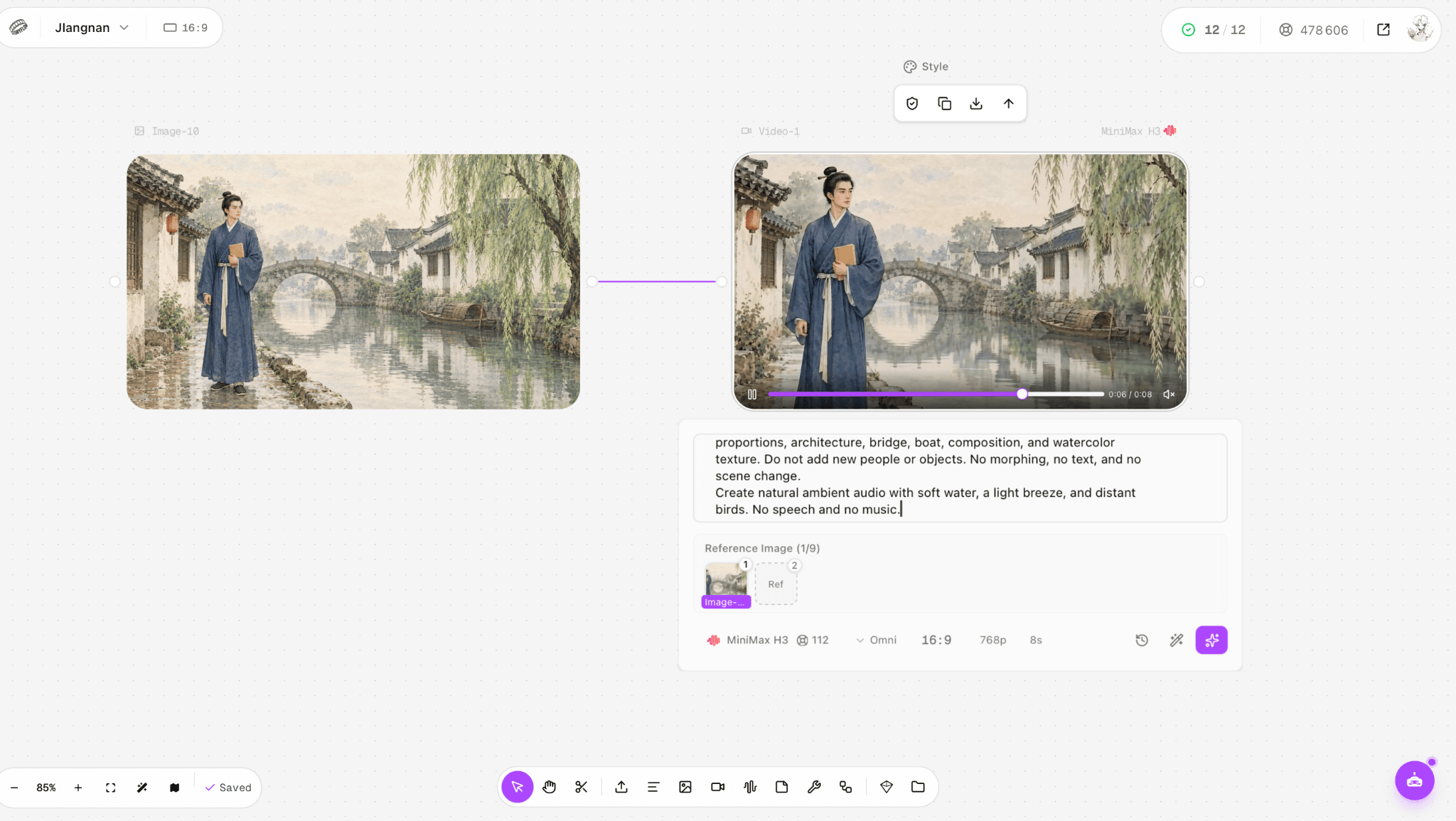
Figure 1. Completed eight-second H3 Video-1 at 768p; the node shows the 112-credit amount confirmed as deducted.
Astorie Standard lists 1,600 monthly credits on its annual plan. The advertised first-year price is $12 per month billed as $144 annually; the page states $16 per month on annual renewal from the second year. At the recorded 112-credit quote, one job consumes 7% of the monthly allocation; fourteen jobs consume 1,568 credits and leave 32. This is an allocation calculation, not a conversion to MiniMax API dollars. [2]
Ten approved clips would consume 1,120 credits if each took one such attempt. Two attempts per approved clip would consume 2,240 credits, exceeding a 1,600-credit monthly allocation before other activity. That makes the retry allowance more useful than dividing a subscription price by one unusually successful generation. A different duration, resolution or host quote changes the result.
Which purchasing route fits your workload?
Use the direct API when your application needs explicit input roles, job IDs and itemized per-second budgeting. It requires integration, task polling and your own asset organization. Use a host such as Astorie when arranging source images and comparing branches is part of the job; its subscription and node credits become the relevant budget. Move from a host to direct integration only when recurring volume or automation justifies that additional work.
For an occasional project, the practical choice is the route you can fund and review without buying unused capacity. A low base rate alone does not settle the decision: reference-video charges, discarded attempts and delivery requirements can outweigh the first render’s output fee.
FAQ
Is eight seconds at 2K always $1.04?
That is the base H3 API video-output cost. Chargeable input video or images above the first five add to it. [1]
Does a low-resolution first render make the 2K result cheaper?
With no billed inputs, $0.64 then $0.40 regeneration equals the $1.04 base output cost of direct 2K. Extra-input regeneration uses $0.025 per extra image and $0.05 per input-video second, not the initial rates. [1]
Are Astorie credits MiniMax dollars?
No. The completed Astorie task debited 112 host credits; the provider publishes separate API dollar rates. Do not derive a currency conversion from one node.
Can I quote a final cost per approved video?
Only after specifying the number of retries, input materials, output resolution and any sound or editing work. The API tables above quantify generation under stated assumptions, not an all-inclusive finished-film invoice.
Sources
Official specifications and prices checked September 27, 2026. API examples are calculations; the 112-credit host debit was confirmed by the project owner.
1. MiniMax pay-as-you-go H3 and regeneration price table
2. Astorie plan allowances and billing terms
Ready to try it on the canvas?
Open Astorie and fan your prompt across every frontier model in one workflow.