
Seedance 2.5 vs MiniMax H3 for a Quiet Image to Video Shot
Seedance 2.5 vs MiniMax H3
Seedance 2.5 versus MiniMax H3 depends on the shot. In our single-image Jiangnan experiment, Seedance produced the more suitable quiet ambient sound and slightly more natural motion; H3 finished faster and preserved the scene without obvious distortion, but an intrusive vocal-like sigh hurt the result. Neither generated conspicuous willow, water or boat motion exactly as requested.
Both clips began with the same watercolor still. Astorie made it possible to branch that source into separate model nodes and review their settings and results together. That is a workflow advantage; it does not make the two model outputs equivalent or guarantee the same outcome on another prompt.
What exactly was compared?
Variable | MiniMax H3 | Seedance 2.5 |
Starting image | Same Jiangnan watercolor still | Same Jiangnan watercolor still |
Shown settings | 768p, 8 seconds, 16:9 | 720p, 8 seconds, 16:9 |
Astorie quote | 112 credits | 264 credits |
Reported completion | About 2 minutes | About 4 minutes |
Main observation | Recognizable frame; moderate motion; audible sigh | Slightly more natural; better ambience; weak visible environment movement |
These are two individual outputs at different resolutions; exact prompt equivalence was not independently confirmed. Credits are quotes from Astorie’s interface, not a standardized vendor cost per second. The results show how each run behaved, not a controlled estimate of model-wide superiority. The source image identity was confirmed by the tester.
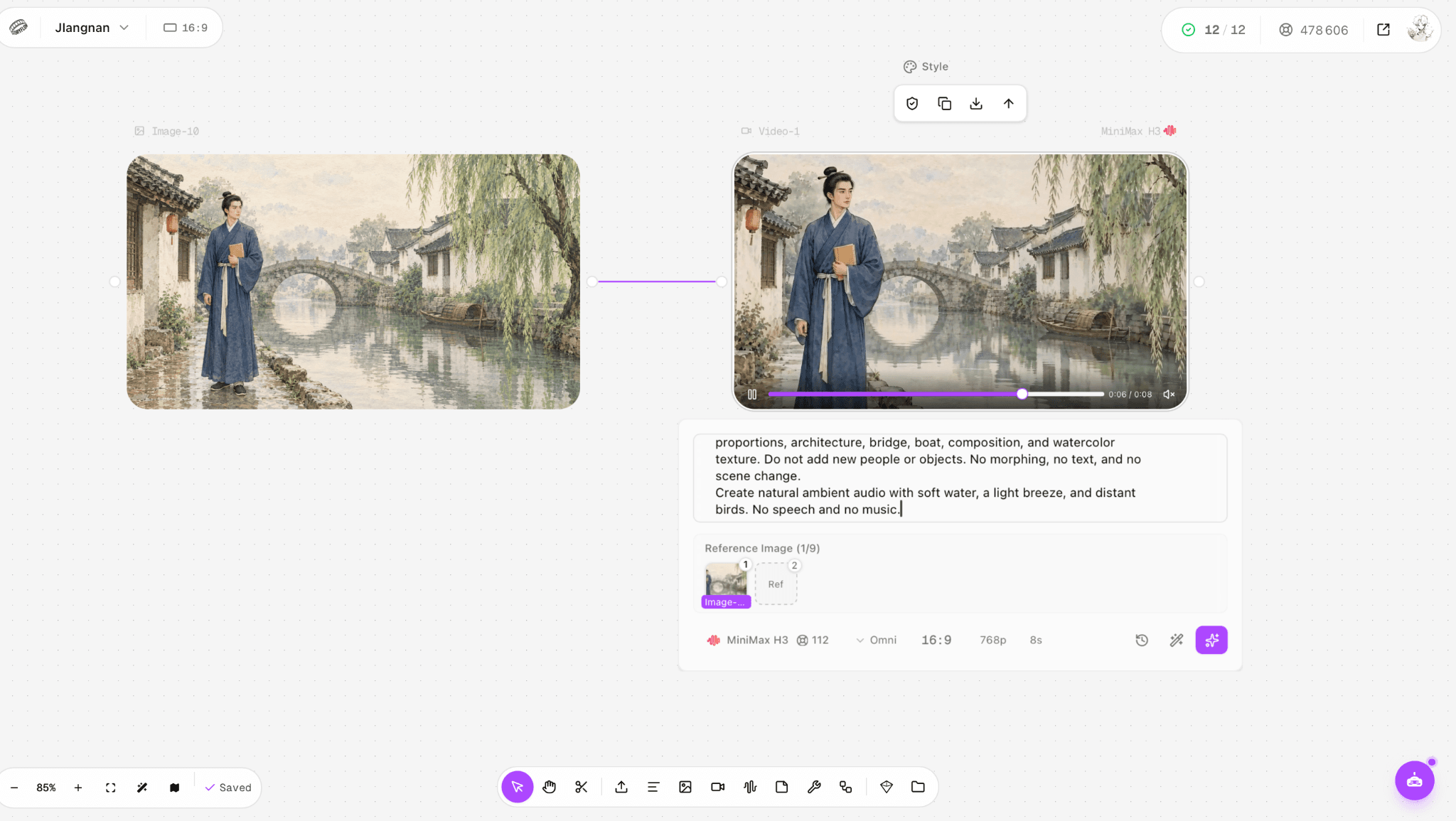
Figure 1. H3 result node showing the reference image and eight-second settings.
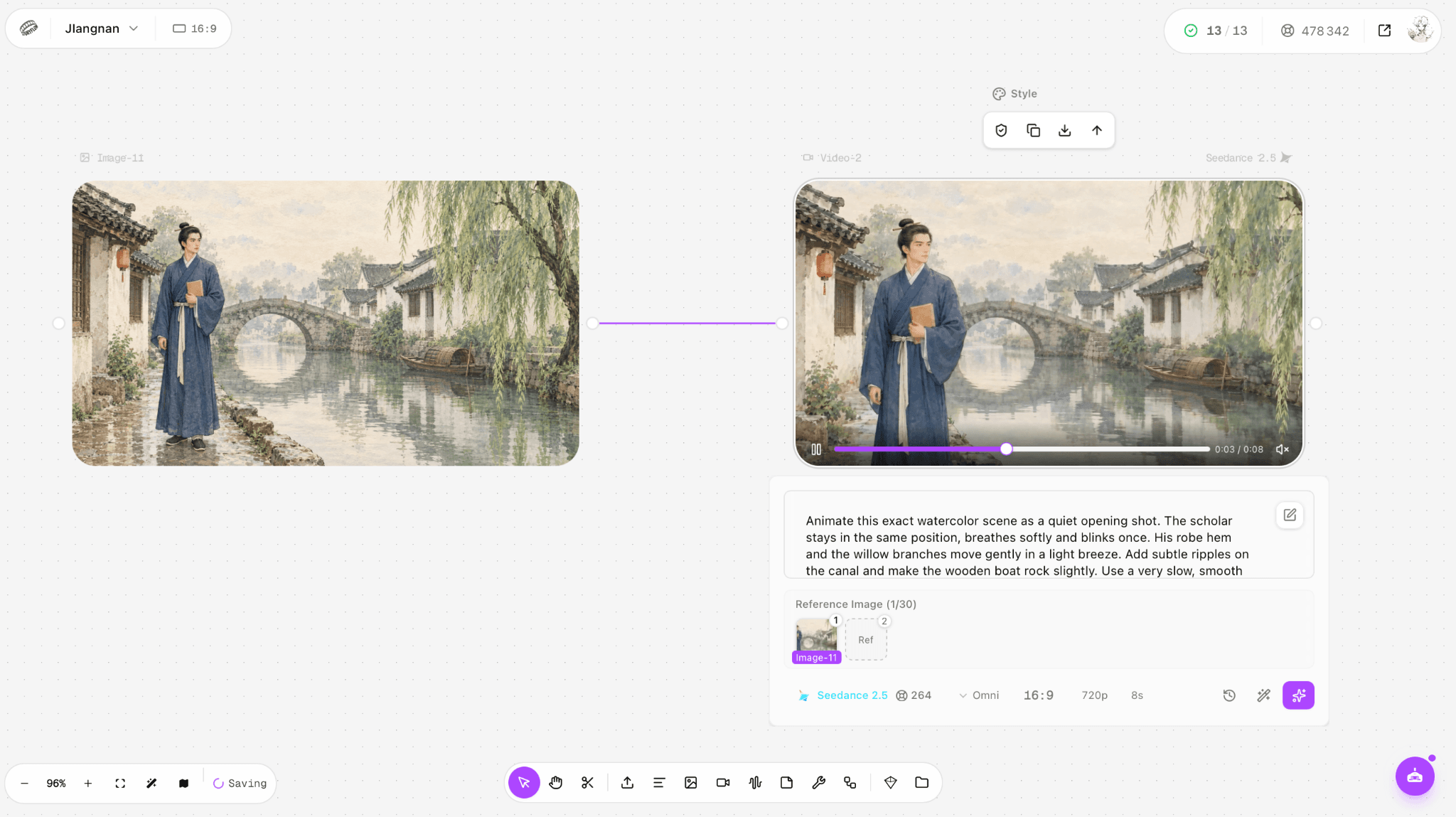
Figure 2. Seedance 2.5 result node and completed eight-second clip from the same source still.
Which clip handled motion more convincingly?
Seedance looked somewhat more natural in our viewing, but the margin was modest. The willow branches, water surface and boat did not show clearly visible movement, despite the request. H3 did show movement, but it was not fully natural. A quiet watercolor scene exposes tiny changes that faster action could hide; for this use case, neither first result met every motion requirement.
If you need proof of a specific action, review the relevant object at the beginning, middle and end. A camera push-in can make a scene feel active even when the boat itself remains stationary. The decision is whether the requested object changes, not whether the preview moves at all.
Which model sounded better?
Both runs had environmental audio. Seedance supplied the cleaner ambience for this quiet opening; H3 inserted a large sigh that sounded conspicuously artificial. This is the decisive difference for our intended scene. If a client needs a natural bed of water and breeze, choose the Seedance result from this pair; if voice or sound design will be replaced anyway, H3’s faster first render may be useful.
A side-by-side inspection method for this particular scene
We examined the same watercolor concept rather than running a laboratory benchmark. The H3 node was eight seconds at 768p and showed 112 Astorie credits; the Seedance 2.5 node was eight seconds at 720p and showed 264 credits. The tester reported roughly two minutes for H3 and four minutes for Seedance. Even with the same source scene, output size, model route and potentially default processing differ, so the time and quote belong to these runs, not to a universal throughput chart.
Acceptance criterion | H3 observation | Seedance 2.5 observation |
Subject and bridge | Stayed recognizable; no obvious deformation | Stayed recognizable in observed clip |
Subject motion | Present but somewhat stiff | Somewhat more natural, not dramatically so |
Willow, water and boat | No controlled motion measure | No obvious movement to the naked eye |
Sound | Ambience plus conspicuous sigh | Ambient audio was cleaner for the quiet scene |
Turnaround and UI quote | About 2 min; 112 credits | About 4 min; 264 credits |
The audio difference was more decisive than the difference in movement. A still screenshot of a bridge cannot show how the soundtrack feels or whether the water actually moves. The original user observations were that Seedance felt a little more natural, not that it successfully animated every requested element. Both models left the boat, willow and canal with little visible movement. Treat “more natural” as a narrow preference from the supplied clips.
When the prompt asks for more motion than the video supplies
For a calm opening, restrained movement can be acceptable. For a brief that explicitly needs willow branches, ripples and a rocking boat, the lack of obvious movement is a missed requirement. Review at full playback speed and choose one visible action as the next prompt revision. Changing subject movement, environment movement, camera angle, model and resolution at once would make the next result difficult to diagnose. If both tested versions miss the movement requirement, the correct outcome is another constrained attempt, not declaring either a winner for motion.
What switching costs are easy to overlook?
Choosing Seedance for this soundscape gains a more usable ambient bed, but costs the longer wait and higher quoted Astorie credits in the observed settings. Moving from a working H3 pipeline may also require transferring source-frame links, saved prompts and review notes. Choosing H3 for early drafts gains a cheaper quoted first attempt in this case; the loss is extra audio review or a separate sound edit. The switch trigger is concrete: use Seedance after an H3 render fails the audio acceptance check; choose H3 for rapid visual drafts only if postproduction can handle sound.
The public model specifications should inform, rather than overwrite, the clip comparison. MiniMax documents H3 at four to fifteen seconds and 768p or 2K on its own API. BytePlus advertises its Seedance family on its official product page, but availability and parameter combinations vary by service and account. Our two Astorie nodes do not prove that every official mode was enabled there. Confirm the exact hosted model and export terms for a production delivery.
How do the official products differ beyond this shot?
MiniMax’s current public H3 API describes four-to-fifteen-second output at 768p or 2K, with text-to-video, first/last-frame and reference routes. BytePlus describes Seedance 2.5 as supporting four-to-thirty-second work and up to fifty multimodal references on its product route. Access, resolutions and pricing depend on the host; the eight-second Astorie interface used for our test did not exercise the full official range. Verify the exact endpoint before planning a 30-second sequence.
When should you switch?
Pick Seedance 2.5 when ambient sound and a longer uninterrupted scene matter more than the higher credit quote and slower observed turnaround. The gain in our scene was cleaner ambience; the loss was spending more Astorie credits and waiting longer for this run. Switch from H3 after a review if vocal artifacts make a quiet scene unusable.
Pick H3 when a short draft needs a lower observed credit quote and a faster first result, and you are prepared to edit or replace imperfect audio. The gain is an efficient shot trial; the loss in our run was the distracting sigh and somewhat stiff motion. Switch from Seedance when you are doing many short visual drafts and can separately manage their sound. Retest on your own subject before adopting either for a series.
FAQ
Was this a head-to-head benchmark?
It was a same-source practical comparison, not an identical-resolution, seed-controlled benchmark.
Which is cheaper here?
H3 had a smaller Astorie quote, 112 versus 264 credits for these selected eight-second nodes. Official API dollar prices and host credits are different measures.
Which produced better audio?
Seedance did in this particular quiet scene. Neither outcome guarantees the audio quality of future generations.
Sources and scope
Official product and API information checked September 25, 2026. Test observations describe only the supplied runs; quoted platform credits are not equivalent to provider API dollar prices.
MiniMax video specifications: https://platform.minimax.io/docs/guides/video-generation
MiniMax pay-as-you-go prices: https://platform.minimax.io/docs/guides/pricing-paygo
BytePlus Seedance 2.5 product information: https://www.byteplus.com/en/product/seedance
Observed H3 clip supplied by tester: https://s3.astorie.ai/req/req_8043042fb4fa4c90941e/0.mp4
Observed Seedance 2.5 clip supplied by tester: https://s3.astorie.ai/req/req_fa319d35e7294ef08cdd/0.mp4
Ready to try it on the canvas?
Open Astorie and fan your prompt across every frontier model in one workflow.